boAt has released the boAt Crest Data Trend 2025 report, offering a data-based overview of fitness and wellness behaviour recorded on the boAt Crest platform during 2025. The findings are drawn from anonymised and aggregated data collected via the boAt Crest app, the companion application for boAt smartwatches.
The report is published against the backdrop of rising digital health adoption in India, where nearly 80% of consumers use healthcare apps or wearable technologies, according to a PwC report. The boAt Crest app enables users to track steps, activity sessions, calories, sleep, fitness plans, AI-powered coaching features, and community challenges.
Gen Z dominates AI-powered fitness and wellness usage
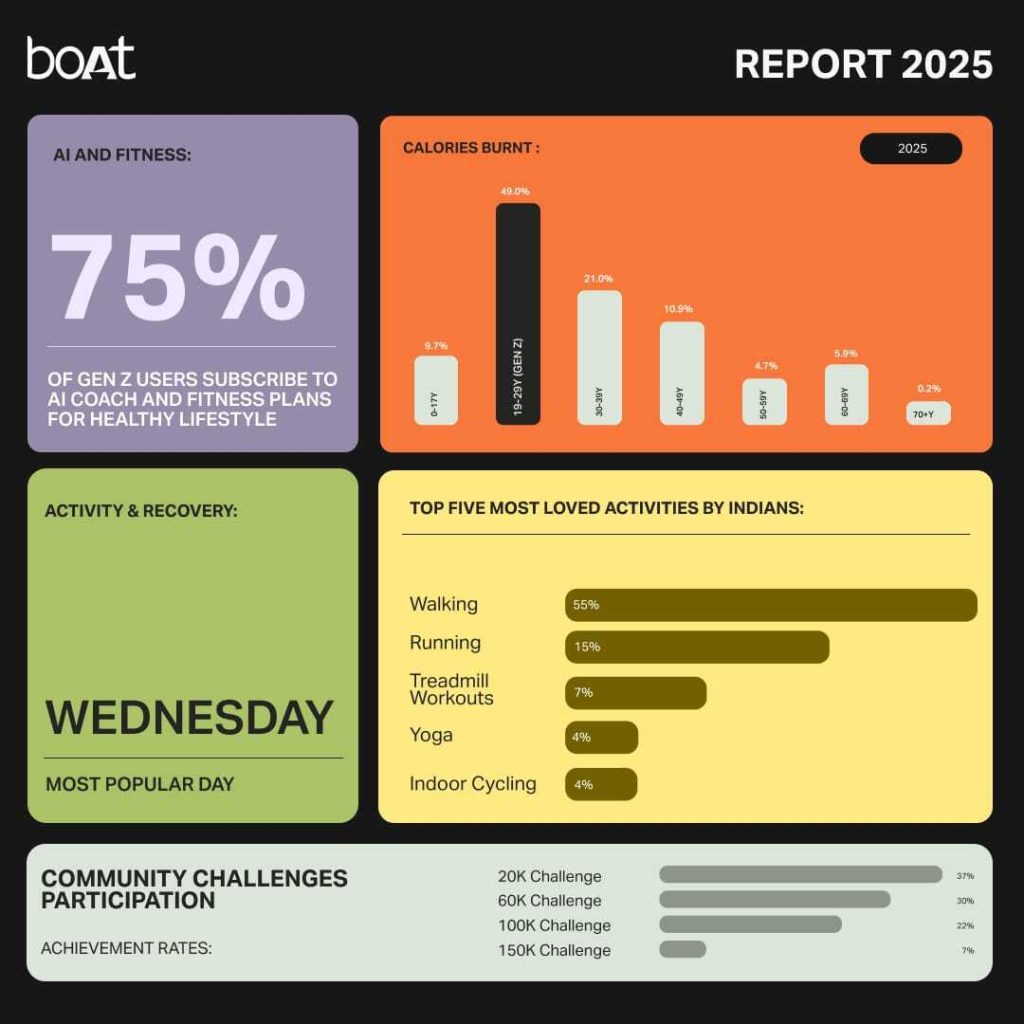
The data shows that users aged 18–29 (Gen Z) account for 75% of all AI Coach and fitness plan subscribers on the boAt Crest platform. This reflects a strong shift among younger users toward AI-guided and structured wellness tools.
In addition, Gen Z users contributed 48.3% of the total calories burned by boAt Crest users nationwide in 2025, making them the highest contributing age group in overall physical activity.
boAt Crest users record over 1 trillion steps in 2025
During 2025, users collectively logged more than 1 trillion steps, equivalent to approximately 750 million kilometres walked. This distance is comparable to travelling to the Moon and back nearly 1,000 times, circling the Earth around 19,000 times, or crossing India from Kashmir to Kanyakumari over two lakh times.
Users aged 18–29 alone logged enough steps to theoretically walk around the Earth more than 4.1 million times, highlighting the scale of movement recorded on the platform.
Activity participation across age groups
The boAt Crest platform recorded over 6.5 million activity sessions during the year. Users aged 18–29 were the most active, followed by those in the 30–39 age bracket.
Average daily step counts by age group were:
- 0–17 years: 4,438 steps
- 18–29 years: 5,794 steps
- 60–69 years: 5,524 steps
The data indicates consistent daily movement habits across age groups, including senior users.
Walking remains the most tracked activity
Walking continued to be the most commonly recorded activity, accounting for 55% of all workouts. Other activities included:
- Running: 15%
- Treadmill workouts: 7%
- Yoga: 4%
- Indoor cycling: 4%
The remaining 15% consisted of lifestyle-based fitness activities such as strength training, high-intensity functional workouts, and sports including cricket and badminton.
Midweek activity peak replaces weekend trend
The report identifies Wednesday as the peak day for both activity sessions and sleep tracking. In contrast, weekends recorded lower engagement levels, indicating a shift from weekend-centric fitness behaviour to more evenly distributed activity during the workweek.
Community challenges favour achievable step targets
The boAt Crest app offered monthly step-based community challenges with targets of 20K, 60K, 100K, and 150K steps. Users were allowed to participate in multiple challenges and change targets monthly.
The 20K Step Challenge recorded the highest participation, accounting for 50% of total challenge engagement, suggesting a preference for achievable and consistent fitness goals over higher step targets.
AI feature usage concentrated among younger users
Despite discussions around slowing growth in India’s wearables market due to feature parity, the report notes continued engagement with AI-powered wellness tools. More than 75% of smartwatch users actively using AI-based fitness features and plans belong to Gen Z, indicating sustained usage among younger demographics.
Releasing the report, Shyam Vedantam, Chief Product Officer, boAt, said:
There is a clear behavioural shift in how Indians approach wellness. AI is moving wearables beyond tracking into understanding—helping users build consistent, achievable habits rather than chase extremes. From an industry perspective, the future of wearables will be shaped by intelligent personalisation, context-aware insights, and products that adapt in real time to how people live, move, and recover.
Our innovation roadmap focuses on using AI to make wellness more predictive, personalised, and effortless. The next phase of wearables will shift from tracking what happened to anticipating what users need—whether through smarter recovery insights, adaptive fitness plans, or context-aware nudges that evolve with behaviour. Every product decision going forward is anchored in real user data and long-term habit formation, not short-term feature cycles.