Zoom Communications has expanded its enterprise agentic AI platform with new workflow orchestration capabilities across Zoom Workplace, Zoom Phone, and Zoom CX.
The update enables organizations to automate tasks and trigger workflows from meetings, calls, chats, and customer interactions by connecting collaboration tools with enterprise systems, allowing conversations to initiate actions across business platforms instead of requiring manual follow-up across separate systems.
Expanding AI Companion 3.0
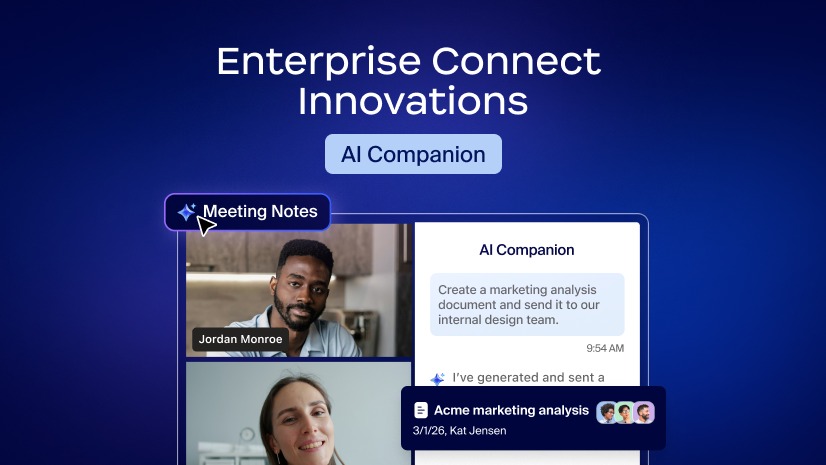
Zoom AI Companion is expanding with AI Companion 3.0, which will roll out across Zoom Workplace, Zoom Business Services, and Workvivo. The update introduces a new AI technology stack designed to support conversation-to-completion workflows.
Earlier versions of AI Companion were limited to web browser access, but the new version integrates directly into Zoom applications and connects conversations with enterprise data and business apps through Zoom’s federated AI platform.
Zoom said monthly active users of AI Companion increased more than threefold year over year in Q4 FY26, and paid AI features were included in each of its ten largest customer experience deals during the quarter.
Zoom also expanded the Custom AI Companion add-on, allowing organizations to create AI agents that can retrieve information, automate tasks, and coordinate workflows across external platforms such as Salesforce, Slack, and ServiceNow.
Capabilities include:
- Custom and prebuilt AI agents: Organizations can deploy prebuilt agents for sales, IT, and marketing or create their own agents and workflows without coding.
- Enterprise data connections: New third-party integrations and 10 secure enterprise search connectors enable access to data across applications such as Google Drive, Microsoft OneDrive, and Box.
- Personalisation and memory: AI Companion can use user context such as roles, preferences, and focus areas to provide tailored insights.
Zoom also introduced Zoom AI Services, a suite of enterprise AI APIs that provide capabilities including transcription, translation, summarisation, reasoning, speech processing, language processing, and image processing for developers.
New Features: AI Companion 3.0
AI collaboration canvases
Zoom introduced new AI-based canvases — AI Docs, AI Sheets, and AI Slides — allowing teams to convert meeting discussions into documents, data analysis, and presentation content within meetings.
Zoom Workplace updates
The next generation of Zoom Workplace adds agentic AI capabilities and interface changes:
- Interface update: A more consistent interface across desktop, mobile, and web.
- AI Companion tab: A dedicated workspace for queries, writing, and workflow automation.
- Zoomie group assistant: A team facilitator that operates across Zoom Rooms, meetings, and chat to support meeting coordination.
- AI-first chat: Includes custom AI agents, topic-based summaries, and a “For You” view for prioritised messages.
- Live voice translator: Provides real-time translation in Zoom meetings, allowing participants to speak in their own language while others hear translated audio. The feature launches with support for five languages.
- Deepfake risk detection: Meeting security technology that detects synthetic audio or video and provides alerts during calls.
Zoom Phone updates
Zoom introduced additional AI features for Zoom Phone, which supports more than 10 million seats worldwide.
- Agentic workflows: Automatically perform actions such as drafting emails or sending summaries after calls.
- SMS for Zoom Virtual Agent AI Receptionist: Enables the virtual receptionist to interact with customers through text, answer questions, collect information, assist with scheduling, and transfer conversations to a human agent when needed.
- Zoom Phone Mobile: Allows users to make business calls using the native mobile dialer while maintaining Zoom’s AI calling features.
- Customer Engagement Pack: Adds analytics and AI insights to help teams prioritise calls, track queue visibility, and monitor performance across voice calls and SMS.
The service also provides AI-generated call summaries, automated follow-ups, and real-time insights across devices.
Zoom CX and Revenue Workflow Automation
Zoom is expanding automation across its customer experience and revenue tools:
- Zoom Virtual Agent 3.0: Expands automation for contact center interactions.
- AI Expert Assist 3.0: Provides contextual guidance, workflow orchestration, and automated tasks for contact center agents.
- CX Insights: Allows CX leaders to ask questions about customer experience and operational metrics using natural language and receive analysed insights based on interaction transcripts and operational data.
- Customer Workflow Orchestration: Enables organizations to design automated customer journeys triggered by contact center events or enterprise system signals such as CRM or ERP.
- Advanced Quality Management for Zoom Virtual Agent: Provides analysis of automated interactions, performance trends, and resolution outcomes for both human and virtual agents.
-
Zoom Revenue Accelerator updates: Introduces AI Sales Assist, which provides real-time prompts and guidance during sales calls, and Ask ZRA, which allows analysis of calls and deals using natural-language queries.
Availability
Zoom stated that the expanded agentic AI capabilities will be integrated across Zoom Workplace, Zoom Phone, Zoom CX, and related services.
Speaking on the new update, Velchamy Sankarlingam, President of Product & Engineering at Zoom, said:
The next stage of enterprise AI will be defined by the ability to move from conversation to action. Zoom’s agentic AI platform is built to coordinate action across systems, turning every meeting, call, and customer interaction into a trigger for workflow automation.