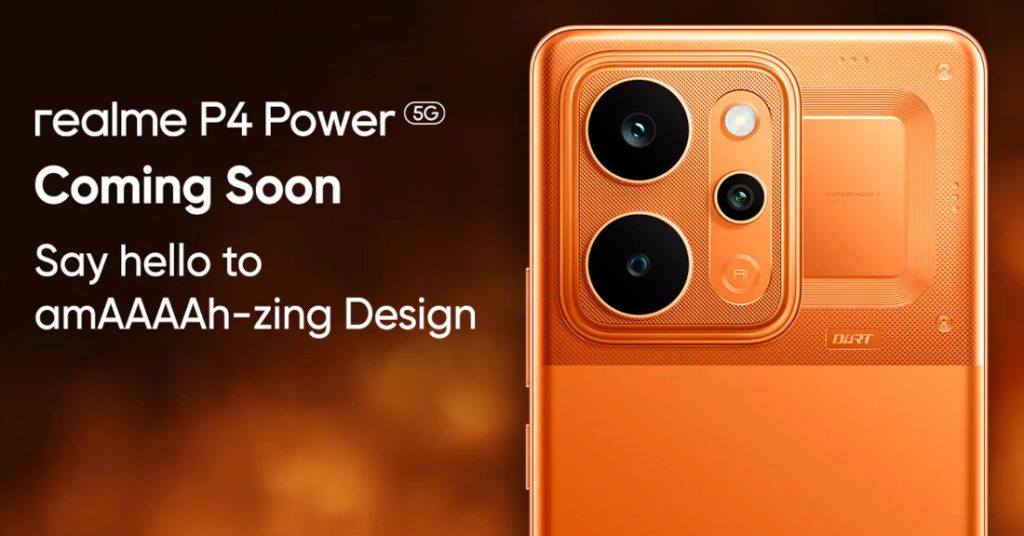
realme, has announced a strategic collaboration with Pearl Academy, one of India’s leading design institutions. The partnership aims to co-create the design of the upcoming realme P4 Power smartphone. This initiative represents a significant shift in the brand’s product development strategy, moving toward a “by the youth, for the youth” approach for its India-exclusive P Series.
A Student-Led Design Process
The collaboration involved integrating Pearl Academy students directly into realme’s design and product development ecosystem. Unlike traditional contests where student submissions are often theoretical, this initiative saw students working alongside realme’s internal teams from the ideation phase through to concept refinement.
Through a series of immersive workshops and hands-on sessions, students were exposed to the practical realities of designing mass-market consumer technology. The process required participants to balance creative expression with industrial constraints, such as:
- Scalability and manufacturing feasibility.
- Production timelines.
- Evolving user expectations.
This engagement provided students with insight into how conceptual sketches are challenged, adapted, and strengthened to become viable commercial products.
The ‘TransView’ Design Concept

For the first time in realme’s history, a student’s vision has directly influenced the design language of a mass-market device. Following the workshop phase, a design concept submitted by Sankalp Panchal, a student at Pearl Academy, was shortlisted and selected for integration into the final realme P4 Power device.
The resulting design philosophy is termed “TransView Design.” According to the brand, this aesthetic focuses on the intersection of transparency and technology. Rather than concealing internal elements, the design seeks to make technology visible, symbolizing clarity and transformation.
The design language intends to reflect the complexity of the Gen Z demographic. It embraces contrasting traits—confidence and introspection, playfulness and purpose—aiming to position the smartphone as an extension of personal identity rather than merely a functional tool.
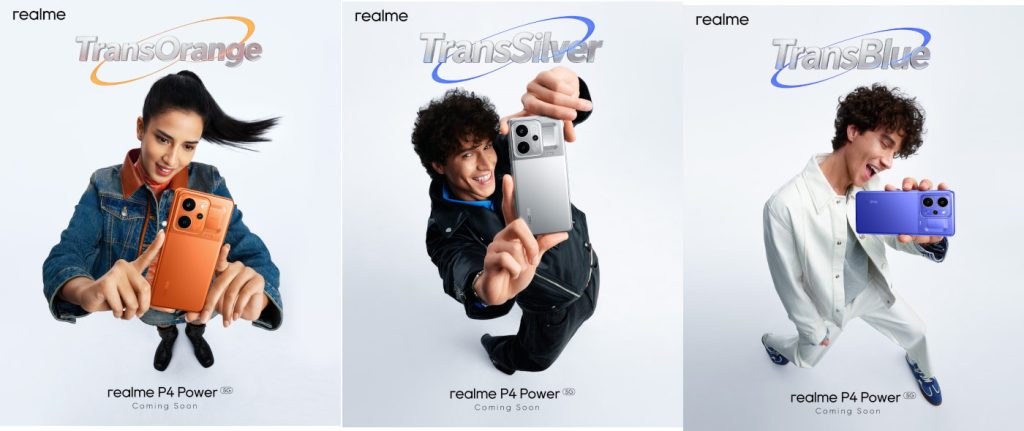
The phone will come in Trans Orange, Trans Silver and Trans Blue colours.
Bridging Education and Industry
Beyond the product outcome, the initiative highlights a growing trend of collaboration between educational institutions and consumer brands. For the students involved, the project served as a bridge between academic theory and real-world application.
By giving young creators a seat at the table, realme aims to deepen its connection with its core demographic. The brand views the realme P4 Power not just as a new hardware release, but as proof of concept that student ideas can play a tangible role in shaping the direction of mainstream consumer technology.
After teasers, Francis Wong has revealed that the phone will feature a 10,001 mAh battery.
Regarding this, Francis Wong, Chief Marketing Officer, realme India, said:
As a brand that started its journey from India to the globe, we see India as a design powerhouse, not just a market. We believe the hyper-local beauty born here has the potential to become a globally beloved trend. Our collaboration with Pearl Academy allowed us to work directly with young designers and understand how today’s generation views design, functionality, and self-expression. Those perspectives have directly influenced the realme P4 Power, reaffirming our commitment to growing the most popular smartphone brand among the youth.
Aditi Srivastava, President, Pearl Academy, said:
This collaboration offered our students rare, hands-on exposure to how a mainstream consumer product is conceived, shaped, and brought to life. At Pearl Academy, we believe education is most impactful when learning extends beyond the classroom and into real-world practice. Strategic industry partnerships like this play a critical role in strengthening our student experience by embedding real business contexts, live briefs, and professional rigour into the learning process. By working closely with realme’s design and product teams as active contributors rather than passive observers, students experienced the full journey from early ideation and sketching to refined, market-ready concepts. The process strengthened their confidence in decision-making, sharpened their understanding of consumer-first design, and gave them a realistic view of the constraints, trade-offs, and discipline involved in building products at scale. Partnerships like these bridge the gap between education and industry, ensuring our students graduate not just with creative ideas, but with the ability to apply them meaningfully in real-world, high-impact environments.