
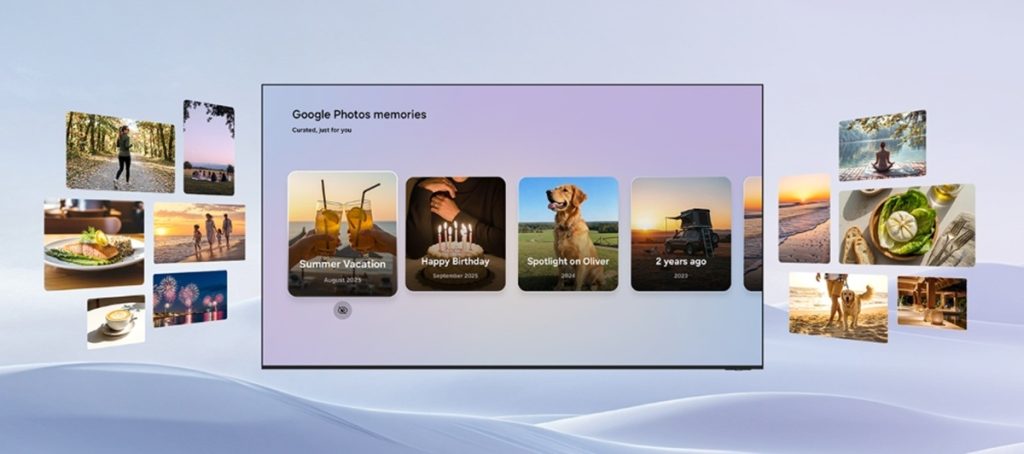
Samsung Electronics has announced that it is working with Google to bring Google Photos to Samsung TVs, enabling users to view and relive their personal photo and video libraries on a larger screen. The integration is intended to extend Google Photos from smartphones to TVs, allowing memories to be accessed in a TV-optimised format.
Google Photos experience on Samsung TVs
With the planned integration, Samsung TV users will be able to sign in using their Google Account and access backed-up photos and videos directly on their television. The experience is designed to present personal photo libraries in a large-screen gallery format, allowing users to browse and revisit memories at home.
Samsung and Google aim to place personal photo content at the centre of the TV experience, allowing users to explore their journeys and past moments in a simple, organised way.
Viewing personal photos on a larger screen
Google Photos currently allows users to store, organise, and revisit photos across devices. Through the upcoming TV integration, photos captured on smartphones will be displayed on Samsung TVs in a larger, cinematic format.
Users will be able to explore curated memories organised by people, places, and meaningful moments. Google Photos will also become part of Samsung’s Vision AI Companion (VAC), expanding photo-based experiences that surface memories throughout the day.
Samsung plans to integrate Google Photos into existing TV features such as Daily+ and Daily Board, allowing memories to appear at contextual moments. Setup is expected to require users to sign in with their Google Account. Photo memories will appear automatically, provided that Memories are enabled in Google Photos settings.
Three planned experiences: Memories, Create, and Personalized Results
Samsung outlined three ways users will be able to rediscover their photo libraries on TV:
- Memories (planned for early 2026): Displays curated stories based on people, locations, and meaningful moments. This will be the first time the Memories experience appears on TVs. The feature will launch exclusively on Samsung TVs for the first six months.
- Create with AI (planned for later in 2026): Introduces themed creative templates built on Nano Banana, Google DeepMind’s image generation and editing model. Users will be able to apply artistic transformations using Remix or convert still images into short videos using Photo to Video.
- Personalized Results (planned for later in 2026): Allows users to view related photos as slideshows based on topics or memory themes, such as oceans, hiking, or specific locations like Paris.
According to Samsung, the experience is designed to allow families to rediscover and view personal memories together on a shared screen.
Availability
Features and availability will vary by model and region. The Google Photos integration will be available on Samsung TV models launching in 2026, requiring a Google Account and backed-up photos or videos. For existing Samsung TV models, availability will depend on the OS update schedule.
The Memories feature is expected to be available starting March 2026. Create with AI and Personalized Results are planned to roll out in the second half of 2026. Select AI-based creative templates will be available exclusively on Samsung TVs.
Speaking on the development, Kevin Lee, Executive Vice President of the Customer Experience Team at Samsung Electronics’ Visual Display (VD) Business, said:
Samsung TVs have long brought people together, and adding Google Photos to the big screen makes that experience more personal. Through this partnership, we enable users to rediscover and revisit meaningful moments by highlighting the stories behind their photos—directly from their living room.
Commenting on the announcement, Shimrit Ben-Yair, Vice President of Google Photos and Google One, said:
Google Photos serves as a home for people’s photos and videos, helping them organise and bring their memories to life. We’re pleased to bring Google Photos to Samsung TVs, allowing people to view their favourite photos on a larger screen and reconnect with their memories in different ways.