vivo Ignite 2026 national finale winners announced


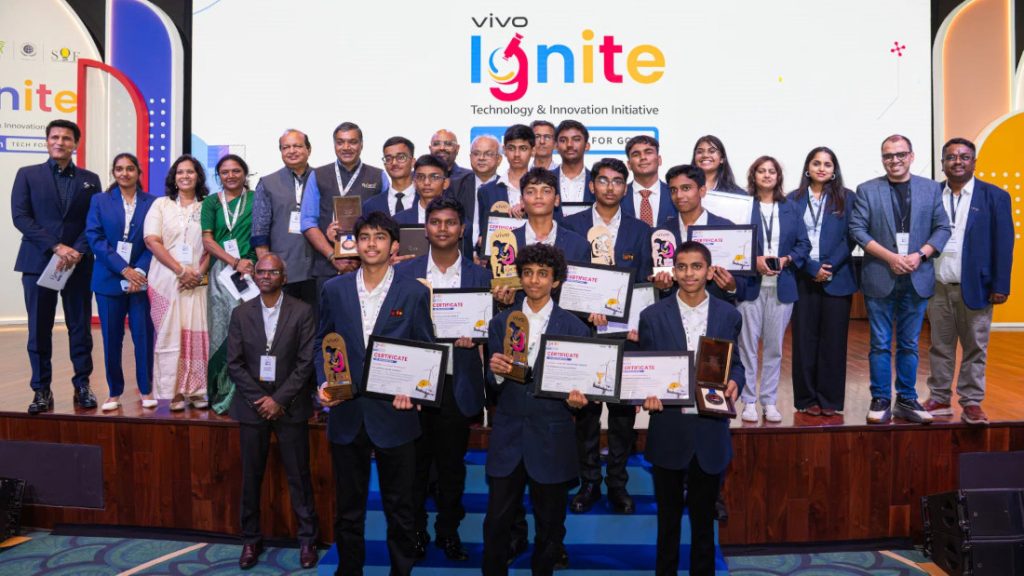
vivo India has declared Dheyay Shah from RMG Maheshwari English School in Surat, Gujarat, the national winner of vivo Ignite 2026. The announcement took place at the initiative’s National Finale held at Bharat Mandapam, New Delhi, on October 28.

Now in its fourth edition, vivo Ignite is a nationwide innovation initiative designed for students in Grades 8 through 12. Shah secured the top position for his project, JALAAKAR – The Shape of Water: Predict, Alert, & Act, which integrates machine learning with historical groundwater data to forecast water availability and assist in resource management.

Scale and Participation

The 2026 edition saw widespread participation across India:

  • Registrations: More than 38,000 students registered from over 12,000 schools.
  • Submissions: Over 6,100 project ideas were submitted.
  • Geographic Reach: Entries represented 705 districts across all 28 states and 8 Union Territories, spanning over 4,500 cities and including 92 Aspirational Districts.
  • Scholarships and Awards: The program offered educational scholarships and rewards totaling up to INR 35 lakh.

The initiative was supported by knowledge partners including the IITM Pravartak Technologies Foundation (Technology Innovation Hub of IIT Madras), the Science Olympiad Foundation (SOF), and the UN Global Compact Network India (UNGCNI). Grant Thornton served as the process validator.

National Finale and Educator Recognition

The finale brought together student finalists, educators, and key institutional stakeholders. Dignitaries in attendance included Dr. Panneerselvam Madanagopal, CEO of MeitY Startup Hub; Shri Ratnesh Jha, Executive Director of UNGC NI; and Dr. M J Shankar Raman, CEO of IITM Pravartak Technologies Foundation. The event was hosted by technology commentator Rajiv Makhni.

In addition to the student honors, vivo India recognized 10 educators under the National Teacher Innovation Fellowship (NTIF). Selected from a pool of more than 200 applicants across 14 states and 26 districts, the fellows were commended for developing practical, inclusive, and engaging instructional methods in STEM education.

Top 10 Student Innovations

A jury of academic and industry specialists evaluated the finalists based on scientific application, creativity, feasibility, cost-effectiveness, and potential societal impact. The final cohort comprised 13 students across eight individual and two group projects.

Rank Project Name Innovator(s) & School Key Focus / Technology
1 JALAAKAR – The Shape of Water: Predict, Alert, & Act

Dheyay Shah


RMG Maheshwari English School, Surat, Gujarat

Uses machine learning, historical borewell records, rainfall, and soil metrics to estimate taluka-level groundwater availability.
2 JalRakshak: Predicting Borewell Failure Before It Happens

Vidyut Sundar & Shreyan Limaye


Dhirubhai Ambani International School, Mumbai, Maharashtra

Employs borewell-specific time-series analysis to model water-level decline using extraction and recharge parameters.
3 HydroPlastiNet

Anish Srinivas, Achyutha Pranav V Subramanian, & Akhilesh Ram R


Padma Seshadri Bala Bhavan Senior Secondary School, Chennai, Tamil Nadu

Uses mechanical filtration alongside bentonite and activated charcoal to capture microplastics and dissolved contaminants.
4 Project Unmuted – The Voice of Women

Anushka Bhattacharya


SNBP International School, Rahatani, Maharashtra

Integrates AI, cybersecurity mechanisms, and deepfake detection to offer structured support for victims of online harassment.
5 Project IRIS: Infrared Reflective Interface System

Ayushman Choudhary


Bhavan’s B.P. Vidya Mandir, Ashti, Nagpur, Maharashtra

Combines infrared reflectometry with inertial measurement to track eye and head movements for assistive applications.
6 AVRODH – Automated Verification for Restricted Operator Descent into Hazard

Shaurya Dubey


Army Public School, Bareilly Cantt, Uttar Pradesh

Utilizes gas sensors, RFID tracking, and safety interlocks to prevent unauthorized or unsafe entry into hazardous zones.
7 Smart Device for Instant Helping during Vehicle Accidents

Abhinav Srivastava


SJS Shaktinagar, Sonbhadra, Uttar Pradesh

Detects collisions via dedicated sensors, switches to internal backup power, and dials emergency services (112).
8 Project DrishtiBodh: LiDAR-Based Smart Safety Collar

Jitesh Ladda


Scottish Academy, Parbhani, Maharashtra

Features LiDAR sensors and a microcontroller to alert visually impaired users to nearby obstacles via directional vibration.
9 AquaSentinel AI: Smart Fluoride Safety Device for Schools

Sai Adhrit Singh


Dr. Virendra Swaroop Education Centre, Kanpur, Uttar Pradesh

Employs colorimetric testing, light sensors, and an offline machine-learning model to measure fluoride levels in drinking water.
10 Neuradrive: Movement for All

Advik Jain


The Emerald Heights International School, Indore, Madhya Pradesh

Analyzes electrooculography (EOG) and electroencephalography (EEG) signals to translate neural and ocular activity into assistive device commands.

Author: Srivatsan Sridhar

Srivatsan Sridhar is a Mobile Technology Enthusiast who is passionate about Mobile phones and Mobile apps. He uses the phones he reviews as his main phone. You can follow him on Twitter and Instagram