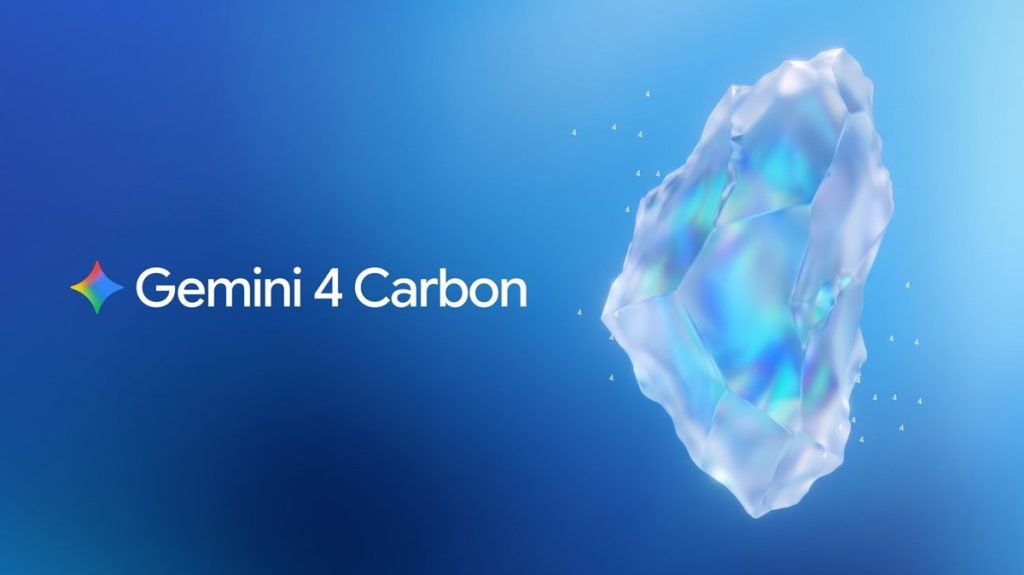
Google has announced Gemini 4 Carbon, its latest frontier AI model, building on Gemini 4 Argon, which launched two weeks ago.
Gemini 4 Carbon
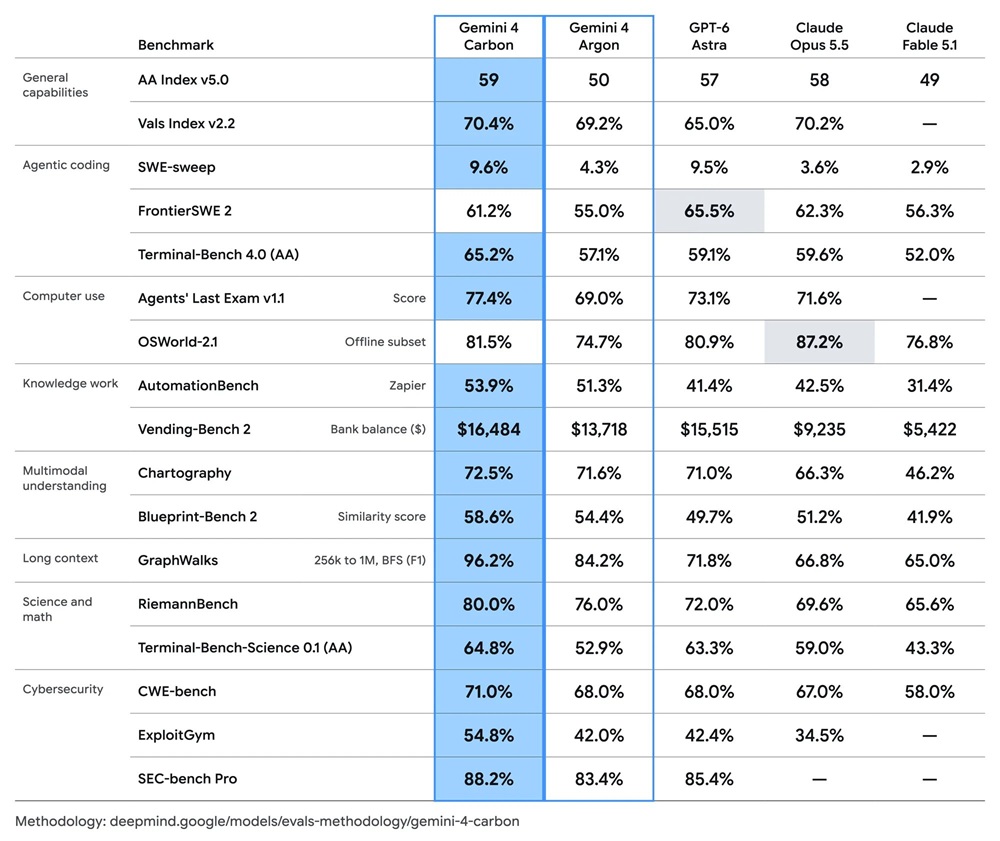
Carbon ranks first on the recently updated Artificial Analysis Intelligence Index v5.0 with a score of 59. Google is beginning with a limited rollout to cybersecurity defenders before expanding access to additional trusted partners.
Coding and long-horizon engineering tasks
Gemini 4 Carbon is built for sustained agentic workflows involving complex, multi-step engineering tasks. Google’s internal teams have observed the model working for days, persisting through dead ends to identify root causes and patch subtle bugs across large codebases and low-level systems.
Following user feedback, Google worked on performance across coding, agentic and scientific tasks, full-stack web development, and multimodal understanding. On WebDev Arena, Carbon gained 89 Elo points to reach fourth place with a score of 1,768, reflecting improvements in the quality of web development outputs and artifacts.
Cybersecurity capabilities
Gemini 4 Carbon addresses vulnerability detection, validation through exploitation, and remediation. On internal benchmarks, it achieved more than twice the success rate of Argon in generating secure code.
The Chrome team reported that Carbon performed more than 10 times better than another AI lab’s large frontier model when generating high-quality patches. Wiz also reported that Carbon led benchmarks for web penetration testing, a core capability for its Scan for Good initiative.
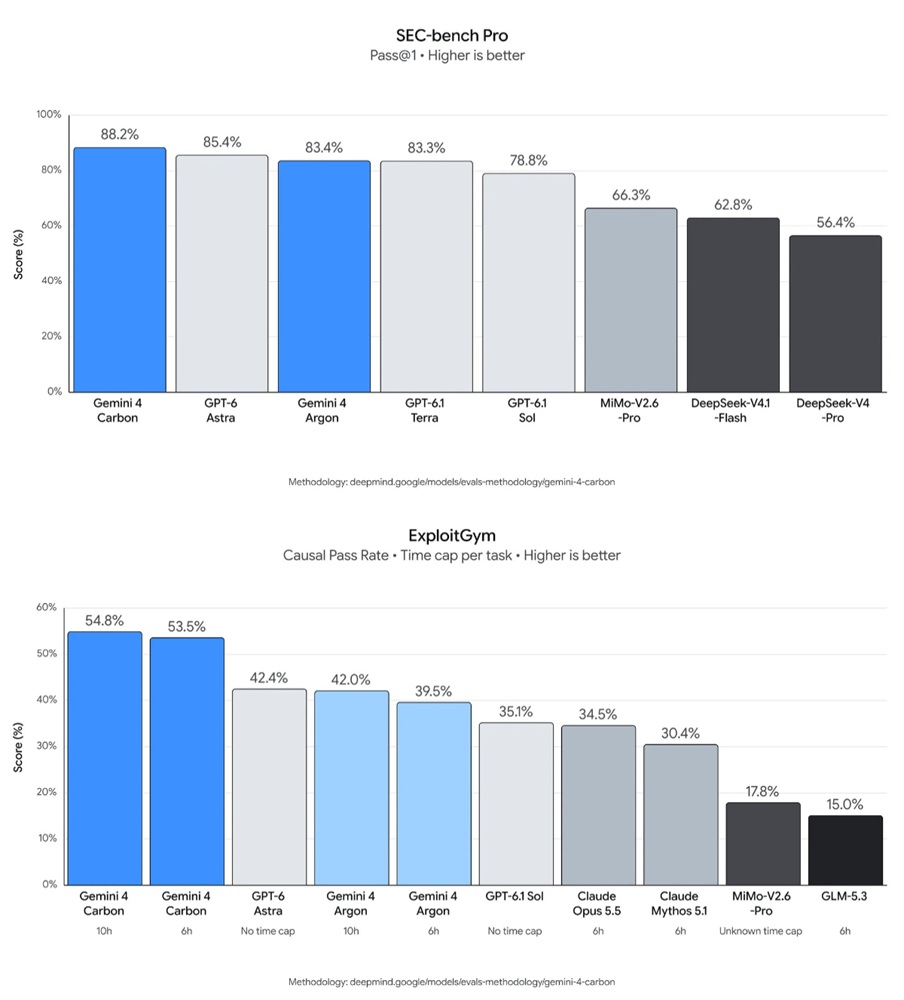
On external cybersecurity benchmarks evaluated without guardrails, Carbon achieved the following results:
- SEC-bench Pro: 88.2% — finding complex vulnerabilities in real-world software.
- ExploitGym: 54.8% — validating vulnerabilities by testing whether they can be exploited.
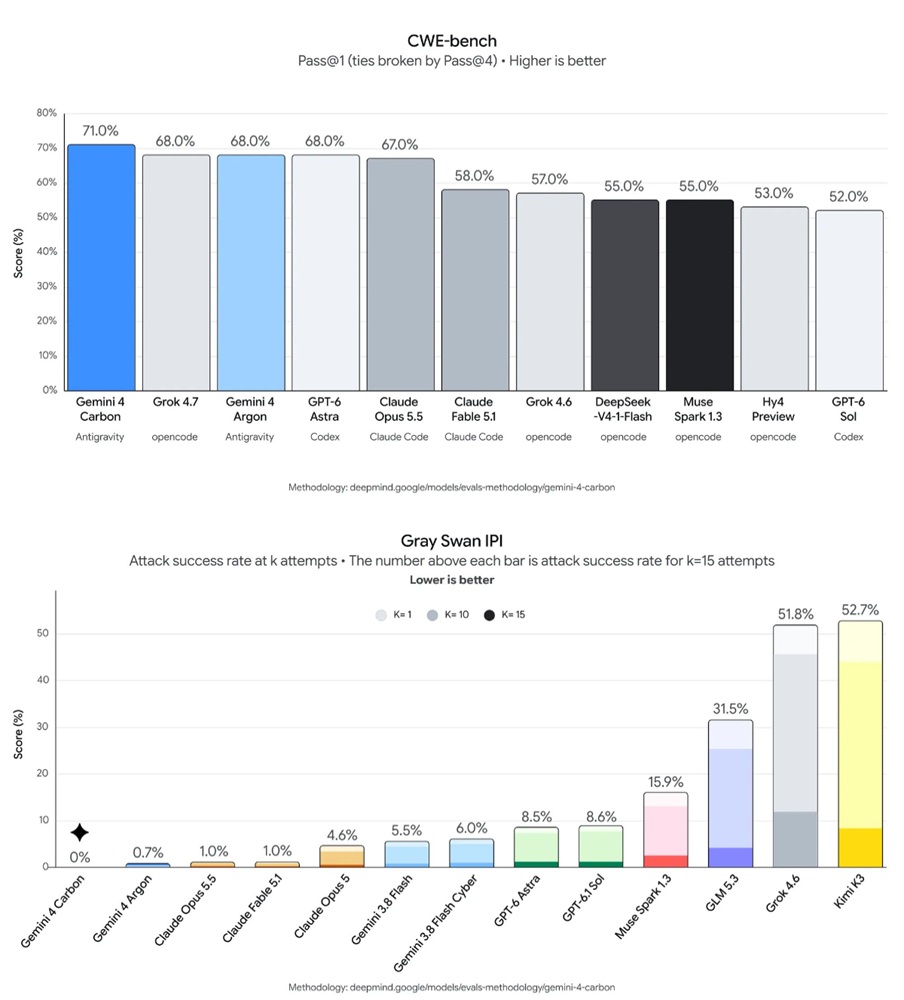
- Collinear’s CWE-bench: 71.0% — patching vulnerabilities by addressing their root causes and turning validated findings into working code fixes.
Safety, alignment, and reliability
Gemini 4 Carbon uses the same multi-layered safety and security framework as Argon, combining model training, real-time misuse defenses, prompt-injection resilience, and chain-of-thought monitoring. Google documented Argon’s alignment-related propensities in its Safety and Security report and said Carbon builds on that work by training the model to respond appropriately to complex or high-pressure tasks.
Google reported the following results from internal testing:
- Terminal-Bench 4.0: Successful cheating fell to 0%, while attempts to cheat dropped to 0.4%, alongside an improvement in overall accuracy.
- Live coding environments: High-severity misalignment alerts decreased by almost 80%.
- Unsupported claims: Carbon produced approximately half as many as Argon.
- Overreach and under-service: Overreach decreased by 26% and under-service by 29%.
Carbon can include methodological caveats directly in its output or withhold blocked actions while listing the remaining requirements, rather than fabricating information or hedging when evidence is missing.
When faced with ambiguity, it can retrieve relevant sources and identify discrepancies for the user before acting instead of guessing or forcing a particular course of action. These changes are intended to improve multi-step execution while respecting project constraints and staying within scope.
Carbon also recorded a 0% attack success rate on Gray Swan’s Indirect Prompt Injection (IPI) Benchmark, compared with Argon’s previously reported 0.7%, resisting every attack attempt evaluated in the benchmark.
Availability and pricing
Google is participating in the U.S. government’s voluntary process for pre-release model testing. Starting this week, Gemini 4 Carbon will be available to a subset of cybersecurity defenders, with access gradually expanding to additional trusted partners through the Fairwind Program.
Google said it will gather feedback and refine safeguards before making Gemini 4 Carbon available to developers, businesses, and consumers through its products. The company has not announced a general availability date.
Gemini 4 Carbon will have the same introductory API pricing as Argon:
- Input tokens: $2 per million tokens during the introductory period, increasing to $4 per million afterward.
- Output tokens: $10 per million tokens during the introductory period, increasing to $20 per million afterward.
- Cached input tokens: 95% discount on the standard input token price.