
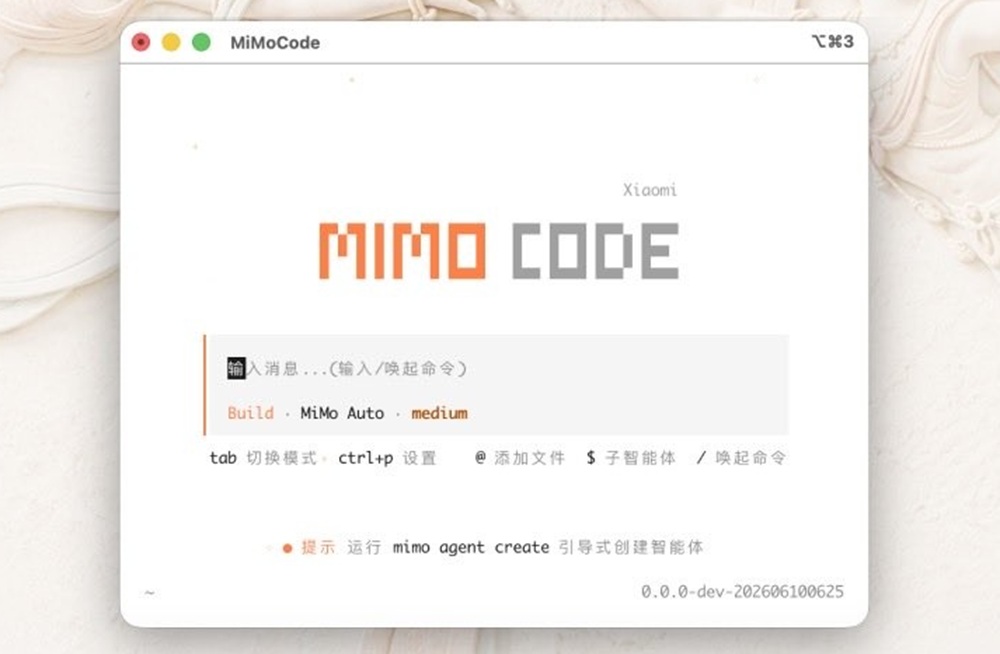
Xiaomi has released MiMo Code V0.1 as an open-source terminal-native AI coding assistant for developers. It operates inside the terminal to read and write code, execute commands, manage Git operations, and maintain persistent project memory across sessions.
The release includes MiMo V2.5, a multimodal model available free for a limited time, featuring a one-million-token context window and designed to work out of the box.
Key features: MiMo Code
- Terminal-native AI coding assistant capable of reading/writing code, running commands, and managing Git
- MiMo V2.5 multimodal model with 1M token context window, free for a limited time
- Infinite context with automatic knowledge accumulation and lossless compression for large codebases
- Agent-model synergy with a closed loop of testing, review, and validation
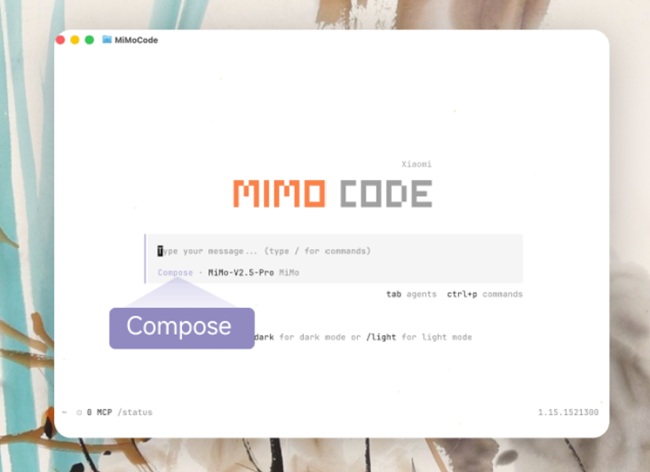
- Compose mode workflow: Specs → Plans → Build → Report
- Self-evolving system that distills session experience and improves over time
- Voice input powered by MiMo-V2.5-ASR for speech-based prompts
- Claude Code compatibility with automatic loading of skills, MCP servers, and commands
- Support for multiple model providers including Anthropic, OpenAI, DeepSeek, Kimi, and GLM
- Persistent memory system using SQLite FTS5 full-text search
- Multi-agent system with build, plan, and compose modes
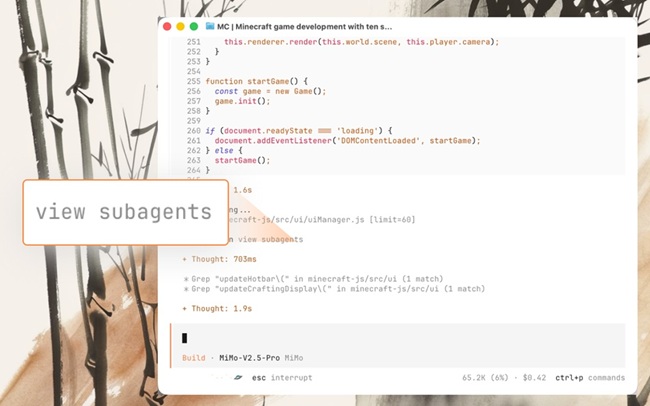
- Subagent system with parallel execution and lifecycle tracking
- Tree-structured task tracking (T1, T1.1, T1.2, etc.) integrated with checkpoints
- Goal system using
/goalcommand with independent judge model validation - Dream tool (
/dream) for extracting persistent knowledge into project memory - Distill tool (
/distill) for converting repeated workflows into reusable skills/commands - Configuration support via
.mimocode/mimocode.jsonor global config - Max Mode (experimental) for parallel best-of-N reasoning with judge selection
- Tab key support to switch between primary agents
Technical details
MiMo Code uses a persistent memory system that stores project-level knowledge and maintains continuity across sessions. It includes:
- Project memory (MEMORY.md) for architecture and rules
- Session checkpoint (checkpoint.md) for structured state snapshots
- Scratch notes (notes.md) for temporary agent usage
- Task progress logs (tasks/<id>/progress.md) for tracking execution
The system automatically injects memory when sessions resume, ensuring continuity without manual reloading.
It also includes intelligent context management, which creates automatic checkpoints, reconstructs context when limits are reached, and uses token budgeting to prioritize relevant memory.
The multi-agent architecture supports build, plan, and compose modes. Each mode handles different stages of development, while subagents can be created for parallel tasks with full lifecycle management.
The compose mode follows a structured workflow of specification, planning, execution, debugging, testing (TDD), verification, and merging.
Onboarding options include:
- MiMo Auto (free, anonymous, zero configuration)
- Xiaomi MiMo Platform (OAuth login)
- Import from Claude Code (one-step migration)
- Custom provider (OpenAI-compatible API support)
Installation
MiMo Code V0.1 is open-source and built as a fork of OpenCode, extending it with persistent memory, multi-agent orchestration, and context management capabilities.
macOS & Linux:
curl -fsSL https://mimo.xiaomi.com/install | bashWindows:
npm install -g @mimo-ai/cliAfter installation, users can configure MiMo Auto (anonymous mode), Xiaomi MiMo Platform login, import from Claude Code, or use custom API providers. More details are available at mimo.xiaomi.com/mimocode.