
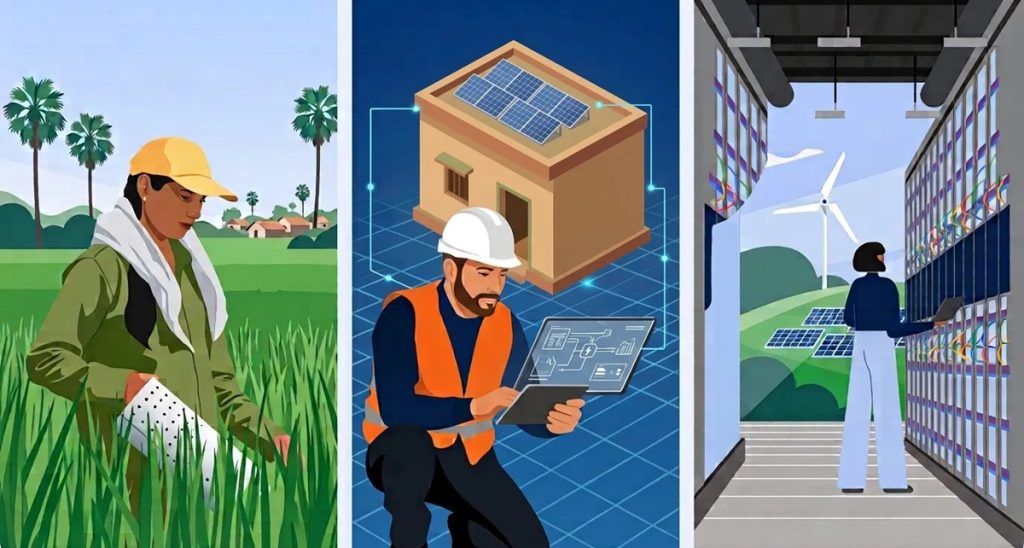
Google has announced five new sustainability and clean-energy initiatives in India. The announcements form part of efforts related to India’s clean energy transition and national climate priorities.
Solar API expands to over 300 million rooftops in India
Google’s Solar API, part of Earth AI, can now generate insights for more than 1.2 billion buildings globally and over 300 million rooftops across India. It uses AI and imagery to help installers assess a home’s solar potential without an on-site visit, reducing the time and cost required to prepare accurate designs and final customer proposals.

The expansion comes amid increased residential solar adoption in India, supported by government incentive programs such as the PM Surya Ghar: Muft Bijli Yojana.
Local platforms including Solar Ladder and OpenSolar are integrating Solar API data into their workflows. The data can be used to:
- Automate 3D system layouts
- Model parapet and water tank clearances
- Generate mobile proposals during the first client meeting
- Automate manual roof surveys and custom layouts
150MW solar project in Rajasthan
Google has entered into a new long-term agreement with ReNew Power for a 150-megawatt (MW) utility solar generation project in Rajasthan. Under the agreement, Google will receive the environmental attributes associated with the clean electricity generated by the project and apply them to help address electricity-related emissions across its broader value chain.
The project is Google’s second Scope 3-focused solar project in India, bringing its total contracted capacity with ReNew to 300MW of new solar generation capacity on India’s national grid. The agreement builds on Google’s approach to supply chain decarbonization through direct procurement of clean energy attributes.
Rice farming project targets methane and water use
Google is partnering with Mitti Labs on a project expected to help tens of thousands of smallholder rice farmers in Telangana adopt climate-smart farming practices. Globally, rice cultivation accounts for up to 12% of all methane emissions.
The project introduces Alternate Wetting and Drying (AWD), which periodically drains and refloods fields instead of keeping them continuously submerged. This introduces oxygen into the soil, disrupting methane-producing microbes while reducing irrigation demand and conserving water. Participating farmers will also receive direct payments.

The project marks the largest publicly announced agreement to date to purchase credits generated by reducing methane emissions from rice cultivation. It aims to mitigate:
- Nearly 3 million tonnes of CO2e on a 20-year Global Warming Potential (GWP20) basis
- 1 million tonnes of CO2e on a 100-year GWP100 basis
NASA-enabled satellite monitoring and on-the-ground field networks will verify the results.
Climate technology research and startups
Google launched the Google Center for Climate Technology in February in partnership with the Government of India’s Office of the Principal Scientific Adviser. The Center supports researchers and innovators applying AI to environmental challenges. Out of 77 applications, it selected three inaugural grant recipients across two tracks: green workforce training and low-carbon construction materials.
Google is now expanding the Center’s scope with two additional focus areas open for research and innovation proposals through the Government of India’s Manthan Platform:

- Water Stewardship: Developing scalable technologies and management practices to address rising freshwater demand and protect and conserve watershed resources.
- Waste and Circularity: Advancing research into e-waste and battery recycling processes to support more circular approaches to resource use.
The inaugural cohort of the Google DeepMind Accelerator: AI for the Planet includes four Indian startups applying AI to environmental challenges. Their work includes:
- Terrastack and Varaha Climate: Plot-level land intelligence, regenerative practices and verified carbon credits for smallholder farmers.
- Farmers for Forests and Climitra Carbon: Geo-AI, drones and satellite models for agroforestry, biodiversity restoration and converting invasive biomass into biochar.
Speaking on this, Vrushali Gaud, Director, Climate Operations at Google, said:
As India strengthens its technological and AI leadership, ensuring that this momentum drives sustainable, inclusive growth is central to our collective future. From deploying geospatial AI to help local solar installers scale rooftop adoption, to collaborating with farmers on climate-smart water practices and adding new clean power to the national grid, these initiatives show how digital innovation and environmental stewardship go hand in hand to create practical, lasting impact for India.