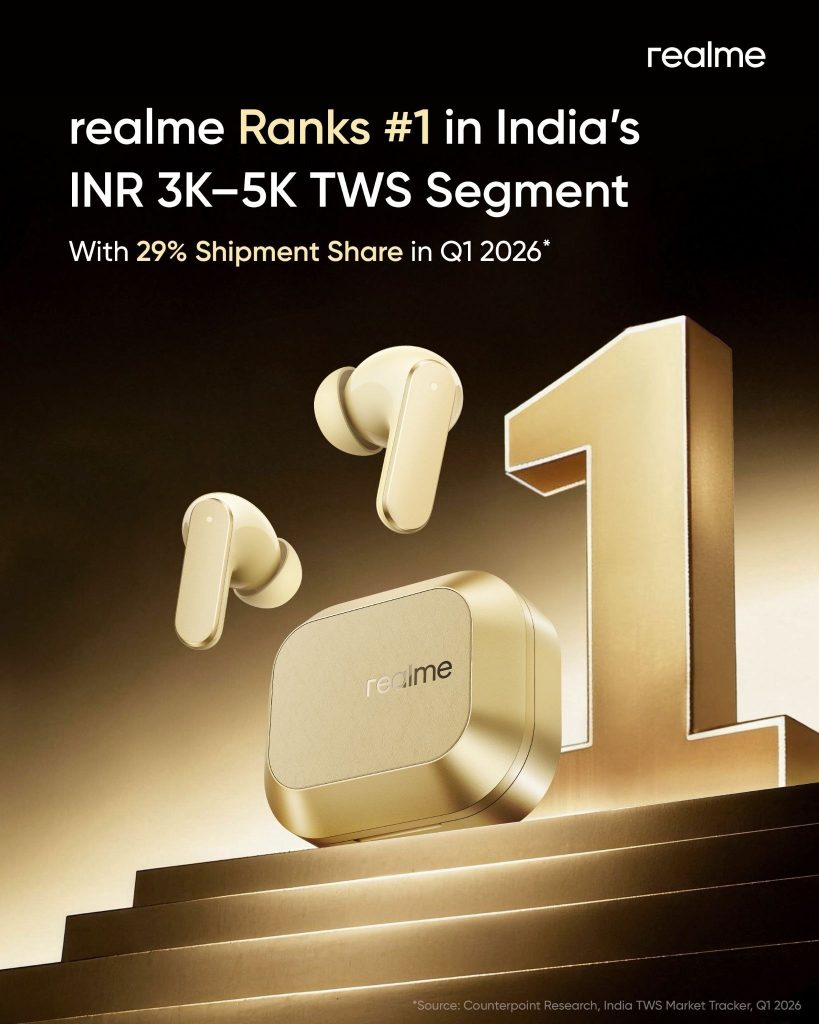
According to the latest quarterly tracker from Counterpoint Research, smart device manufacturer realme secured prominent positions in India’s True Wireless Stereo (TWS) market during the first quarter of 2026, driven by demand for mid-tier and budget audio devices.
Leadership in the Mid-Range Segment
The market research data highlights that realme emerged as the leading brand in the INR 3,000–INR 5,000 price bracket, capturing a 29% shipment share during Q1 2026. This segment has seen increased competition as consumer preferences shift toward more premium audio features.
A significant driver of this performance was the realme Buds Air 8, which became the individual best-performing model within this specific price tier, securing a 15% market share.
Counterpoint’s analysis points out that the brand’s traction in the INR 3,000–INR 5,000 range is largely due to the integration of features typically reserved for higher-end devices. Features such as:
- Active Noise Cancellation (ANC)
- Dual-device connectivity
- Low-latency modes optimized for mobile gaming
These specifications have particularly resonated with younger, tech-focused demographics looking for high functionality at competitive price points.
Budget Market Performance
In addition to its mid-range performance, the company maintained a strong presence in the entry-level market. The realme Buds T200 Lite was reported as the top-selling model in the value-driven INR 1,000–INR 1,500 segment during the same quarter, indicating a volume-driven hold on the lower end of the pricing spectrum.
Broader Market Trends
The report from Counterpoint Research underscores a broader, ongoing evolution within India’s audio wearables market. Indian consumers are increasingly prioritizing advanced features over basic audio playback. Demand is steadily rising for:
- Advanced Active Noise Cancellation (ANC)
- Immersive audio tuning
- Longer battery life cycles
- Lower latency and more stable wireless protocols
realme’s shipment volumes in Q1 2026 reflect how successfully the brand has aligned its product portfolio with these shifting consumer expectations across multiple price tiers in the AIoT (Artificial Intelligence of Things) ecosystem.