
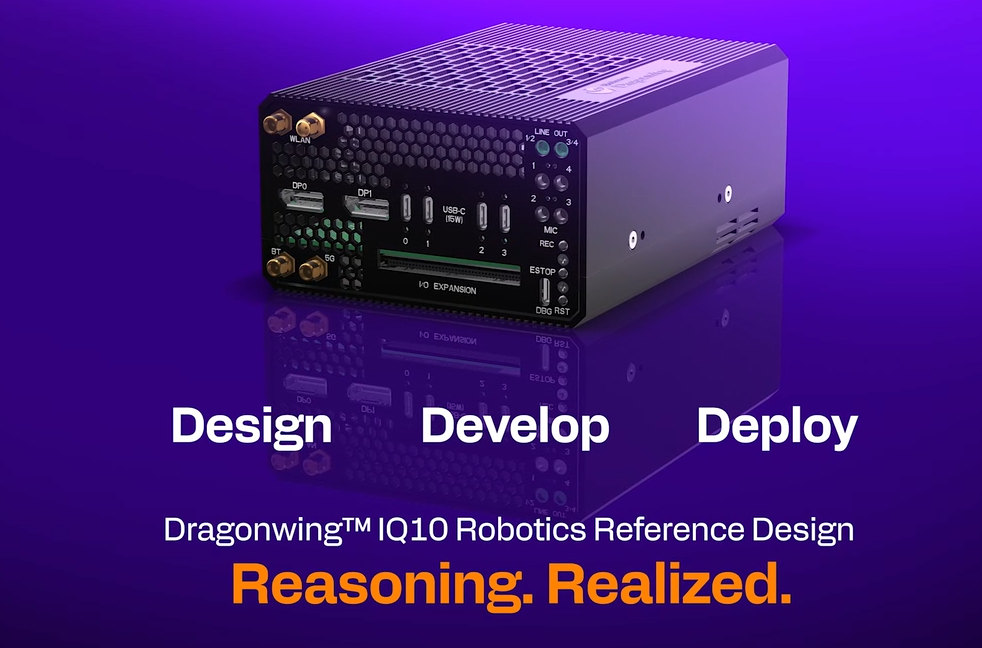
Qualcomm has introduced Dragonwing IQ10 Robotics Reference Design (RRD) that is built to address production-level requirements, offering a unified foundation for sensor-AI systems that demand flexible execution, modular expansion, and predictable deployment.
Moving Beyond Fragmented System Integration
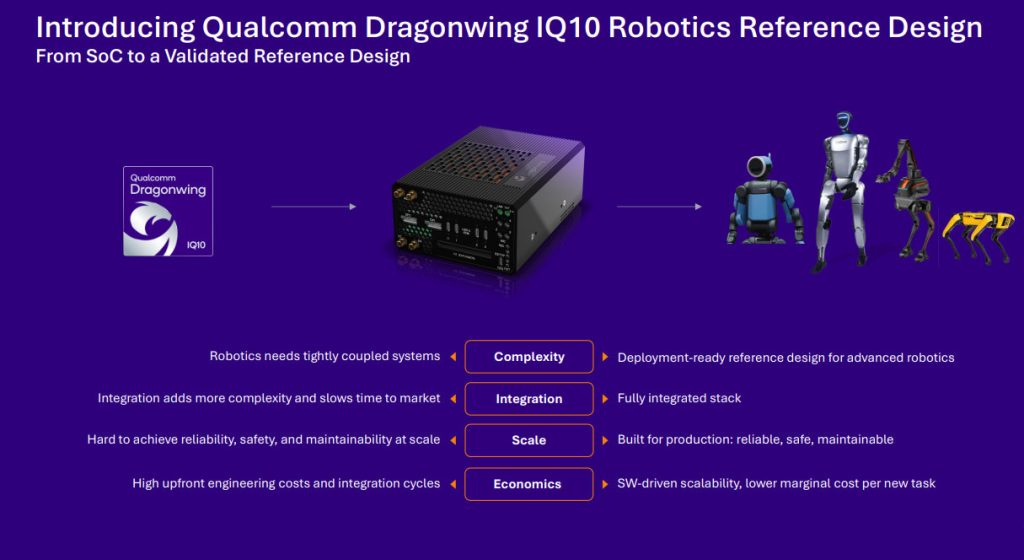
Historically, transitioning a robot from a prototype to a deployable production platform involved stitching together fragmented toolchains, separate bridging components, and disparate software layers. This approach frequently introduced timing inefficiencies, data synchronization challenges, and high operational burdens.
The Dragonwing IQ10 RRD consolidates the key hardware and software building blocks of a production robot into a single, cohesive reference design. By utilizing dedicated, native sensor interfaces and scaling through PCIe expansion, the platform aims to reduce integration complexity, shorten development cycles, and establish clear validation boundaries for developers.
Core Advantages of the Platform
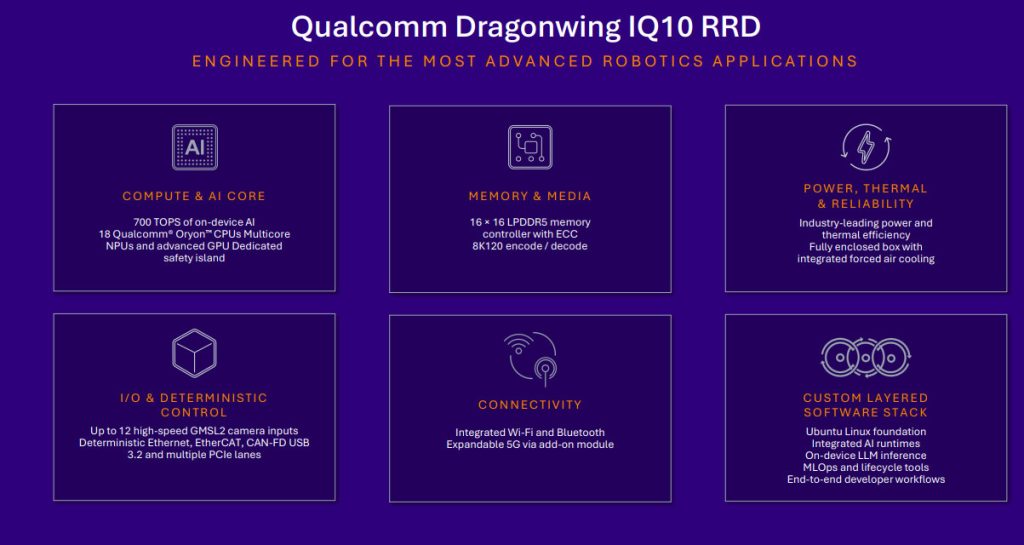
- High-Performance Embodied AI Compute: Built on the Qualcomm Dragonwing IQ10 processor, the reference design delivers up to 700 TOPS of AI performance. This processing power is driven by 18 Qualcomm Oryon CPU cores, multicore NPUs, and a GPU architecture engineered to support on-device perception, planning, and reasoning natively—eliminating the need for external hardware accelerators.
- Native Multi-Modal Perception: Real-world autonomy depends on fast, reliable sensor data. Rather than relying on separate bridging components that introduce latency, the Dragonwing IQ10 RRD integrates sensor ingestion natively.
- Direct Support: Natively supports up to 12 GMSL2 cameras alongside LiDAR, Time-of-Flight (ToF), and Inertial Measurement Units (IMUs).
- Data Alignment: Keeps diverse vision, depth, and motion data streams synchronized and aligned.
- Latency Reduction: Minimizes delays between physical sensing and central processing, creating a cleaner architecture that easily scales from simple camera configurations to complex multi-sensor systems.
- Deterministic Control and Real-Time I/O: Production robotics requires predictable behavior and precise motion control. The architecture supports high-speed deterministic interfaces across multiple communication protocols, ensuring consistent timing across the entire system. Supported interfaces include:
- PCIe Gen5 and USB 3.2
- Time-Sensitive Networking (TSN) and Ethernet (up to 10G)
- EtherCAT (via dedicated controllers)
- Native and extended CAN-FD
- Built for Environmental Realities: Industrial and outdoor deployments present severe thermal and electrical challenges. The Dragonwing IQ10 RRD is housed in a fully enclosed box with integrated forced-air cooling. It is designed to operate across a wide temperature range of -40 to 70 °C and supports flexible 12V/24V nominal power inputs with integrated over-voltage protection triggering at 26V.
A Layered Software Architecture
Hardware performance is maximized by a tightly integrated, end-to-end robotics software stack. Structured across distinct layers, this modular architecture allows engineering teams to work at their preferred level of the stack, from edge optimization to cloud orchestration.
+-----------------------------------------------------------------+
|               Cloud-Connected Lifecycle Management              |
|          (Fleet Orchestration & Deployment via Qualcomm AI Hub) |
+-----------------------------------------------------------------+
|                        Platform Services                        |
|             (Core Sensing, Planning, & Actuation)               |
+-----------------------------------------------------------------+
|                          ROS2 Support                           |
|          (Decoupling Hardware from Application Logic)           |
+-----------------------------------------------------------------+
|                     On-Device AI Runtimes                       |
|           (Low-Latency Perception & Decision-Making)           |
+=================================================================+
|              Dragonwing IQ10 Hardware Architecture              |
+-----------------------------------------------------------------+
Out of the box, this full-stack capabilities framework supports the essential functional building blocks of modern autonomous systems:
- Perception: Vision, depth mapping, and environment understanding.
- Navigation: Localization and autonomous movement planning.
- Manipulation: Control algorithms for robotic arms and end effectors.
- Orchestration: Task planning and higher-level autonomy.
- Interaction: Natural language interfaces for human-robot communication.
Technical Specifications
The platform’s underlying specifications reflect its focus on high throughput, extensive I/O density, and production reliability:
| Specification | Details |
|---|---|
| Form Factor | Fully enclosed box with integrated forced air cooling (176mm x 125mm x 75mm) |
| Input Voltage | 12V or 24V nominal (input protection trigger at 26V) |
| Memory & Storage | 64GB LPDDR5x (in-package); 512GB UFS4.0 G5 2-lane; 1x PCIe Gen5 NVMe (2280) |
| Camera Inputs | 12x GMSL Camera Inputs (3x MAX96724 mapped to 3x CSI ports) |
| Networking | 2x 10G Base-T ports (Main Domain); 1x 2.5G Base-T port (SAIL Domain) |
| Industrial I/O | 4x EtherCAT (1G Base-T via Intel I226 over PCIe); 8x CAN-FD (4 native, 4 via SPI) |
| Wireless | Wi-Fi 7 + Bluetooth module over PCIe; 5G Modem module over PCIe |
| Expansion / Video | 2x DisplayPort 2.1 (supporting Multi-Stream Transport); SPI, I2C, UART, and GPIOs |
Scaling to Production
As autonomous systems grow more complex, the primary engineering challenge shifts away from whether a platform can run a specific workload, and toward whether it can scale, operate safely, and support repeatable deployments at scale.
The Dragonwing IQ10 RRD establishes a consistent foundation for sensor fusion and edge intelligence, ensuring developers do not need to redesign their core data pipelines as their physical platforms evolve. This architectural approach is currently being explored by a broad ecosystem of early access partners, including NEURA Robotics, Advantech, APLUX, Booster, Innodisk, MeiG, NEXCOM, Radxa, Thundercomm, and VinMotion.
The Qualcomm Dragonwing IQ10 RRD will be officially unveiled at Computex 2026, with early access for customers from this June 2026, and the global availability is scheduled to begin in September 2026.