
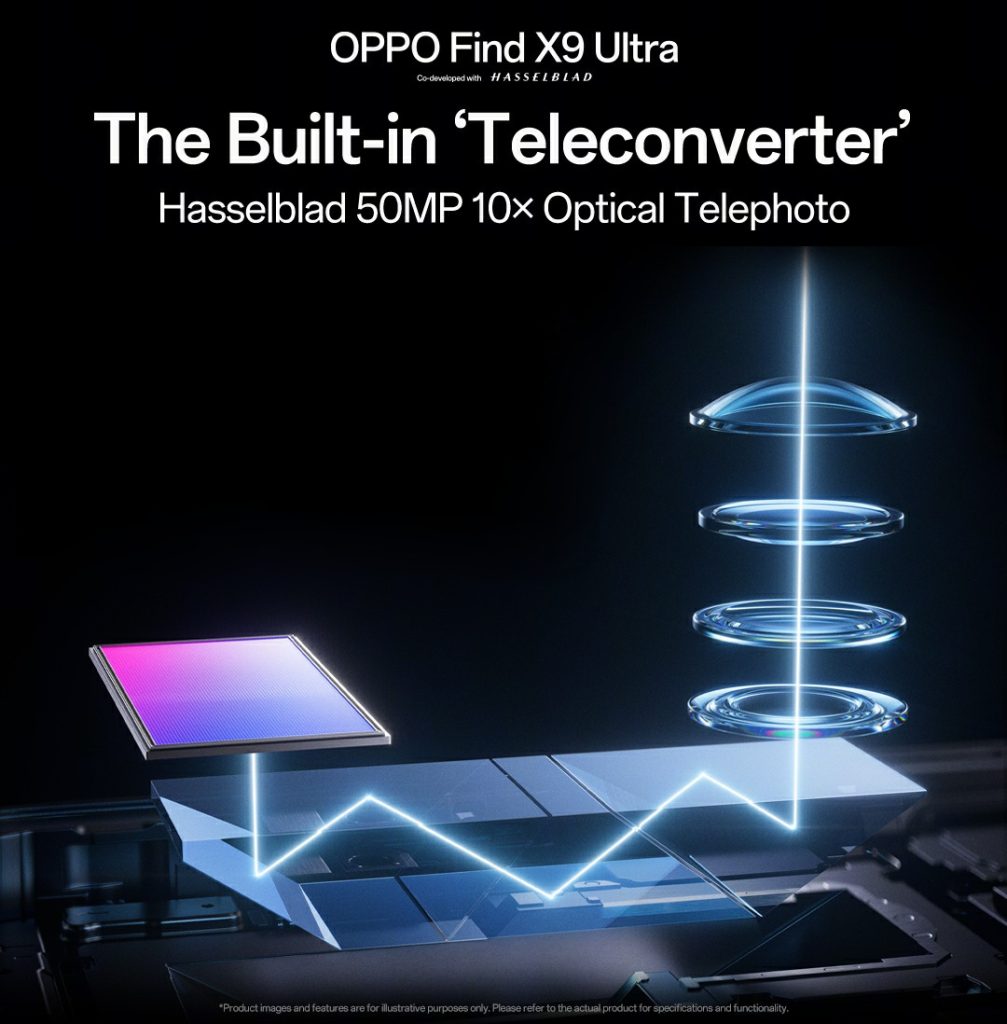
OPPO has released new details for its upcoming Find X9 Ultra smartphone, heavily focusing on a significant update to its camera system. The promotional materials outline a new Hasselblad-branded 50MP 10x Optical Telephoto lens, designed to address the physical limitations that typically restrict modern flagship smartphones to 4x or 5x optical zoom ranges.
To incorporate a native 10x zoom without substantially increasing the device’s thickness, OPPO has introduced several new hardware and engineering designs.
Core Technology: The Quintuple Prism Reflection Periscope
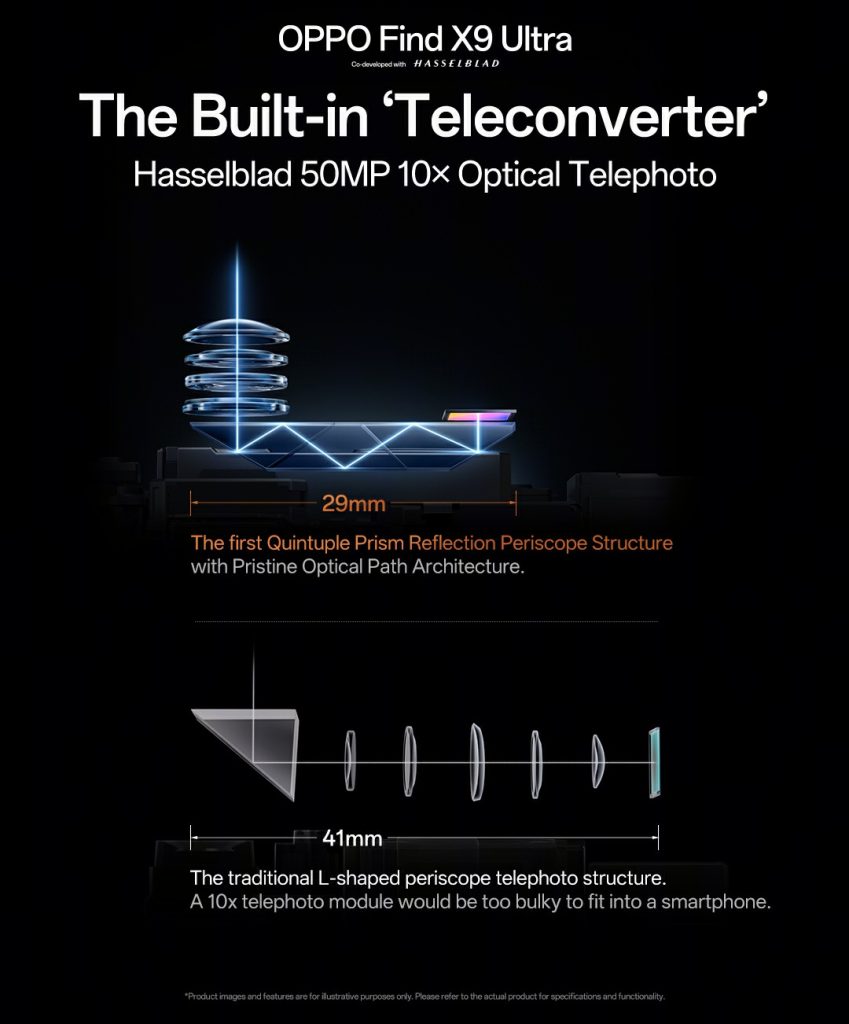
The primary engineering challenge of a 10x optical zoom is the requirement for a longer focal length. Traditional L-shaped periscope structures capable of 10x zoom (typically requiring around 41mm of internal space) are generally too bulky for slim smartphone profiles.
To bypass this, OPPO developed the Quintuple Prism Reflection Periscope Structure. By bouncing the light path five times before it reaches the sensor, the module compresses the necessary optical length down to 29mm—a 30% reduction in size compared to traditional designs.
Key Camera Innovations
Building around this new periscope structure, the Find X9 Ultra’s telephoto module integrates several specific technologies to maintain image quality and stability:
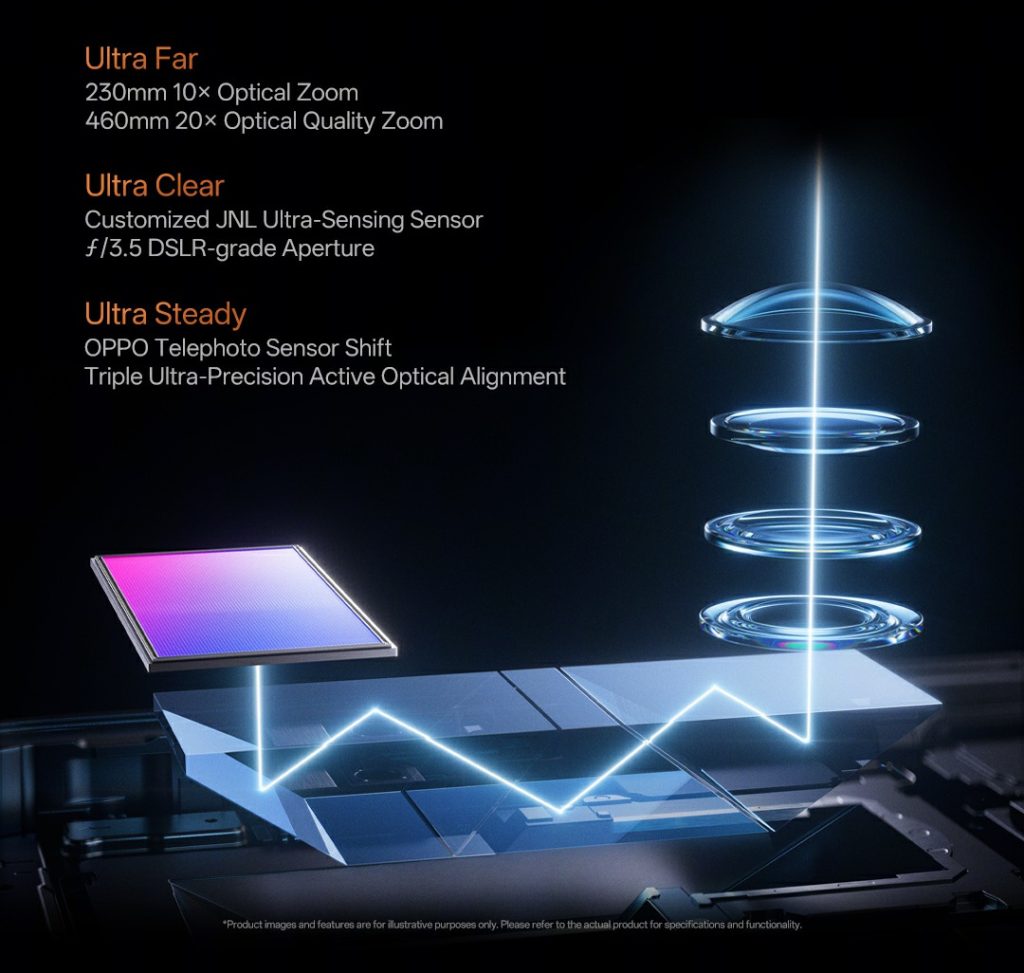
- Hasselblad 50MP Customized Sensor: The camera utilizes a customized JNL Ultra-Sensing Sensor with an f/3.5 aperture. It offers a 230mm equivalent focal length at 10x optical zoom and uses sensor cropping to achieve a 460mm equivalent at 20x “optical quality” zoom.
- Pristine Optical Path Architecture: Because each additional light reflection in a prism can degrade quality and introduce stray light, OPPO implemented a three-piece prism design separated by a “Nanometer-scale Diaphragm” and an “Air Capsule.” According to the provided specifications, this design cuts stray light by 99.999%, ensuring a pure optical path to the sensor.
- Sensor Shift Stabilization: Traditional periscope optical image stabilization (OIS), which stabilizes the prism itself, is incompatible with a five-reflection system. Instead, OPPO shifted the stabilization mechanism directly to the sensor. This “Telephoto Sensor Shift” is designed to keep the viewfinder steady at high magnifications where micro-jitters are highly visible.
- Triple Active Optical Alignment (AOA): During assembly, the camera module undergoes a triple AOA process. This dynamically aligns the lens, sensor, and prism in real-time to guarantee the sharpest possible optical output.
Target Applications

OPPO is positioning the Find X9 Ultra’s telephoto capabilities toward scenarios that traditionally require dedicated camera equipment.
Promotional images demonstrate the stark difference between an ultra-wide field of view (“What I See”) and the detailed 10x crop, suggesting the device is optimized for situations requiring significant reach, such as stadium concerts or wildlife photography.
The OPPO Find X9 Ultra will be introduced in April, and the company has already confirmed the global launch of the phone.