
Apple has announced the latest 14- and 16-inch MacBook Pro, featuring the new M5 Pro and M5 Max chips, after introducing the M5 model last year. The company indicates these new chips bring substantial performance enhancements and new AI capabilities to its pro laptop line.
The laptops come standard with increased starting storage—1TB for the M5 Pro and 2TB for the M5 Max—with SSD speeds up to twice as fast, reaching up to 14.5GB/s to accelerate professional workflows across 4K and 8K video, Large Language Models (LLMs), and complex datasets. The new 14-inch MacBook Pro with M5 also now starts at 1TB of storage.
The new MacBook Pro includes the N1, a new Apple-designed wireless networking chip that supports Wi-Fi 7 and Bluetooth 6. Further features include up to 24 hours of battery life, a Liquid Retina XDR display (with a nano-texture option), Thunderbolt 5 connectivity, a 12MP Center Stage camera, studio-quality microphones, and a six-speaker sound system with Spatial Audio.
Fusion Architecture and Advanced Processing
The M5 Pro and M5 Max utilize a new Apple-designed Fusion Architecture, which the company states is engineered from the ground up for AI. This architecture combines two dies into a single system on a chip. The new CPU supports up to 18 cores, incorporating 6 “super cores” and 12 new performance cores designed for power efficiency during multithreaded professional workloads. Apple states this produces a performance increase of up to 30%.
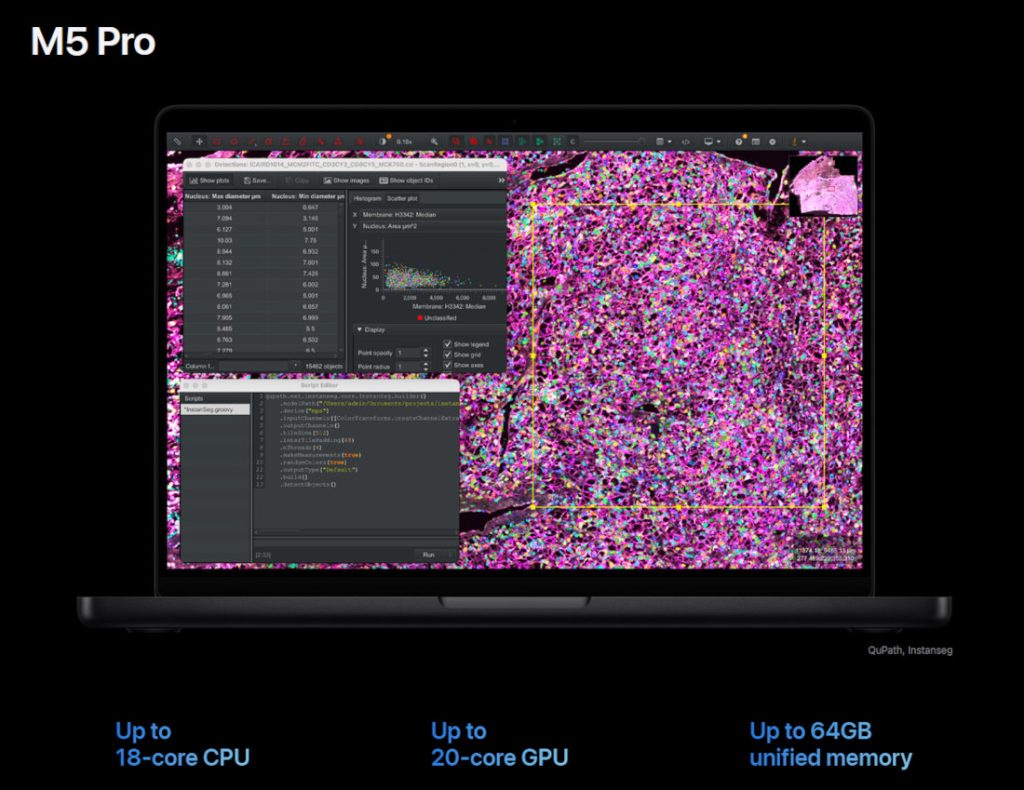
The M5 Pro is aimed at users with complex tasks, such as coding or processing large image libraries, while the M5 Max is built for more demanding applications like rigorous simulations. Apple reports that these chips handle LLM prompt processing up to 4x faster than the M4 Pro and M4 Max, and AI image generation up to 8x faster than the M1 Pro and M1 Max. Additionally, the new architecture boasts up to a 50% increase in graphics performance compared to the M4 Pro and M4 Max, which is intended to support real-time 3D scene rendering and instant VFX previews.
The system also features higher unified memory bandwidth to support intensive AI model training and video projects. The M5 Pro supports up to 64GB of unified memory with up to 307GB/s bandwidth, while the M5 Max accommodates up to 128GB of unified memory with up to 614GB/s bandwidth.
Performance Comparisons
Apple highlighted several performance metrics for the new MacBook Pro models:
14- and 16-inch MacBook Pro with M5 Pro:
- Up to 7.8x faster AI image generation and 6.9x faster LLM prompt processing compared to the M1 Pro (3.7x and 3.9x faster than the M4 Pro, respectively).
- Up to 5.2x faster 3D rendering in Maxon Redshift compared to the M1 Pro (1.4x faster than the M4 Pro).
- Up to 1.6x faster gaming performance with ray tracing (e.g., Cyberpunk 2077: Ultimate Edition) compared to the M4 Pro.
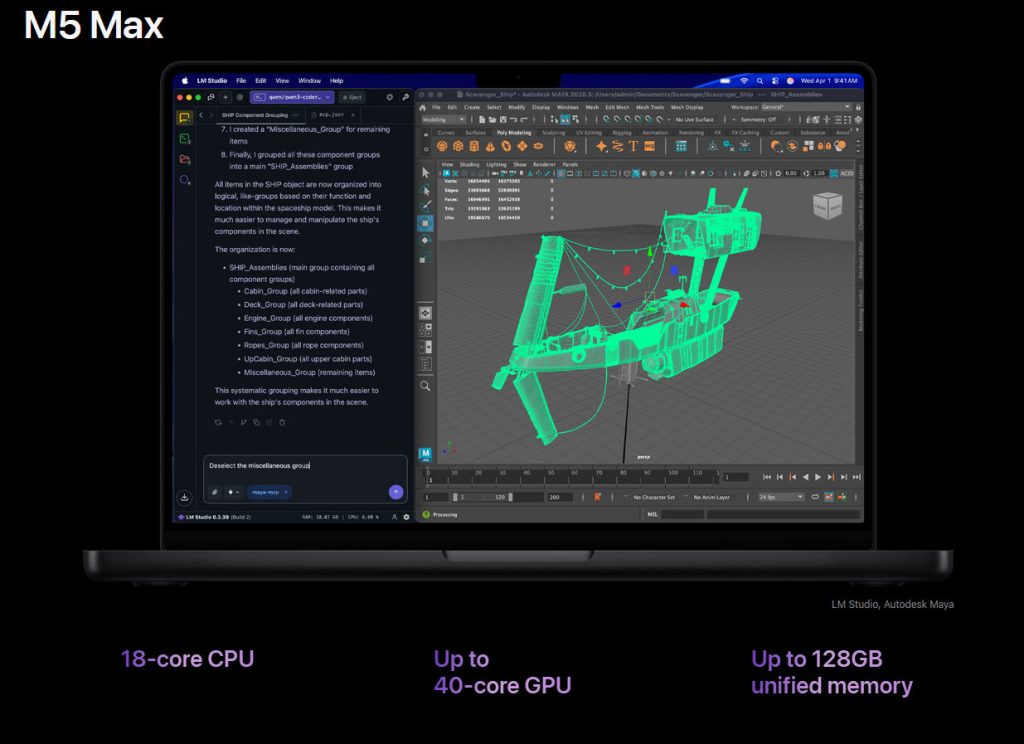
14- and 16-inch MacBook Pro with M5 Max:
- Up to 8x faster AI image generation and 6.7x faster LLM prompt processing compared to the M1 Max (3.8x and 4x faster than the M4 Max, respectively).
- Up to 5.4x faster video effects rendering in Blackmagic DaVinci Resolve Studio compared to the M1 Max (3x faster than the M4 Max).
- Up to 3.5x faster AI video-enhancing performance in Topaz Video compared to the M4 Max.
Value for Upgrading Users
Apple is emphasizing the benefits of upgrading for users with Intel-based Macs or earlier Apple silicon models. Key advantages include:
- Enhanced AI performance: Upgraders from M1 models will see up to an 8x increase in AI performance due to Neural Accelerators in the GPU.
- Battery life: The up to 24-hour battery life provides Intel users with up to 13 additional hours, and M1 users with up to 3 additional hours. The system supports fast charging up to 50% in 30 minutes using a 96W or higher adapter and reportedly maintains consistent performance on battery or plugged in.
- Display: The Liquid Retina XDR display features 1600 nits peak HDR brightness and up to 1000 nits for SDR content.
- Connectivity: Includes three Thunderbolt 5 ports, an HDMI port supporting up to 8K resolution, an SDXC card slot, and MagSafe 3. The M5 Pro supports up to two high-resolution external displays, while the M5 Max supports up to four.
- Camera and Audio: The 12MP Center Stage camera includes Desk View support, paired with studio-quality mics.
Apple MacBook Pro (2025 – M5) 14″ and 16″ specifications
- 14.2-inch (3024×1964 pixels) / 16.2 (3456×2234 pixels) Liquid Retina XDR display at 254 pixels per inch, ProMotion technology for adaptive refresh rates up to 120Hz, Up to 1,000 nits sustained (full-screen) brightness, 1,600 nits peak brightness, 10,00,000:1 contrast ratio
- Apple M5 Pro chip – 15-core CPU with 5 super cores and 10 performance cores, 16-core GPU, Hardware-accelerated ray tracing, 16-core Neural Engine, 307GB/s memory bandwidth / 18-core CPU with 6 super cores and 12 performance cores, 20-core GPU, Hardware-accelerated ray tracing, 16-core Neural Engine, 307GB/s memory bandwidth
- Apple M5 Max chip – 18-core CPU with 6 super cores and 12 performance cores, 32-core / 40-core GPU, Hardware-accelerated ray tracing, 16-core Neural Engine, 460GB/s / 614GB/s memory bandwidth
- 24GB / 36GB / 48GB unified memory (Configurable to 128GB (M5 Max with 16-core CPU))
- 1TB / 2TB SSD (Configurable to: 4TB, or 8TB)
- macOS
- Backlit Magic Keyboard with Touch ID, Ambient light sensor, Force Touch trackpad for precise cursor control and pressure-sensing capabilities
- Wi-Fi 67 802.11be, Bluetooth 6.0
- 12MP Center Stage camera with support for Desk View, 1080p HD video recording, Advanced image signal processor with computational video
- Studio‑quality three-mic array with high signal-to-noise ratio and directional beamforming, 3.5 mm headphone jack with advanced support for high-impedance headphones, High-fidelity six-speaker sound system with force-cancelling woofers, Wide stereo sound
- Support for spatial audio when playing music or video with Dolby Atmos on built-in speakers, Spatial audio with dynamic head tracking when using AirPods (3rd generation), AirPods Pro, and AirPods Max
- 3 x Thunderbolt 5 USB Type-C with support for Charging, DisplayPort, Thunderbolt 5 (up to 120 Gbps), USB 4 (up to 40 Gbps), SDXC card slot, HDMI 2.1 port, MagSafe 3 port
- 14″ Dimensions: 15.5 x 312.6 x 221.2 mm (Height X Width X Depth); Weight: 1.60kg (M5 Pro) / 1.62kg (M5 Max)
- 16″ Dimensions: 168 x 355.7 x 248.1 cm (Height X Width X Depth); Weight: 2.14kg (M5 Pro) / 2.15kg (M5 Max)
- 14″ – 72.4-watt-hour lithium-polymer battery with up to 24 hours Apple TV app movie playback and up to 16 hours wireless web; 70W USB-C Power Adapter (included with M5 Pro with 16-core GPU) / 96W USB-C Power Adapter (included with M5 Pro with 20-core GPU), USB-C to MagSafe 3 Cable
- 16″ – 100-watt-hour lithium-polymer battery with up to 24 (M5 Pro) / 22 (M5 Max) hours Apple TV app movie playback and up to 17 (M5 Pro) / 16 (M5 Max) hours wireless web; 140W USB-C Power Adapter, USB-C to MagSafe 3 Cable
Pricing and Availability
- MacBook Pro 14″ M5 Pro 15-core CPU, 16-core GPU, 24GB Unified Memory, 1TB SSD Storage – Rs. 2,49,900
- MacBook Pro 14″ M5 Pro15-core CPU, 16-core GPU, 24GB Unified Memory, 2TB SSD Storage – Rs. 2,89,900
- MacBook Pro 14″ M5 Pro 18-core CPU, 20-core GPU, 24GB Unified Memory, 2TB SSD Storage – Rs. 3,09,900
- MacBook Pro 14″ M5 Pro 18-core CPU, 32-core GPU, 36GB Unified Memory, 2TB SSD Storage – Rs. 3,09,900
- MacBook Pro 16″ M5 Pro 18-core CPU, 20-core GPU, 24GB Unified Memory, 1TB SSD Storage – Rs. 2,99,900
- MacBook Pro 16″ M5 Pro 18-core CPU, 20-core GPU, 48GB Unified Memory, 1TB SSD Storage – Rs. 3,39,900
- MacBook Pro 16″ M5 Max 18-core CPU, 32-core GPU, 36GB Unified Memory, 2TB SSD Storage – Rs. 4,29,900
- MacBook Pro 16″ M5 Max 18-core CPU, 40-core GPU, 48GB Unified Memory, 2TB SSD Storage – Rs. 4,99,900
The nano-texture display option can be added at Rs. 15,000 extra. The new MacBook Pro will be up for pre-order from tomorrow, March 4, on apple.com/in/store and in the Apple Store app in 33 countries and regions.
It will begin arriving to customers, and will be in Apple Store locations and Apple Authorised Resellers, beginning Wednesday, March 11.