
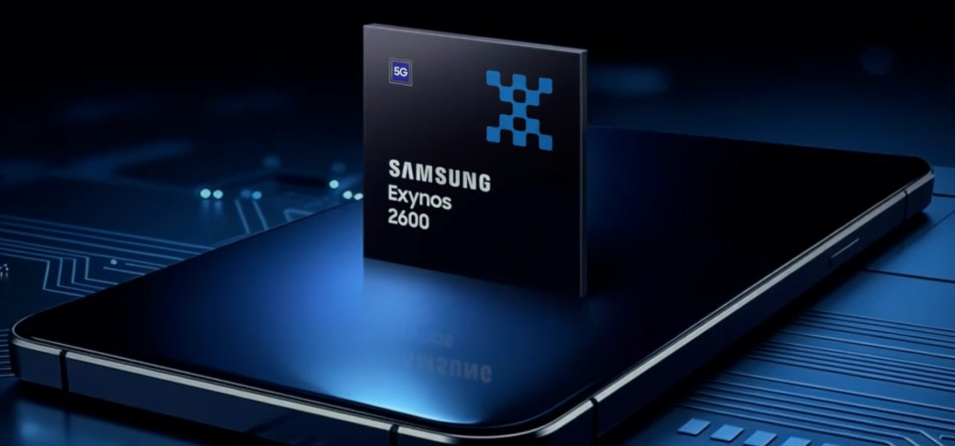
After teasers, Samsung has officially announced the Exynos 2600, its next-generation mobile System-on-Chip (SoC). Built on the industry’s first 2nm Gate-All-Around (GAA) process, the new chipset introduces significant architectural shifts, moving away from traditional core configurations to prioritize high-efficiency machine learning and sustained gaming performance.
Redesigned CPU Architecture and Performance

The Exynos 2600 features a 10-core CPU structure based on the latest Armv9.3 architecture. In a departure from the “tri-cluster” (big, middle, and little cores) design of its predecessor, the Exynos 2600 replaces “little” efficiency cores with “middle” cores to broaden the performance envelope.
The configuration includes:
- Arm C1-Ultra: A primary core designed to accelerate responsiveness and IPC performance.
- Nine Middle Cores: Split into three high-performance middle cores for multi-threaded applications and six high-efficiency middle cores for system management.
This shift, combined with support for Scalable Matrix Extension 2 (SME2), results in a reported 39% improvement in CPU computing performance and a reduction in response latency for on-device AI tasks.
Enhanced On-Device AI and Security
Artificial Intelligence is a focal point for the Exynos 2600. The integrated NPU promises a 113% increase in generative AI performance compared to the previous generation. This allows the chip to handle larger, more complex AI models locally, facilitating tasks such as real-time image editing and advanced AI assistant functions.
To support these on-device capabilities, Samsung has introduced upgraded security measures:
- Post-Quantum Cryptography (PQC): The Exynos 2600 is the first mobile SoC to feature hardware-backed hybrid PQC, providing ROM-rooted protection designed to secure data against future cryptographic threats.
- Virtualization Security: Enhanced hardware-level isolation for sensitive processes.
Xclipse 960 GPU and Gaming Features
For graphics, the SoC integrates the Exynos Xclipse 960 GPU. According to Samsung, the new architecture provides double the computing performance of the previous model and a 50% improvement in ray tracing.
The chip also introduces Exynos Neural Super Sampling (ENSS™). This AI-based technology handles resolution upscaling and frame generation, which Samsung claims can make gaming experiences feel up to three times smoother while operating within strict mobile power budgets.
Professional-Grade Imaging and Thermal Management
The ISP (Image Signal Processor) in the Exynos 2600 supports camera sensors up to 320MP and incorporates a new Visual Perception System (VPS). The VPS allows the ISP to recognize and process fine details within a frame in real time, reducing power consumption during photography by up to 50%. Other imaging features include:
- Deep Learning Video Noise Reduction (DVNR): Optimized for low-light video capture.
- APV Codec: Adopted to improve color precision and detail for professional-level video recording.
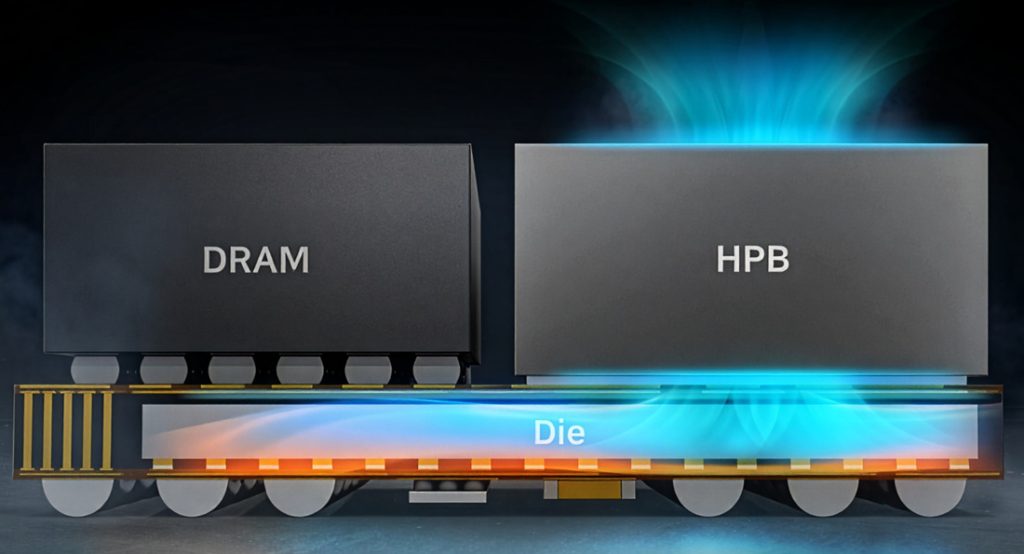
To maintain these performance levels, Samsung has implemented the Heat Path Block (HPB), a first for the mobile SoC industry.8 This technology, alongside High-k EMC materials, optimizes the heat-transfer path and reduces thermal resistance by 16%, allowing the internal temperature to remain stable during heavy workloads like high-end gaming.
Highlights of Samsung Exynos 2600 SoC
- Based on the 2-nanometer (nm) Samsung GAA process technology
- Deca-Core CPU with 1 x ARM Cortex-C1 Ultra CPU for ultimate processing power at 3.8 GHz, 3 x ARM C1-Pro CPUs at 3.25 GHz and 6 x ARM C1-Pro CPUs at 2.75 GHz for optimal performance
- Samsung Xclipse 960 GPU, AMD RDNA 3 architecture, hardware accelerated ray tracing (RT) and variable rate shading (VRS)
- UFS 4.1 storage, LPDDR5X Memory
- Integrated NPU AI engine with 32K MAC NPU + DSP
- Hardware-backed Post-Quantum Cryptography
- Up to 320MP in single camera mode, Single-camera 108MP @30fps, Dual-camera 64MP+32MP @30fps
- Up to 8K decoding: 60fps with 10-bit HEVC(H.265), VP9, AV1, Up to 8K encoding: 30fps with 10-bit HEVC(H.265), VP9
- Display Up to 4K/WQUXGA @120Hz, QHD+ @144Hz
- 5G NR Sub-6GHz 9.64 Gbps (DL) / 2.55 Gbps (UL), 5G NR mmWave 12.1 Gbps (DL) / 3.67 Gbps (UL), LTE Cat.24 8CA 3Gbps (DL) / Cat.22 4CA 422Mbps (UL)
- Wi-Fi 7, Bluetooth 6.0, GNSS
Availability
The Samsung Exynos 2600 SoC is expected to power the Galaxy S26 series that should launch in early 2026.