

vivo India released the seventh edition of its annual Switch Off Report, titled “The Impact of Excessive Smartphone Usage on Parent-Child Relationships.” The 2025 edition underlines the purpose of vivo’s Switch Off initiative — to understand how smartphone habits affect family interactions and encourage more in-person engagement. This report is part of a broader effort highlighting the importance of spending quality time with loved ones.
Study Overview
The vivo Switch Off Study 2025 combined Quantitative and Qualitative research:
- Quantitative Study: 1,517 smartphone owners (1,017 parents and 500 children) across eight cities: New Delhi, Mumbai, Kolkata, Chennai, Hyderabad, Bangalore, Ahmedabad, and Pune.
- Qualitative Study: 18 participants (12 parents, 6 children) in New Delhi and Mumbai.
Participants included parents aged 35–50 with children aged 10–16, and children aged 10–16. The study was conducted by CyberMedia Research (CMR), a market research firm in India.
Key Findings
1. Phone-Free Moments and Family Connection
- Dinner emerged as the most reliable daily connection moment.
- 72% of children spend the most time with their parents during dinner.
- 91% of children reported conversations are easier and more meaningful when phones are set aside.
- Families are adopting small shifts: reducing notifications, keeping phones away during shared time, and choosing offline activities.
2. Children and AI Use
- 54% of children (10–16 years) use AI tools daily for homework, personal development, and sometimes companionship.
- 33% of children occasionally rely on AI instead of real-life interactions, often because they perceive their parents as busy.
- AI adoption is driven by curiosity, creativity, and academic needs.
3. Smartphone Usage Patterns
- Average daily use: Parents 4.4 hours, Children 3.5 hours.
- Parents check phones frequently during shared moments: movies (70% vs. 31%), family events (64% vs. 59%), dinner (53% vs. 32%).
- Children mainly use phones for entertainment, self-expression, and personal downtime.
- Usage by demographics: Mothers 4.2 hrs/day, Fathers 4.4 hrs/day; Boys 4.0 hrs/day, Girls 3.0 hrs/day.
- Daily routines incorporate smartphone use: morning notifications, afternoon OTT, late-night scrolling.
4. AI and Digital Confidence
- AI usage varies by age and gender: 83% of boys (13–14) use AI tools vs. 38% of girls (10–12) using AI selectively.
- High reliance on AI can reduce curiosity-driven parent-child conversations, highlighting the need for guided digital interactions.
5. Emotional Dynamics of Attention
- Meaningful interaction requires uninterrupted attention and steady eye contact.
- 87% of children feel more comfortable speaking during no-phone dinners.
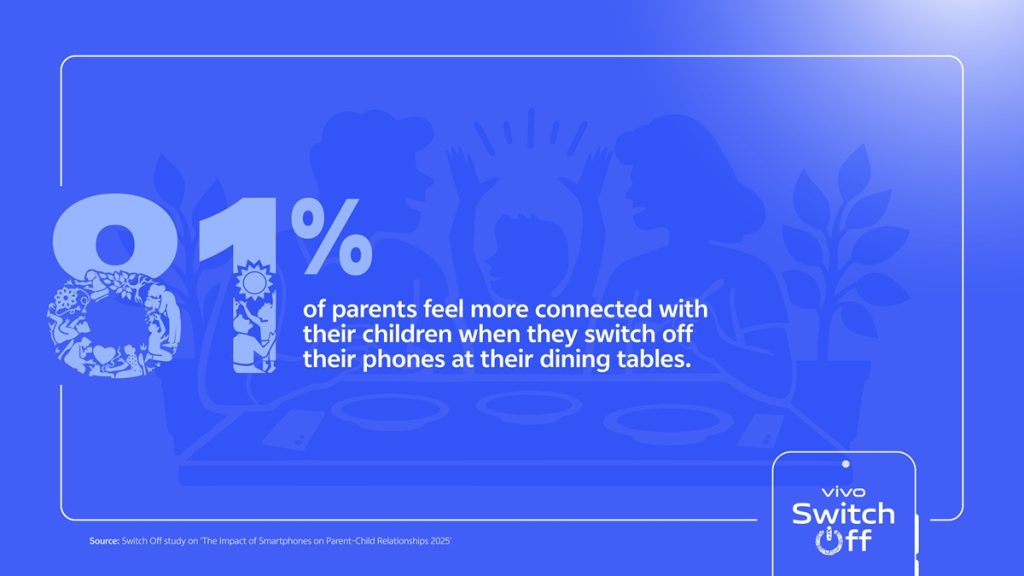
- 81% of parents observe stronger bonding when devices are set aside.
- Parental micro-checking interrupts conversations and reduces warmth, creating emotional distance.
6. Measures to Reconnect
- Limiting screen time: 54% parents, 49% children
- Blocking social media during certain hours: 51% parents, 41% children
- Turning off non-essential notifications: 49% parents, 50% children
- Switching to basic phones/digital detox: 47% parents, 30% children
Impact:
- Felt more in control: 59% parents, 47% children
- Inspired to maintain healthier habits: 51% parents, 57% children
- Wished they had started earlier: 40% parents, 43% children
- Gained confidence in managing phone use: 40% parents, 33% children
Children adjust their usage more when those around them stay offline, showing modeling is more effective than rules.
7. Family Aspirations
- Both parents and children seek fewer interruptions and deeper presence in daily conversations.
- Families aim for predictable phone-free zones, especially around meals and shared routines.
- There is a shared goal of healthier digital boundaries to strengthen emotional connection.
Outlook
The vivo Switch Off Report 2025 indicates that deliberate phone-free moments can significantly improve family interactions. Families are increasingly adopting structured routines to manage smartphone usage and foster meaningful connections.
Continued attention to digital boundaries, guided AI use, and small behavioral adjustments can help parents and children strengthen bonds while balancing online and offline interactions. The report suggests a growing awareness among Indian families of the value of presence, focus, and quality time together.
Underlining the focus behind the Switch Off campaign, Geetaj Channana, Head of Corporate Strategy, vivo India, said,
At vivo, we believe technology should enhance real relationships, not distance people from them. While smartphones bring learning, convenience and connection, using them mindfully is essential for nurturing healthier family interactions. The findings of this year’s Switch Off Study remind us that families are actively seeking balance, choosing to disconnect during key moments and rebuild presence in their everyday lives.