
Nxt Quantum has detailed its data architecture and privacy measures, highlighting an operational focus on domestic data residency, granular user controls, and pre-launch external auditing for its operating environment.
Sovereign Data Routing and Perimeter Monitoring
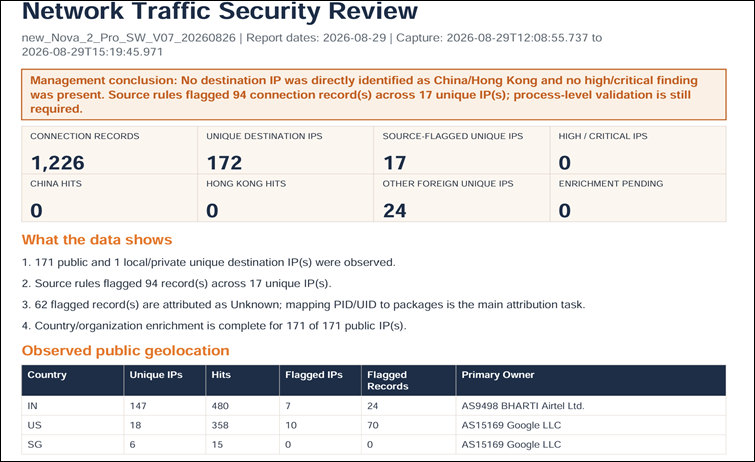
Under its sovereign data framework, Nxt Quantum routes application data traffic exclusively through domestic infrastructure hosted in India. The platform relies on an automated network monitoring system that scans source rules across more than 1,000 active connections and 172 unique destination IP addresses to maintain perimeter integrity.
Routine application traffic and system IP pings remain strictly within India. Outbound international transmission is restricted to core Google services hosted in California and Singapore, which provide baseline operating system functionality and essential service dependencies.
According to the company, this structure is designed to align network operations with local data sovereignty standards while maintaining compatibility with standard mobile operating requirements.
NxtPrivacy Dashboard in OS Version 1.1
Alongside network-level restrictions, the release of NxtQuantum OS v1.1 introduces an updated privacy interface dubbed the NxtPrivacy Dashboard. The update centralizes permissions management, allowing users to view, adjust, or revoke hardware and data access across all installed applications from a single hub.
Key capabilities introduced in version 1.1 include:
- Background Monitoring: Real-time visibility into which applications access sensitive resources—such as location, microphone, or camera—while running in the background.
- Permission Alerts: Automated notifications flagging dormant, excessive, or unused permissions, prompting users to re-evaluate app access levels.
- Unified Controls: Consolidated controls aimed at reducing the administrative overhead of managing permissions across disparate system menus.
Independent Verification via Project Open Review 2.0
To assess software security and system behavior prior to commercial deployment, parent entity Ai+ is utilizing Project Open Review 2.0. The initiative grants pre-launch access to independent third parties, including technical journalists, ethical hackers, creators, and security analysts.
Participants are invited to test Ai+ devices, examine system traffic, and report software vulnerabilities or discrepancies directly to the engineering team ahead of general release.
Commenting on the update, Madhav Sheth, CEO, NxtQuantum Shift Technologies (Ai+ Smartphone), said:
The future of technology isn’t defined by what it can do. It’s defined by how much people can trust it and the aspirations it enables. That belief is central to how we are building NxtQuantum OS.