Xiaomi has officially scheduled its autumn flagship product launch event in China on September 7. The presentation will feature an extensive lineup, including Xiaomi SkyNomad range-extended electric (EREV) family SUVs, which include the N70 Pro, N70 Max, and N90 Max — alongside the company’s latest foldable device, the Xiaomi 18 Fold, and the Xiaomi Mi Pad 9 Pro Max tablet.
Xiaomi 18 Fold Introduces “Mid-Fold” Architecture
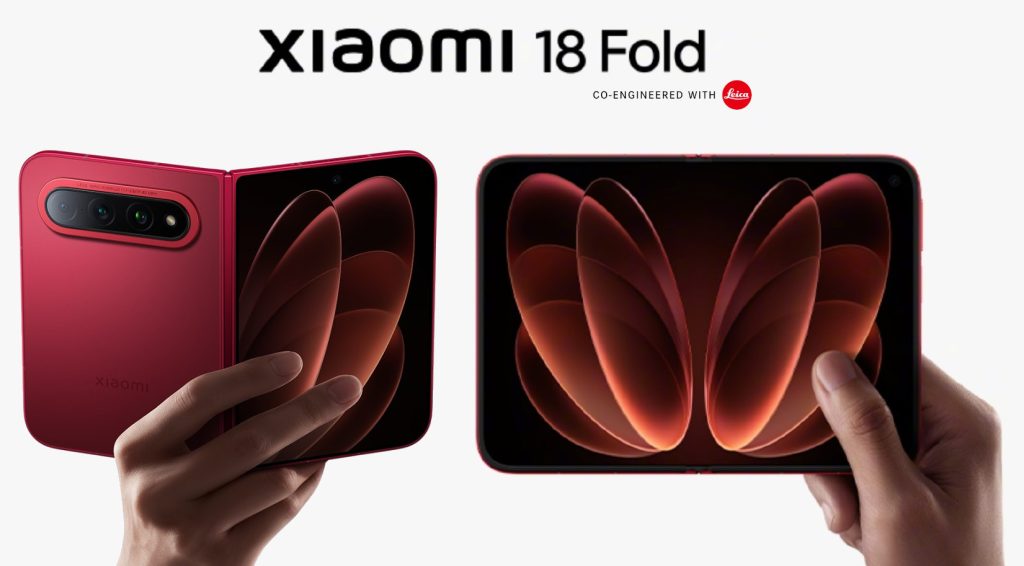
The focal point of the hardware preview is the Xiaomi 18 Fold, which introduces what the manufacturer classifies as a “mid-folding” form factor. Positioned at the top of Xiaomi’s portfolio, the device was co-engineered with Leica and features an ultra-narrow bezel design with large super-elliptical corner radii, a flat wraparound chassis, and a horizontal, racetrack-style camera housing holding three lenses and an LED flash.
Display and Structural Engineering

- Displays: A 5.38-inch cover screen pairs with a 7.58-inch foldable main internal display.
- Hinge Mechanism: A next-generation Xiaomi “dragon bone” hinge featuring a water-drop profile, three-level linkage system, and edge-to-edge protective framing.
- Glass Composition: The internal panel employs dual-layer Ultra-Thin Glass (UTG) to reinforce puncture resistance. Exterior faces utilize Xiaomi Dragon Crystal Glass 3.0.
- Frame Material: Machined from aerospace-grade 7-series aluminum alloy.
Xiaomi founder and CEO Lei Jun stated that the structural updates yield a 1.2-meter drop resistance rating, positioning the device’s physical resilience alongside standard candybar smartphones. Relative to the previous Xiaomi MIX Fold 4, Xiaomi reports a 258% increase in resistance against sharp-object impacts and a 214% improvement in drop resistance against steel ball impacts.
Lu Weibing, Partner and President of Xiaomi Group, noted that the device is intended to shift foldables from niche early-adopter hardware into primary flagship devices capable of rivaling standard form factors across daily performance metrics.
Debut of the XRING O3 Flagship SoC
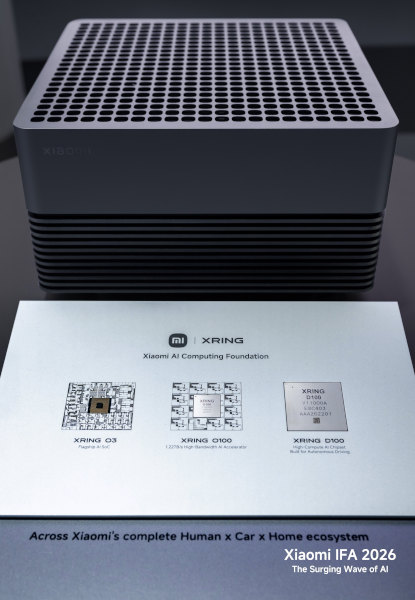
Both the Xiaomi 18 Fold and the upcoming Xiaomi Mi Pad 9 Pro Max will debut the in-house XRING O3, a flagship processor engineered for high-throughput AI workloads and intensive graphics processing.
| Component | Technical Specifications | Claimed Generational Delta |
|---|---|---|
| CPU Architecture | Deca-core all-big-core layout; dual SME2 acceleration units | Multi-core score exceeds 15,000 (+60% vs. predecessor) |
| GPU | G2-Ultra NX architecture; 8 integrated NX neural accelerators | +85% graphics rendering, -64% power consumption |
| NPU | Redesigned for Xiaomi MiMo edge models; 200 TOPS tensor / 3.13 TFLOPS vector | +45% edge AI processing performance |
| Memory Interface | Industry-first LPDDR6 mobile memory standard support | 113.8 GB/s bandwidth (+48% vs. Xuanjie O1) |
| Benchmark Metric | AnTuTu benchmark score surpassing 5.22 million | First mobile SoC to cross the 5-million threshold |
Beyond core computation, the XRING O3 incorporates dedicated silicon for peripheral processing, including an AI Night Reduction (AINR) engine within the Image Signal Processor (ISP), dedicated AI super-resolution hardware in the Display Processing Unit (DPU), and an integrated AI engine embedded in the Audio Digital Signal Processor (ADSP).
Battery Architecture
Power is supplied by a 6,000 mAh Jinshajiang battery utilizing high-density stacking technology. With a 20% silicon content formulation, it achieves an energy density of 920 Wh/L. Charging specifications include 67W wired fast charging and 50W wireless charging.
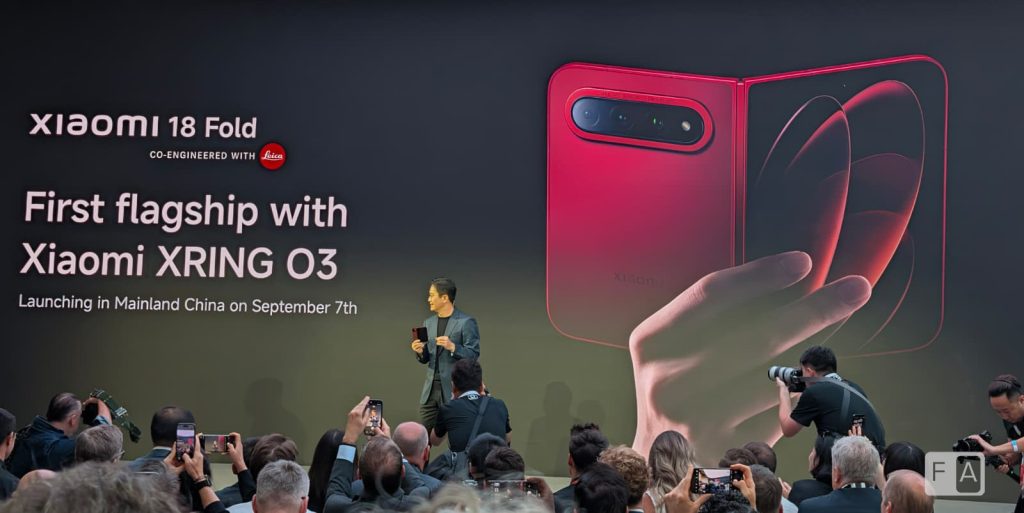
Xiaomi will showcase the foldable at the IFA 2026 later today. Full pricing, regional availability, and complementary accessory ecosystems will be disclosed during the September 7 event.