
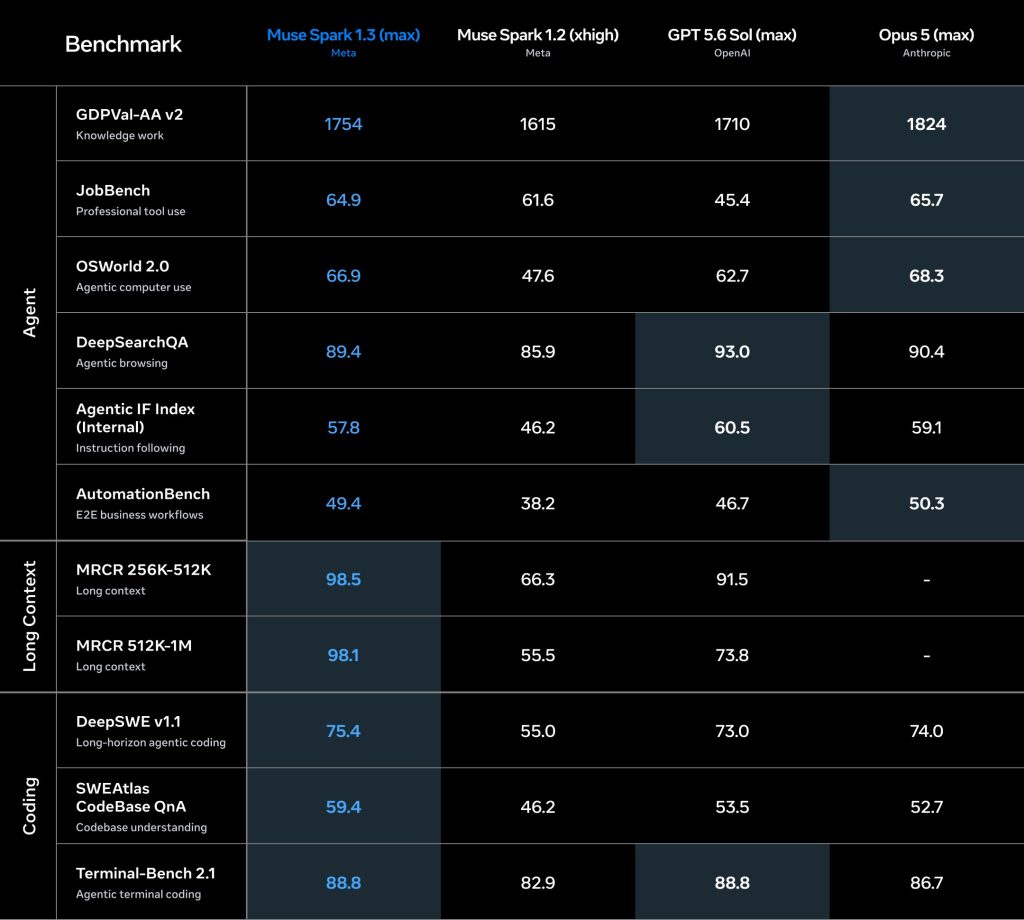
Meta has introduced Muse Spark 1.3, with improved performance across agentic and coding tasks. Meta said the model builds on learnings from months of broad adoption of Muse Code and the Meta Model API, with changes intended to make it easier to use in real-world settings.
Agentic workflows
Muse Spark 1.3 is designed to better sustain longer-horizon work by collaborating with users and handling multiple workflows within a single, long thread. For open-ended objectives, it can use tools to build its own context from messy and conflicting sources, identify and correct gaps in its plan, and retain what it has learned to produce a final deliverable.
Meta trained the model across a diverse set of harnesses to generalize across different agentic environments. Its collaboration capabilities include:
- Asking clarifying questions when prompts are ambiguous
- Requesting help from the user when it gets stuck
- Seeking confirmation before taking consequential actions
- Providing frequent updates or working silently in the background based on user preferences
Muse Spark 1.3 also follows complex, long-form instructions more reliably than earlier Muse Spark models. Across multi-step tasks, it can preserve detailed requirements without dropping constraints or drifting from the requested workflow.
The model has improved multitasking capabilities and can more accurately map incoming prompts to the appropriate task within messy, single-threaded contexts, including when users return to previous requests or interrupt ongoing tasks.
Muse Spark 1.3 has also been trained to better understand its capabilities and limitations. This includes recognizing:
- What it can and cannot do
- What it knows and does not know
- When it encounters hurdles, rather than generating unsupported outcomes
Coding
Muse Spark 1.3 was trained on more long-horizon coding tasks for common engineering workflows. Compared with Muse Spark 1.2, it takes fewer turns where they are not needed, is less verbose and has a cleaner coding style.
In comparisons conducted by Meta engineers, Muse Spark 1.3 was significantly faster and more efficient than Muse Spark 1.2, using around 20% fewer tool calls and around 25% fewer tokens.
Safety
Meta has made safety improvements in areas related to the model’s agentic and coding capabilities. Muse Spark 1.3 has stronger adversarial robustness, including improved resistance to:
- Adversarial inputs
- Prompt injections
On complex agentic tasks, the model also has better calibration for identifying what constitutes an irreversible action and responding accordingly.
Availability
Muse Spark 1.3 is available today in Muse Code and the Meta Model API. Previously available reasoning modes are also available now, while max reasoning will be introduced after additional safety testing.
Muse Code can be installed on macOS or Linux using:
curl -fsSL https://dev.meta.ai/install.sh | bashMeta said its roadmap includes bigger models and an open-weights release of Muse Spark.