
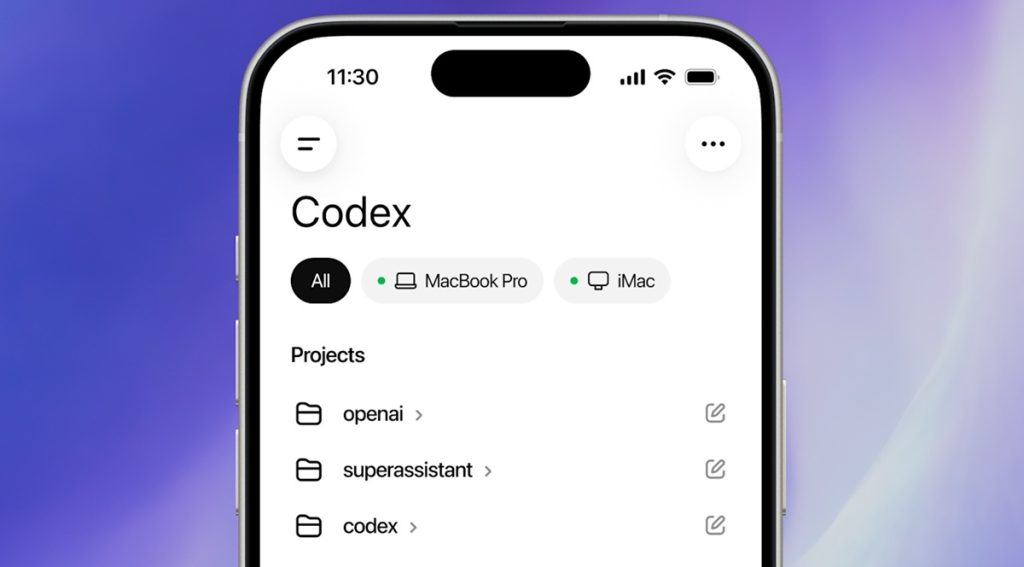
OpenAI has announced that Codex is now available in preview inside the ChatGPT mobile app for iOS and Android devices. The update allows users to monitor, manage, and continue AI-powered coding tasks directly from their phones while Codex runs on connected laptops, devboxes, dedicated Mac minis, or managed remote environments.
The company says the mobile experience is designed to support longer-running AI-assisted development workflows. Users can review outputs, approve commands, switch models, answer questions from Codex, change directions, and start new tasks without staying at their desktop systems.
OpenAI also revealed that more than 4 million people now use Codex every week, highlighting growing adoption of AI-powered coding workflows.
Codex mobile app experience
Codex inside the ChatGPT mobile app provides a mobile interface that synchronizes with active development environments in real time. When connected to a machine running Codex, the app loads the live state from that environment, including:
- Active threads and project context
- Approvals and plugins
- Screenshots and terminal output
- Diffs and test results
- Live task updates across connected devices
OpenAI says the system is designed to do more than remotely control a single task or send new work to a computer. From the mobile app, users can work across multiple threads, review outputs, approve commands, change models, and begin new tasks while files, credentials, permissions, and local configurations remain stored on the connected machine.
The company also says Codex uses a secure relay layer that keeps trusted machines reachable across devices without exposing them directly to the public internet. The same infrastructure synchronizes active session state and context across signed-in ChatGPT devices.
Designed for long-running AI workflows
OpenAI highlighted several usage scenarios for the mobile Codex experience, including:
- Debugging and fixing software issues remotely
- Reviewing refactor decisions during commutes
- Preparing customer support summaries
- Sending new development ideas directly to Codex
Because Codex runs directly from connected development environments, it can inspect files, reproduce issues in browsers, run tests, and continue working even when users are away from their computers. If clarification or permissions are required, users can respond or approve actions directly from the mobile app.
Remote SSH and enterprise updates
OpenAI also announced that Remote SSH support is now generally available. The feature allows Codex to connect directly to managed remote environments commonly used by enterprise and development teams.
The desktop app can automatically detect hosts from existing SSH configurations, enabling users to create projects and run threads inside remote machines similarly to local environments. Once connected, those environments can be accessed across authorized ChatGPT devices through the same relay infrastructure.
The company also introduced additional enterprise-focused updates, including:
- Programmatic access tokens for CI pipelines, release workflows, and internal automation systems
- Hooks support for secret scanning, validators, logging, memories, and repository-specific customization
- HIPAA-compliant Codex usage in local environments for eligible ChatGPT Enterprise workspaces
OpenAI says HIPAA-compliant support enables healthcare organizations to use Codex for patient care and operational workflows while meeting compliance requirements.
Availability
Codex in the ChatGPT mobile app is rolling out in preview for iOS and Android users across all ChatGPT plans, including Free and Go, in supported regions.
- Users can access the feature by updating the ChatGPT mobile app and the Codex app on macOS.
- Support for connecting the mobile app to the Codex app on Windows is coming soon.
Remote SSH and Hooks are available across all plans. Programmatic access tokens are available for Enterprise and Business plans, while HIPAA-compliant Codex usage is limited to eligible ChatGPT Enterprise workspaces using local environments.