

Swiggy has announced the upcoming launch of Swiggy Builders Club, a community, partnership, and builder enablement program for developers, startups, and enterprises building AI-native commerce experiences on its platforms.
The initiative builds on Swiggy’s earlier MCP rollout, which opened up core commerce infrastructure. Builders Club acts as a next-step ecosystem layer on top of that infrastructure, defining how external builders participate, what capabilities they access, and how integrations are evaluated and scaled into deeper partnerships.
What is Swiggy Builders Club?
Swiggy Builders Club is an ecosystem program that brings external developers into Swiggy’s AI stack as contributors, partners, and early participants, not just API consumers. It is structured around community engagement, partnerships, skills-based development, and an invite-led access model for developers, founders, and enterprise teams building in an AI-first environment.
The objective is to enable AI-native commerce applications where agents can perform real-world actions such as ordering food, shopping groceries, and booking dining experiences.
Access, APIs, and infrastructure
At launch, Builders Club will provide access to 3 MCP servers and 18+ API tools across:
- Food
- Instamart
- Dineout
These APIs enable the development of AI agents, copilots, assistants, and integrations capable of executing real-world actions such as ordering, shopping, and reservations.
The platform runs on AWS’s enterprise AI stack:
- Amazon Bedrock: Unified access to foundation models from Anthropic, Meta, Mistral AI, and others
- AWS Trainium: AI chips designed to deliver up to 50% lower training costs and 30–40% better inference performance
- Amazon Bedrock AgentCore: Framework-agnostic agentic AI layer supporting multiple models and frameworks
Skills and ecosystem structure
A key component of Builders Club is Skills, which are reusable capabilities that help AI agents perform real-world tasks more effectively. These include order placement, grocery workflows, dining bookings, and multi-step operations across Swiggy services.
The ecosystem combines:
- MCP integrations
- Real-world Skills
- Upcoming Builders Platform
Together, this structure supports Swiggy’s shift toward agentic commerce, where AI systems can move beyond recommendations and directly complete transactions.
Who can apply and benefits
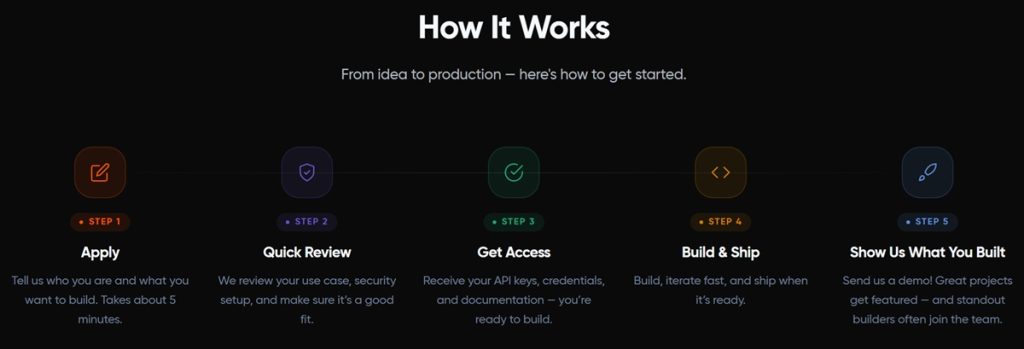
Builders Club is open to developers, startups, and enterprise teams. The process involves application, review, approval, and demo development. It follows an invite-led model to maintain ecosystem quality and structured onboarding.
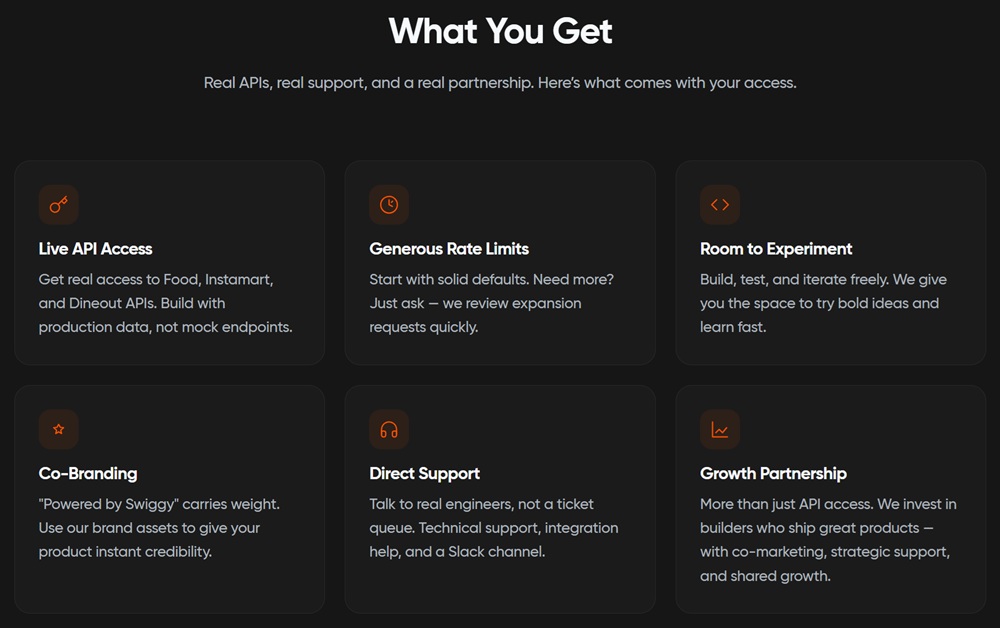
Benefits include:
- Live API access with generous rate limits
- Engineering and builder support
- Co-branding opportunities for selected projects
- Growth partnership support for successful use cases
- Participation in Swiggy’s evolving AI commerce ecosystem
Availability
Applications for Swiggy Builders Club are currently open.
- Developers and teams can apply via: mcp.swiggy.com/builders
Access will be granted in phases after review through an invite-led onboarding process.
Speaking on the launch, Madhusudhan Rao, CTO, Swiggy, said,
The past few months have marked a fundamental shift in Swiggy’s trajectory. With MCP, we opened our commerce infrastructure to AI systems. Builders Club is the next bold step—extending that access to developers and enterprises so they can build AI commerce applications at scale on top of Swiggy. We are moving from platform to ecosystem orchestrator, providing the foundational layer for AI-native commerce innovation. Built on AWS, with Amazon Bedrock and AgentCore, this gives our builder community enterprise-grade infrastructure from day one.
Commenting on the initiative, Sandeep Dutta, President, AWS India and South Asia, said,
Swiggy Builders Club represents the next evolution of AI-powered commerce, and we’re proud that AWS AI services are enabling this developer community. By combining Amazon Bedrock, AWS Trainium, and Amazon Bedrock AgentCore, we’re giving builders the infrastructure to innovate without limits—whether they’re startups experimenting with new ideas or enterprises scaling production AI agents. This partnership demonstrates how open, flexible AI infrastructure can accelerate innovation across India’s digital economy.