
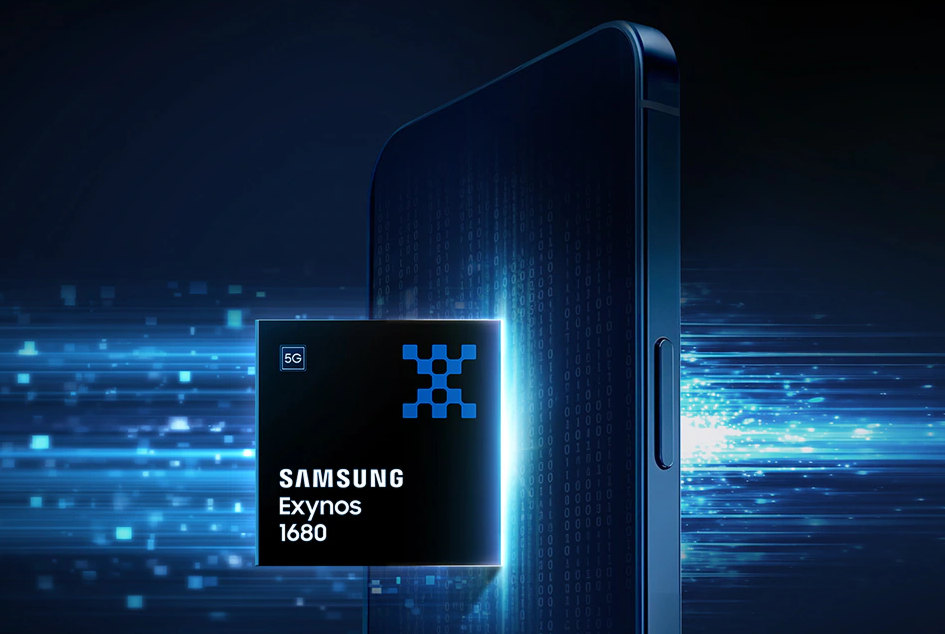
Samsung has introduced its latest mobile platform, the Exynos 1680, as the successor to last year’s Exynos 1580. Designed primarily to facilitate a more fluid on-device artificial intelligence (AI) experience, the new chipset introduces structural upgrades across its Central Processing Unit (CPU), Graphics Processing Unit (GPU), and Neural Processing Unit (NPU) to balance computational speed with overall power efficiency.
CPU
The Exynos 1680 utilizes a revised tri-cluster CPU configuration designed to handle demanding workloads and multitasking.
- Core Configuration: The architecture features an octa-core setup consisting of one primary “big” core, four “mid” cores, and three “little” efficiency cores (1+4+3).
- Generational Change: Compared to its predecessor, Samsung has swapped one efficiency core for an additional mid-core. This adjustment aims to increase overall computing power while maintaining energy efficiency during continuous use.
Graphics and Gaming Performance
For visual processing and mobile gaming, the chipset relies on hardware developed in collaboration with AMD.
- GPU Specifications: The Exynos 1680 integrates the Xclipse 550 GPU, which is built on the AMD RDNA™ 3 architecture. It features a 2WGP (Workgroup Processor) and 2RB (Render Backend) configuration.
- Performance Metrics: The revised architecture delivers a reported 16% performance boost over the previous generation, intended to support high-fidelity graphics and console-like gameplay on mobile devices.
On-Device AI Capabilities
To support complex, localized AI functions without relying heavily on cloud processing, the chipset features dedicated hardware for machine learning tasks.
- NPU Processing: The Neural Processing Unit (NPU) is capable of executing 19.6 trillion operations per second (TOPS).
- Hardware Enhancements: It utilizes a dedicated vector engine to optimize computations, allowing for highly responsive and versatile AI features directly on the smartphone.
Imaging and Camera Support
The Image Signal Processor (ISP) on the Exynos 1680 is equipped to handle advanced mobile photography and videography.
- High Resolution: The platform supports ultra-high-resolution image sensors of up to 200 megapixels.
- AI-Assisted Processing: It leverages AI-powered image processing to improve contrast, capture finer details, and apply advanced noise reduction—resulting in clearer, more accurate photos and videos, especially in low-light environments.
Manufacturing and Connectivity
- 4nm Process Node: The processor is built on an advanced 4-nanometer (4nm) manufacturing process. This allows the chip to maintain a compact footprint while significantly boosting energy efficiency.
- Wireless Standards: It supports Wi-Fi 6E, ensuring faster data transfers, lower latency, and reduced network dependency for a smoother overall user experience.
| Processor | Exynos 1580 (New) | Exynos 1580 |
| Process | 4nm (EUV) | |
| CPU | 1x Cortex-A720 @ 2.90GHz, 4x Cortex-A720 @ 2.60GHz, 3x Cortex-A520 @ 1.95GHz | 1x Cortex-A720 @ 2.90GHz, 3x Cortex-A720 @ 2.60GHz, 4x Cortex-A520 @ 1.95GHz |
| Memory | LPDDR5X, UFS v4.1 | LPDDR5, UFS v3.1 |
| Camera | Up to 200MP in single camera mode, Single-camera 64MP @30fps, Dual-camera 32+32MP@30fps, up to 4K 60fps video recording | |
| Display | FHD+ @ 144Hz | |
| Graphics & AI | Samsung Xclipse 550 GPU; AI AI engine with 8K MAC NPU | Samsung Xclipse 540 GPU; AI AI engine with 6K MAC NPU |
| Modem | 5G NR Sub-6GHz 5.1 Gbps (DL), 1.28 Gbps (UL) / 5G NR mmWave 4.84 Gbps (DL), 0.92 Gbps (UL) / LTE Cat.18 6CC 1.2 Gbps (DL), Cat.18 2CC 211 Mbps (UL) | |
| Connectivity | Wi-Fi 6E, Bluetooth 6.1 | Wi-Fi 6E, Bluetooth 5.4 |
| GNSS | GPS, GLONASS, BeiDou, Galileo | |
Availability
The Samsung Exynos 1680 chip is expected to power the upcoming Galaxy A57 5G smartphone. We can expect more Samsung phones and possibly some tablets with the chip.