
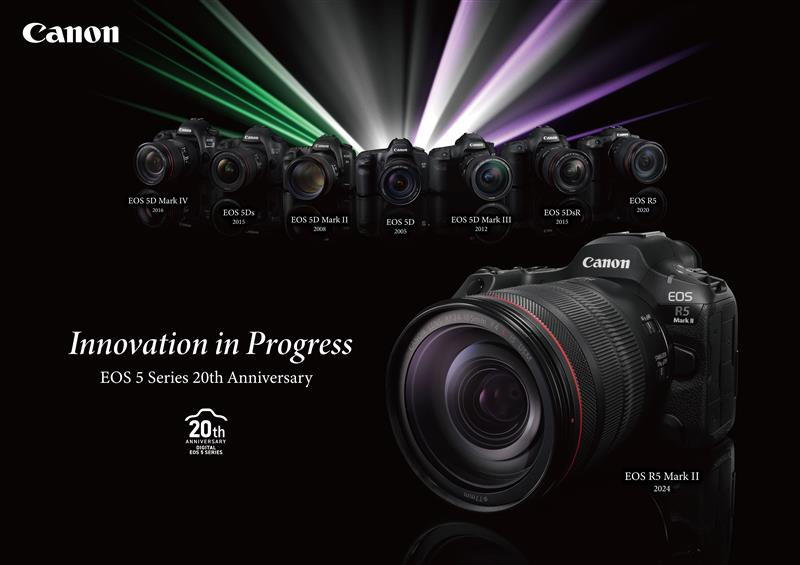
Canon has announced that this year marks the 20th anniversary of its EOS 5 interchangeable-lens digital camera series. Over two decades, this series has aimed to provide new value to both professional and advanced amateur photographers and videographers through technological advancements and innovative features.
The 20-Year History of the EOS 5 Series
The EOS 5 series began in September 2005 with the launch of its first model, the EOS 5D DSLR camera. This camera was notable as the first in Canon’s line for advanced amateur users to incorporate a full-frame CMOS sensor, a feature previously exclusive to professional models. The EOS 5D’s introduction, with its high resolution, extensive color gradation, and broad ISO sensitivity, contributed to the broader adoption of full-frame cameras. As of June 2025, Canon has released a total of eight models within the EOS 5 series.
Evolution and Key Innovations
In November 2008, Canon released the second-generation EOS 5D Mark II. This model was the first in the series to include full-HD video shooting capabilities, which played a role in popularizing video production using DSLR cameras.
Subsequent models in the series have focused on enhancing performance and expressive capabilities. The EOS 5D Mark III, released in March 2012, featured improvements in AF accuracy and continuous shooting speed. In June 2015, the EOS 5Ds and EOS 5Ds R were introduced, distinguished by their approximately 50.6-megapixel sensors, which at the time of their release, represented a significant advancement in pixel count. The EOS 5D Mark IV, released in September 2016, sought to balance features such as a large pixel count, high-speed continuous shooting, and high capturing sensitivity.
Transition to Mirrorless and Future Developments
July 2020 saw the release of the EOS R5, the first full-frame mirrorless camera in the EOS R System to carry the “5” designation. This model, equipped with a high-performance image processor, featured 8K video shooting functionality—a world-first among interchangeable lens cameras at its release—and brought significant enhancements to both still image and video capture.
Its successor, the EOS R5 Mark II, launched in August 2024, further improved still image and video functions. It incorporates a new “Accelerated Capture” image processing system and utilizes deep learning technology. This model aims to address the needs of both professional and advanced amateur users by combining subject tracking with enhanced mobility, facilitating diverse visual expressions.
| Product name | Release date |
| EOS 5D | September 2005 |
| EOS 5D Mark II | November 2008 |
| EOS 5D Mark III | March 2012 |
| EOS 5Ds | June 2015 |
| EOS 5Ds R | June 2015 |
| EOS 5D Mark IV | September 2016 |
| EOS R5 | July 2020 |
| EOS R5 Mark II | August 2024 |
Series Impact and Outlook
The EOS 5 series has consistently been at the forefront of the EOS lineup, introducing advanced technology and fostering innovation in digital imaging.
Canon states its commitment to further developing photography and video culture by continuing to pursue advanced technology and high levels of expressive power through the EOS 5 Series, which has garnered support from a wide range of users.