
‘Made in India’ manufactured smartphones grew 8% YoY in 2025, driven by a 28% surge in exports, which contributed to nearly one-third of India’s manufactured units, according to a recent study by Counterpoint Research. India-based Electronics Manufacturing Services (EMS) company Dixon is leading the chart with a 19% share and 89% YoY growth, owing to increased orders from Motorola, realme, and Xiaomi.
Indian Smartphone Shipment Share by EMS 2025
Another Indian EMS, Bhagwati Products Limited (BPL), made it into top 5 with a 9% smartphone shipment share, thanks to orders from vivo, OPPO and realme. Following Dixon is Samsung, which showcased its strength in in-house production, leading to an 18% share and 4% YoY growth.
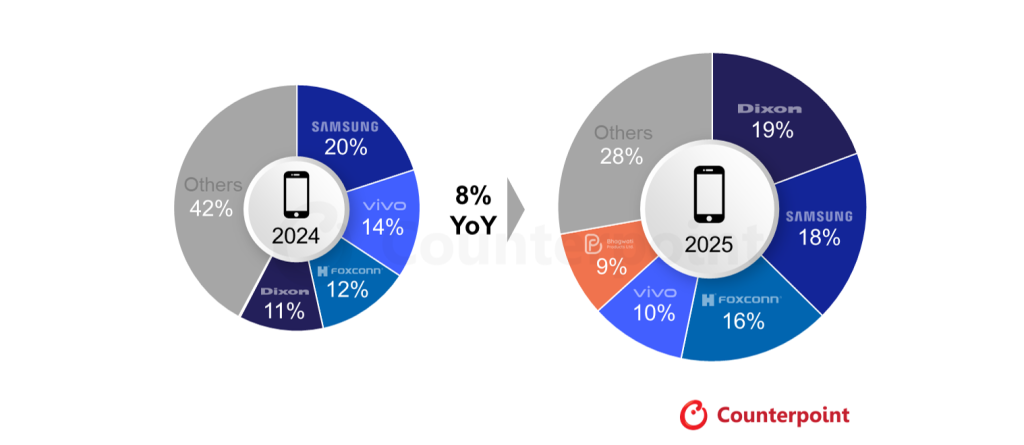
Foxconn, Apple’s major manufacturer, grew 40% YoY, with a 16% shipment share, largely driven by a 48% YoY increase in exports. vivo comes in 4th spot with a 10% share and also started to outsource production from BPL, in addition to its strong in-house manufacturing.
The report notes that the Indian government’s special focus on sectors’ growing momentum was key to success, citing SEZ reforms, the Union Budget, and the most recent FDI relaxations in the industry.
While smartphone manufacturing in India saw positive momentum last year, we can’t deny the fact that there are increasing challenges going forward, like the ongoing memory crisis and the US-Iran war. Analysts suggest that diversification beyond smartphones into tablets and laptops will be key to tackling these headwinds.
The growth of India’s component ecosystem, supported by government initiatives such as the Electronics Component Manufacturing Scheme (ECMS), will be crucial in increasing domestic value addition, says Senior Research Analyst Prachir Singh. This, along with the exploration of a second phase of the smartphone PLI scheme from the government end, would act as a catalyst for the diversification of the portfolio for the EMS companies.
Commenting on the manufacturing landscape, Senior Research Analyst Prachir Singh said,
Domestic EMS players continue to expand even as the first phase of the PLI scheme nears completion. This has been possible due to exports and sustained premiumization in the domestic market. Players beyond the top five are expected to play a more significant role in 2026 as OEMs diversify their partnerships. Rising memory prices will be a key challenge, especially as the smartphone market is projected to decline this year, impacting toplines.
Commenting on the growth in exports, Research Director Tarun Pathak said,
Exports are becoming increasingly central not only for India-based smartphone EMS players but also for the country’s broader export strategy. Electronics grew to become the third largest export category in FY25 (financial year ended March 31), driven largely by smartphones, and is on track to become the second largest category in FY26.