
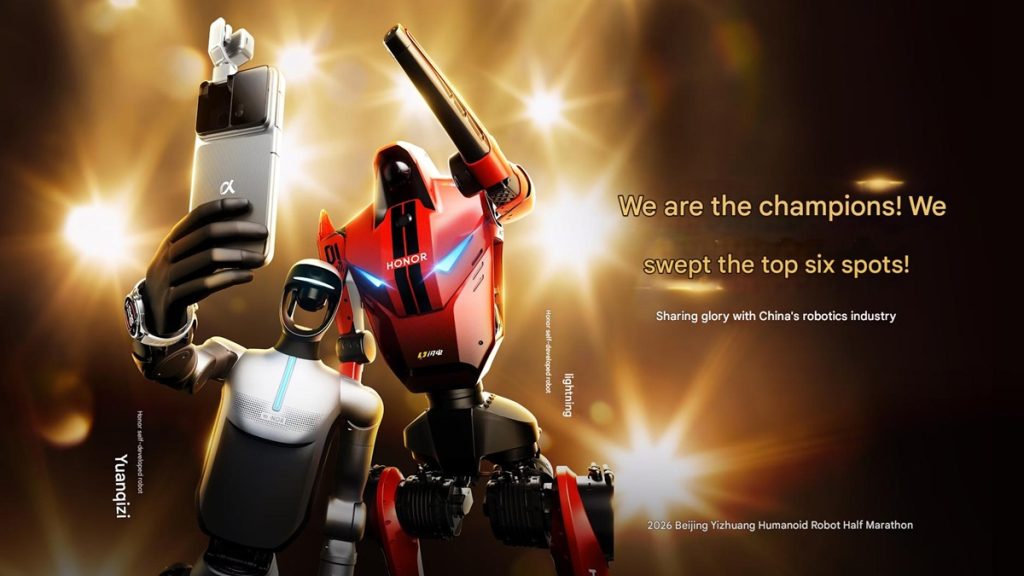
HONOR has achieved a major result in humanoid robotics after its self-developed robot secured top positions at the 2026 Beijing Yizhuang Humanoid Robot Half Marathon. The robot completed the 21 km course in a time faster than elite human benchmarks, highlighting rapid progress in China’s robotics sector.
Race performance and overall dominance
At the 2026 edition of the Beijing Yizhuang Humanoid Robot Half Marathon, HONOR robots delivered a dominant performance, taking the top six positions and leading the overall standings.
The winning autonomous robot completed the 21 km race in 50 minutes and 26 seconds, faster than the human half-marathon benchmark of around 57 minutes set by Uganda’s Jacob Kiplimo.
Other HONOR entries also delivered strong results:
- Autonomous runners-up finished in approximately 51 minutes and 53 seconds
- A separate remote-controlled HONOR robot finished in 48 minutes and 19 seconds, but the autonomous entry was awarded the championship under scoring rules
This marks a major improvement from last year’s winning time of 2 hours, 40 minutes and 42 seconds.
Awards and recognitions
HONOR’s robots also received individual awards during the event:
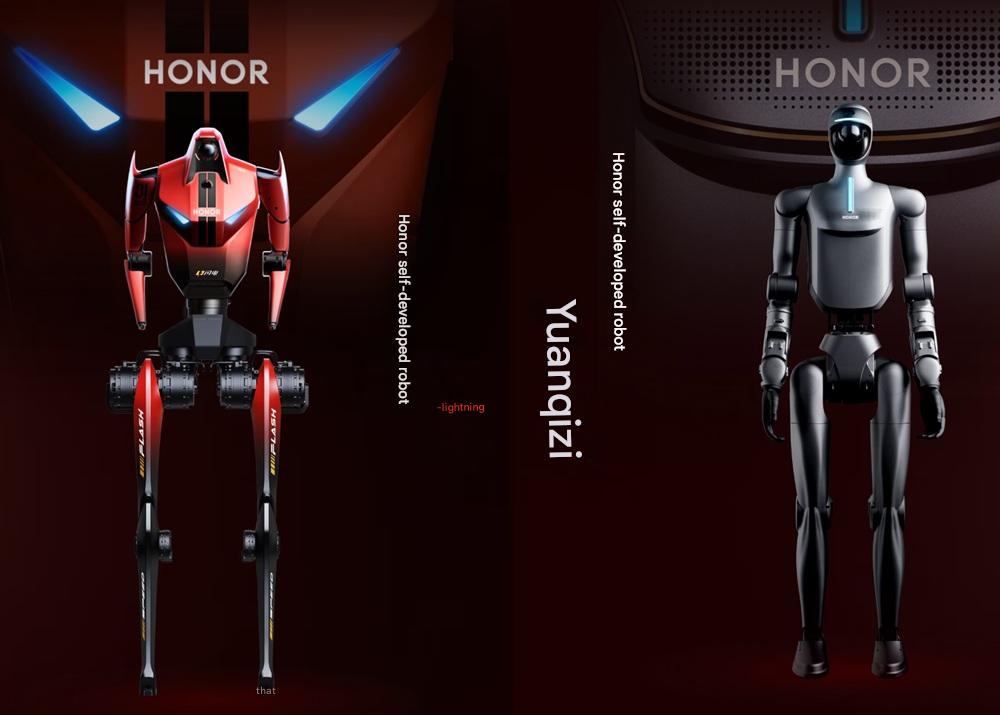
- Shandian – Best Design Award
- Yuanqi Zai – Best Gait Award
These recognitions added to HONOR’s overall dominance across rankings.
Design, motion system and performance capabilities
HONOR humanoid robots are designed around high-performance mobility, stability, and endurance.
Key technical features include:
- Autonomous perception and navigation system
- Self-developed high-dynamic motion system
- High-speed running capability with strong terrain adaptability
- Stable, responsive full-body motion control
- Mecha-style structural design balancing aerodynamics and form
- Long-endurance power system with robust output
- Full-body safety and structural reliability design
The robots are built for sports-focused mobility scenarios and sustained physical activity.
Intelligence, interaction systems and race observations
The robots integrate AI-driven interaction and environmental awareness features:
- Real-time interaction elements such as light strips and signature actions
- Voice-based intelligent dialogue system
- Autonomous environmental perception and navigation with multimodal situational understanding
- Human-robot interaction capabilities, including dance performance functions
During the race, engineers noted that the robot design was inspired by elite athletes, featuring 95 cm leg length and an in-house liquid-cooling system developed for thermal stability.
As reported by ABC News, engineers said the system focuses on structural reliability and cooling efficiency, with potential future applications in industrial environments.
Race incidents and operational insights
The event also highlighted current robotics limitations:
- Some robots fell at the starting line
- Some collided with barriers during the race
- Around 40% of robots ran autonomously, while others were remotely controlled
- A robot also acted as a traffic officer, guiding participants using arm gestures and voice instructions
Despite these issues, observers noted clear performance improvements compared to previous editions, with sentiment reflecting that robot speed now “far exceeds that of humans” and signals the arrival of a “new era”.
Industry context and development outlook
China continues to prioritize robotics and AI development under national technology planning, focusing on embodied intelligence and advanced automation systems.
Global robotics rankings by Omdia highlight strong Chinese presence in the sector, with companies such as AGIBOT, Unitree Robotics, and UBTech Robotics Corp. leading humanoid robot shipments.
- Each shipped over 1,000 units
- AGIBOT and Unitree exceeded 5,000 units
Outlook
At this year’s MWC 2026, the company showcased the HONOR Robot Phone with a 200MP sensor and gimbal stabilization, highlighting its push into advanced imaging and motion technologies.
The Beijing humanoid marathon highlights rapid year-on-year improvement in robotic mobility, with performance approaching human athletic levels in controlled conditions. While stability, navigation errors, and autonomy limitations remain, continued advances in motion systems, AI perception, thermal management, and real-world adaptability are expected to further narrow the gap between experimental performance and practical deployment.