
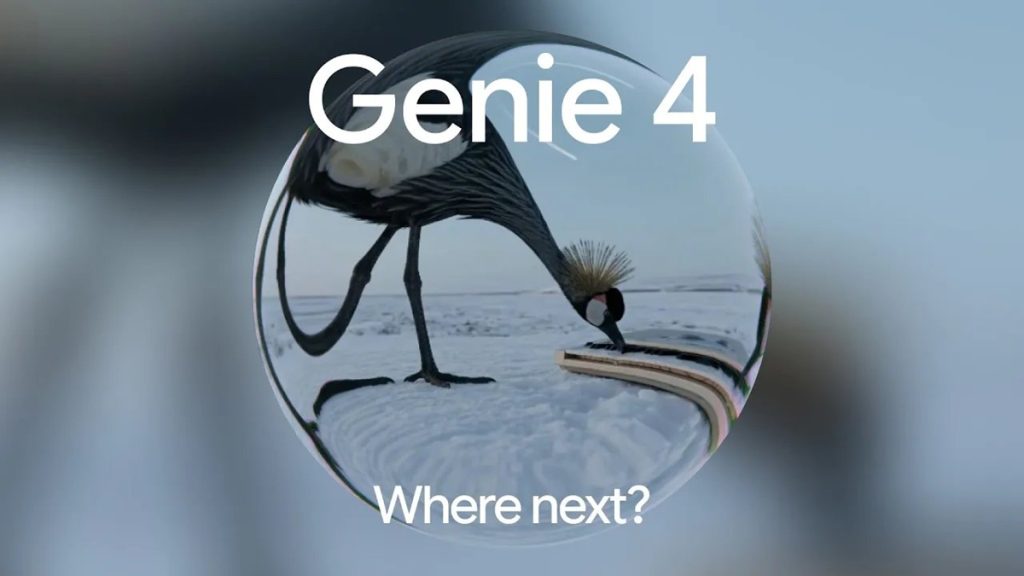
Google DeepMind has announced Genie 4, its new world model for real-time interactive simulation. The model generates interactive environments that users can explore and modify through natural-language prompts, with changes reflected as the simulation evolves.
Genie 4
Genie 4 incorporates capabilities from the Gemini family. Gemini Omni anchors simulations in real-world appearance and behaviour, while other Gemini models provide the reasoning needed to maintain coherence and continuity.
Google DeepMind considers world simulation an important step toward artificial general intelligence (AGI), with potential applications ranging from robot and AI agent training to filmmaking, journalism, gaming and manufacturing.
Features of Genie 4
Users can navigate simulated environments and control the camera with standard keyboard controls, while text prompts modify scenes as they evolve. The model supports four main capabilities:
- Real-time scene control: Users can change the weather, move the camera or introduce people and objects through natural-language prompts. Gemini adapts prompts to the surrounding scene and monitors and steers the simulation between user inputs to help maintain continuity.
- Physics and human action: Genie 4 simulates physical scenarios involving aerodynamics, collisions and other interactions. It also generates people who move naturally, respond to their surroundings and can be steered interactively in real time.
- Native audio generation: Genie 4 is Google DeepMind’s first real-time world model to generate audio natively. It produces environmental sounds, such as wind in trees and waves at a beach, alongside music and interactive dialogue. Characters can converse and respond to user inputs or events in the simulated world.
- Complex event simulation: Gemini 3.8 Flash acts as a guiding agent alongside Genie 4. It observes the scene, breaks goals into steps and reviews incoming frames to track progress and verify whether each step has succeeded. When the environment changes or a user intervenes, Gemini adapts its plan, supporting simulations involving causality, procedural behaviours and multi-step reasoning.
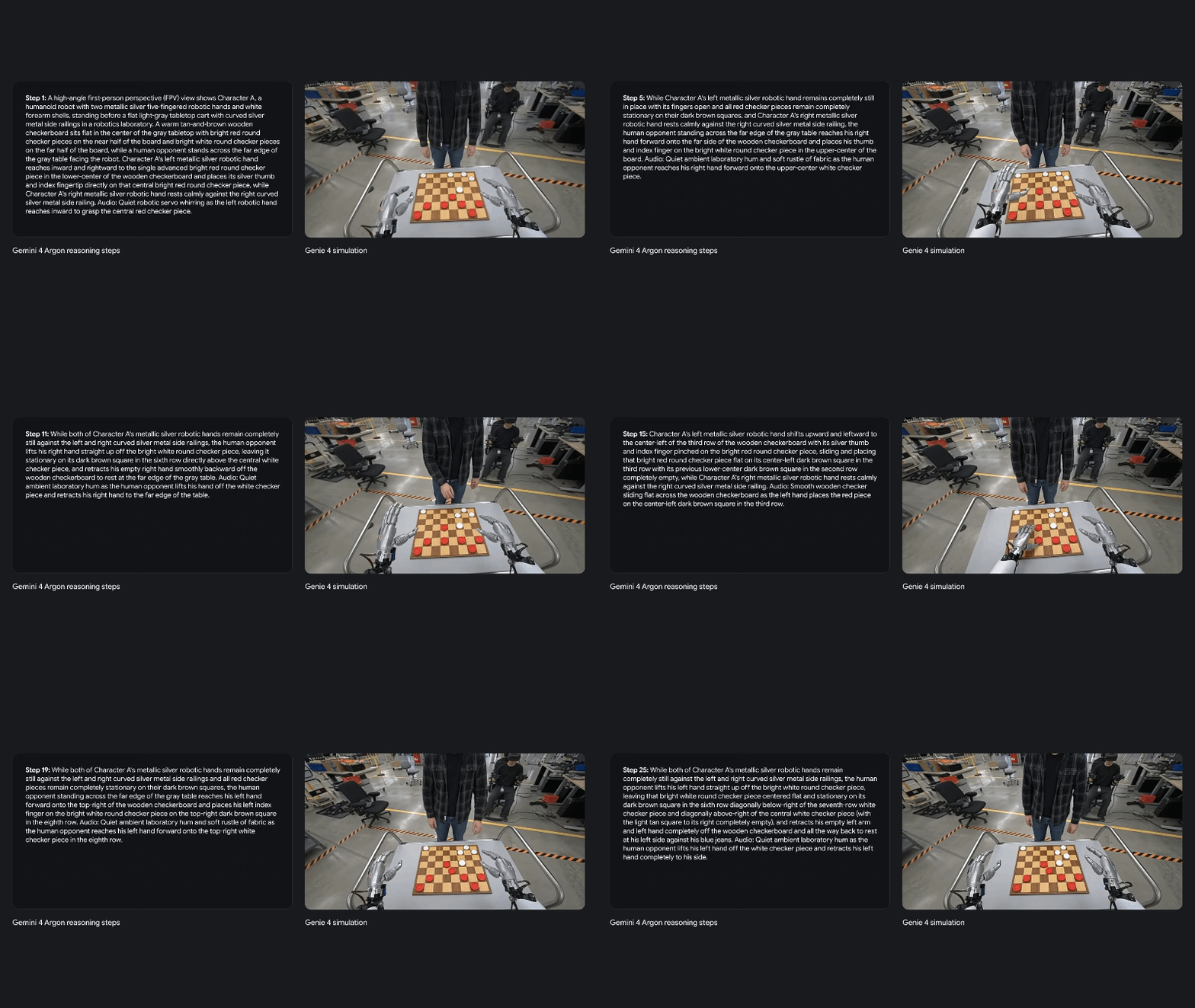
The research also explores Genie 4 with Gemini 4 Argon as part of Gemini Robotics. In one example, Argon breaks a user-instructed task into steps for Genie 4 to render. These steps appear as text captions while the simulation is generated, allowing Gemini to steer the model in real time and adapt the scene as the task progresses.
Use cases being tested
Google DeepMind is working with trusted testers across creative industries, journalism, education, gaming and engineering to assess how interactive world models can support real-world workflows. The testing covers several applications:
- Creative direction: Filmmakers and creative technologists are testing Genie 4 as a draft mode for pre-visualisation and ideation. They can run multiple takes in a live simulation, adjusting camera angles, lighting, dialogue and action in real time.
- Historical scenarios and archival photographs: Photojournalists are exploring how a single 2D archival photograph can become a simulation of its environment in seconds. Teams are also testing dynamic environments to experience historical spaces and visualise short-term environmental events, including flash floods and wildfires.
- Interactive experience design: Game developers and creative technologists are testing how to turn an initial idea into an explorable prototype in seconds. They can experiment with visual styles, material aesthetics and interactive mechanics through natural-language prompts before writing engine code.
- Industrial simulation: Enterprise partners are evaluating Genie 4 for rapid scenario generation and identifying gaps that need to be addressed for simulation applications. This work is taking place alongside robotics research.
Hybrid world models
Google DeepMind is exploring hybrid world models that combine the structured reasoning of code and language models with the sensory representation of pixel-level simulation.
In this approach, Gemini maps the environment’s structure and plans the narrative timeline, while Genie generates the physical environment, including how it looks, sounds and responds. The company says combining these capabilities could support world models with greater coherence, controllability and grounding.
Safety and limitations
Before launching the research preview, Google DeepMind conducted internal safety evaluations intended to prevent the generation of harmful or malicious content. Genie 4 includes safety guardrails consistent with the policies applied to Google’s other models. All generated video and audio will include SynthID, Google’s imperceptible digital watermarking technology, which helps identify AI-generated content across visual and audio formats.
Genie 4 remains an early-stage research model. Although it can maintain coherent environments during short sessions, visual details and object permanence can shift or drift over time, particularly during longer simulations, after multiple complex prompt edits or while navigating through a scene. The following remain areas of ongoing research:
- Complex physical interactions between users, independent agents and shared environments
- Real-time audio accuracy
- Rendering clear, legible text
- Spatial accuracy and the representation of real-world locations
- Long-term consistency and extended interaction sessions
Availability
Google DeepMind is rolling out Genie 4 as a research preview to a limited group of trusted testers and gathering feedback before a broader release to consumers and developers.
The model is coming soon to Google AI Ultra subscribers through Project Genie and to early access partners through the Gemini API and Google AI Studio. Users can also join the Genie 4 waitlist through Project Genie.