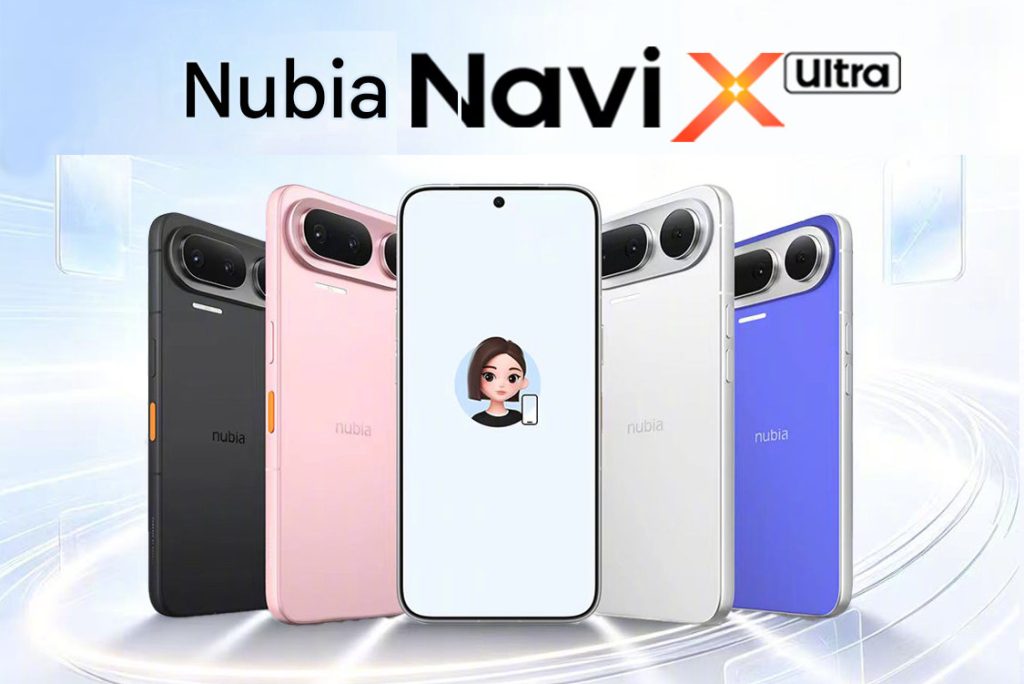
nubia officially announced the launch of the NaviX Ultra smartphone, positioning the device as the second generation of its “beanbag” line and what the brand terms the world’s first AI intelligent smartphone.
Developed under ZTE nubia with deep integration of the consumer version of the Doubao Mobile Assistant, the device focuses heavily on system-level agent capabilities designed to automate multi-step operations across applications.
Core Hardware Specifications
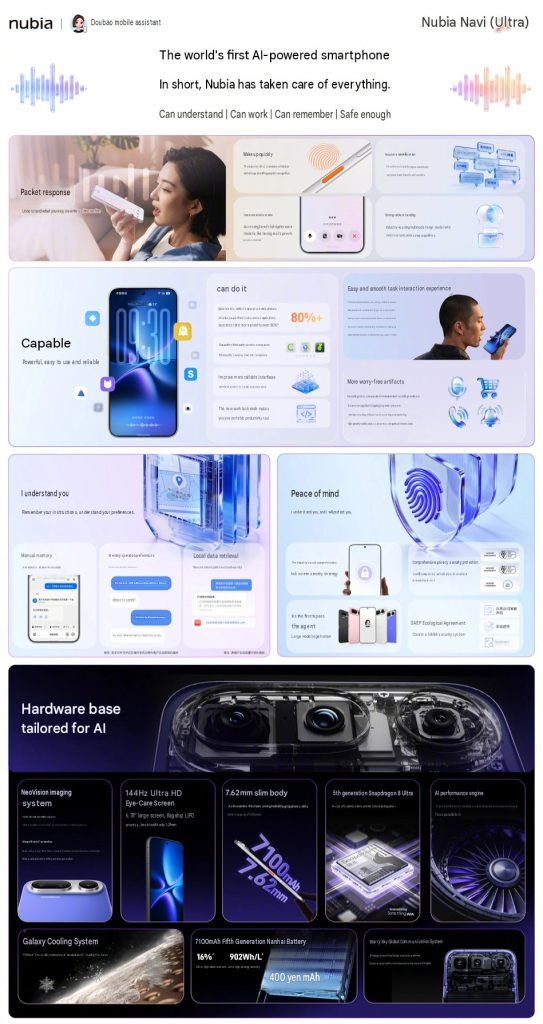
The NaviX Ultra is powered by the Snapdragon 8 Elite Gen 5 mobile platform. Heat dissipation is handled by the Galaxy Cooling System, which incorporates a 7,100 mm² three-dimensional vapor chamber.
- Display: A 6.78-inch LTPO 2.0 panel featuring an adaptive refresh rate from 1Hz to 144Hz, 100% DCI-P3 color gamut coverage, and a peak brightness of 4,500 nits using Q10+ luminescent material. Dimming technologies include DC dimming paired with 2,160Hz high-frequency PWM dimming.
- Camera Setup: The rear camera module consists of a 200MP primary sensor, a 50MP ultra-wide-angle lens, and a 64MP periscope telephoto camera. Software support includes “AI Image Master” alongside voice-guided composition functions.
- Battery & Charging: Despite a chassis thickness of 7.62 mm, the device houses a 7,100 mAh fifth-generation Nanhai battery supporting 90W wired fast charging and 50W wireless fast charging.
- Connectivity: The device runs on the Starry Sky Global Communication System, a network engine designed to enhance signal stability.
AI Integration and Operating Architecture
The NaviX Ultra introduces an independent hardware AI button that integrates capacitive fingerprint recognition. The physical control operates in tandem with Seed’s full-duplex voice model, enabling conversational interruptions without restarting dialogue threads.
According to Nubia, the device’s voice recognition architecture yields an AI wake-up rate 48% higher in noisy environments like subways or transit hubs compared to competing devices, alongside a 21% improvement in sentence accuracy. The system natively supports over ten regional dialects, including Cantonese and Minnan, with trigger options covering voice proximity, over-the-air voice activation, and earphone tap controls.
The software foundation relies on the consumer debut of the Doubao Mobile Assistant, built around four key technical pillars:
- Deep Reasoning: Automated decomposition and execution planning for multi-step prompts.
- Generalization: Knowledge transfer across different applications to handle unfamiliar workflows.
- Self-Correction: Autonomous path adjustment when handling unexpected system states.
- Extended Context Adherence: Consistent alignment with user parameters across long-running tasks.
nubia reports an end-to-end task execution success rate exceeding 80% for single-sentence cross-app requests. The system interfaces with third-party platforms such as Cao Cao Mobility, system-level mapping, music services, and Lark. Tasks can be processed silently in the background with multi-threaded scheduling and request queuing.
Everyday Utility and Security Framework
Additional software features center on data processing, context retention, and system management:
- Screen & Vision Search: Screen Q&A allows instant recognition and action execution based on displayed information, while camera-based video calls enable real-world scene analysis. Screen Recognition Shopping identifies items and navigates directly to purchasing channels.
- Communication Management: “Smart Call” handles incoming calls through automated or custom response scripts, while “Priority Notifications” pins critical alerts based on user-defined rules.
- Productivity: “Recording Notes” automates transcription and summarization via Lark Notes integration, supporting natural-language search over archived audio.
- User Memory: The system retains explicitly authorized preferences to adjust future behavior and allows natural-language queries against authorized local files.
On the security side, nubia stated that the NaviX Ultra is the first mobile device to secure official registration for an intelligent agent large model. The device operates under a full-chain architecture that incorporates the SAEP security protocol, granular lock-screen access permissions, and international privacy certifications. nubia noted plans to open its system-level agent APIs to third-party developers going forward.
nubia NaviX Ultra specifications
- 6.78-inch (2800×1260 pixels) 1.5K OLED 1-144Hz refresh rate LTPO display, 10-bit color depth and 100% DCI-P3 color gamut, up to 4500 nits peak brightness, DC dimming, 2,160Hz PWM dimming
- Octa Core Snapdragon 8 Elite Gen 5 3nm Mobile Platform with Adreno 840 GPU
- 12GB / 16GB LPDDR5X RAM with 512GB / 1TB (UFS 4.1)
- Android 16 with Nebula AIOS 2
- Dual SIM (nano + nano)
- 200MP main camera, OIS, 50MP ultra-wide lens, 64MP periscope telephoto lens, telephoto macro with OIS
- 32MP front-facing camera
- Side-mounted fingerprint sensor, Infrared sensor
- USB Type-C audio, Dual speakers, DTS:X ULTRA, three mics, dual X-axis linear motors
- Dimensions:162.11×75.69×7.62mm;Weight: 208g
- 5G NSA /SA, Dual 4G VoLTE, Wi-Fi 7 802.11 be (2.4GHz + 5GHz + 6GHz), Bluetooth 6.0, GPS (L1/L5)+ GLONASS, USB Type-C 3.2 Gen 1, NFC
- 7100mAh battery with 90W wired fast charging, 50W wireless charging
Pricing and availability
Pricing begins at 5,999 yuan, with an effective national subsidy starting price of 5,499 yuan. Three storage variants will be available:
- 12GB + 512GB: 5,999 yuan (USD 893 / Rs. 85,775 approx.)
- 16GB + 512GB: 6,499 yuan (USD 968 / Rs. 92920 approx.)
- 16GB + 1TB: 7,499 yuan (USD 1,117 / Rs. 1,07,220 approx.)
The smartphone comes in four color options: Dream, Blue, Black, and White. It is already on sale in China, and the company said that the sales exceeded 100 million yuan in just one second of sale.