
Cathay Pacific and Google have announced a joint initiative to test artificial intelligence technology designed to reduce aircraft condensation trails, or contrails.
The partnership makes the Hong Kong-based carrier Google’s first commercial airline partner in the Asia-Pacific region to trial the system, as well as the first globally to evaluate contrail avoidance strategies on ultra-long-haul flight paths.
The operational trials evaluate the feasibility, constraints, and atmospheric impact of contrail avoidance across Cathay Pacific’s international network, expanding empirical research into geographic zones that have historically seen limited testing.
The Climate Impact of Aviation Contrails
Contrails form when water vapor and soot from jet engine exhaust encounter specific cold, humid air masses at cruising altitudes. While most dissipate rapidly, some persist and spread into thin, cirrus-like cloud layers.
Atmospheric science research suggests that these persistent contrails trap outgoing terrestrial radiation, potentially accounting for roughly one-third of aviation’s total global warming footprint. Consequently, non-carbon-dioxide (non-CO₂) warming mechanisms have increasingly become a focus of industry decarbonization strategies alongside fleet renewal, operational efficiencies, and sustainable aviation fuels (SAF).
AI Forecasting and Cockpit Implementation
Google’s contrail mitigation model integrates predictive machine learning algorithms, satellite imagery analysis, and atmospheric weather forecasts to project the locations and altitudes of contrail-prone air layers. Similar to standard maneuvers executed to avoid turbulence, dispatchers and flight crews use these projections to plan minor vertical deviations around affected zones.
In Cathay Pacific’s operations, the dynamic forecast data is transmitted to cockpits via in-flight connectivity and integrated directly into the airline’s proprietary Electronic Flight Folder (EFF). This interface displays contrail-forming regions alongside flight planning parameters, allowing pilots to assess altitude adjustments during active flight planning without disrupting standard cockpit routines.
Trial Findings and Geographic Focus
Operational trials launched in late 2025 targeted more than 100 flights. According to program data:
- Contrail Reduction: More than 80 flights actively followed avoidance routing, resulting in an estimated 40% reduction in the localized warming effect caused by contrails on those routes.
- Corridor Sensitivity: The Hong Kong–Singapore route served as a primary testing ground due to frequent atmospheric conditions favorable to contrail persistence. Minor flight level adjustments on this single corridor contributed to more than half of the total climate benefit observed during the initial trial phase.
Expansion and Industry Evaluation
The operational findings provide empirical benchmarks for routing adjustments, but broader atmospheric questions remain regarding trade-offs, such as any marginal fuel burn incurred during altitude changes versus the net warming impact avoided.
To address these parameters, Cathay Pacific and Google—in collaboration with Contrails.org, an independent nonprofit research initiative—are launching a broader second phase of operational testing. This next phase will cover wider operational sectors across the airline’s Asian and transpacific routes, generating open-source and peer-reviewable datasets to help regulators, carriers, and air traffic authorities evaluate potential airspace policies and operational frameworks.
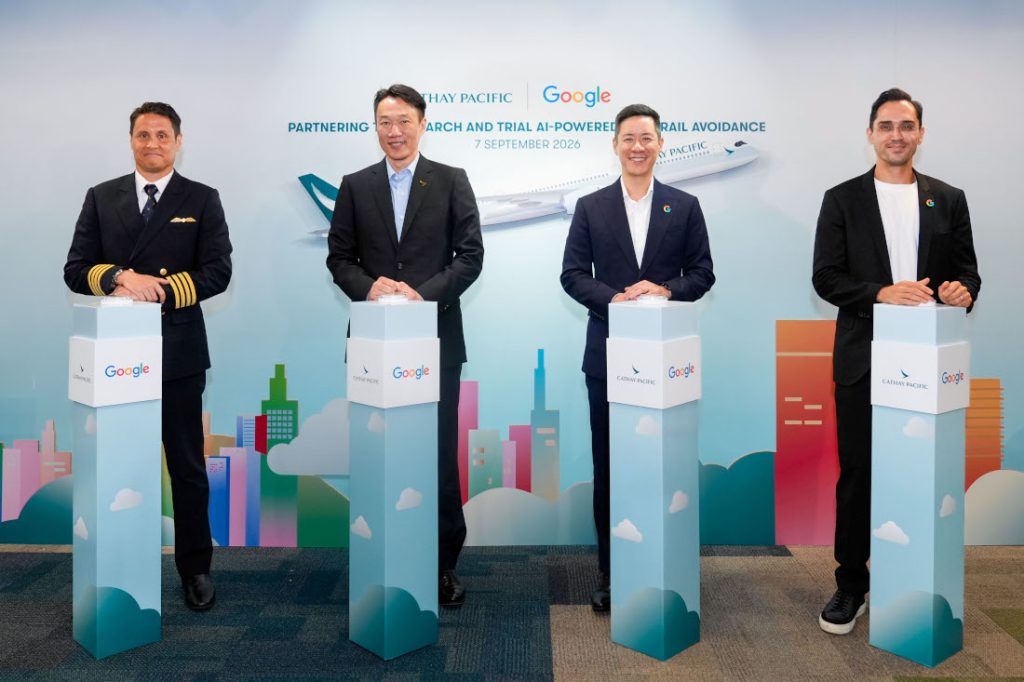
Lawrence Fong, Director Digital and IT, Cathay said:
Aviation needs solutions to address climate change, and AI is accelerating that progress. This partnership combines Cathay’s operational expertise with Google’s world-class AI capabilities to tackle complex sustainability challenges at scale. At Cathay, we believe innovation should deliver tangible and meaningful impact, and this collaboration sets a new benchmark for leadership in our industry.
Michael Yue, Managing Director and General Manager, Google Hong Kong said:
At Google, we believe AI has the power to help address complex environmental challenges and our partnership with Cathay Pacific is a prime example of this in action—researching how predictive AI can be deployed in live operations to help address the climate impact of contrails with today’s aircrafts and today’s fuel. This work reflects our ongoing commitment to developing sustainable solutions that deliver lasting impact, and we’re excited to expand our trial with Cathay Pacific and continue contributing to open climate science together.