
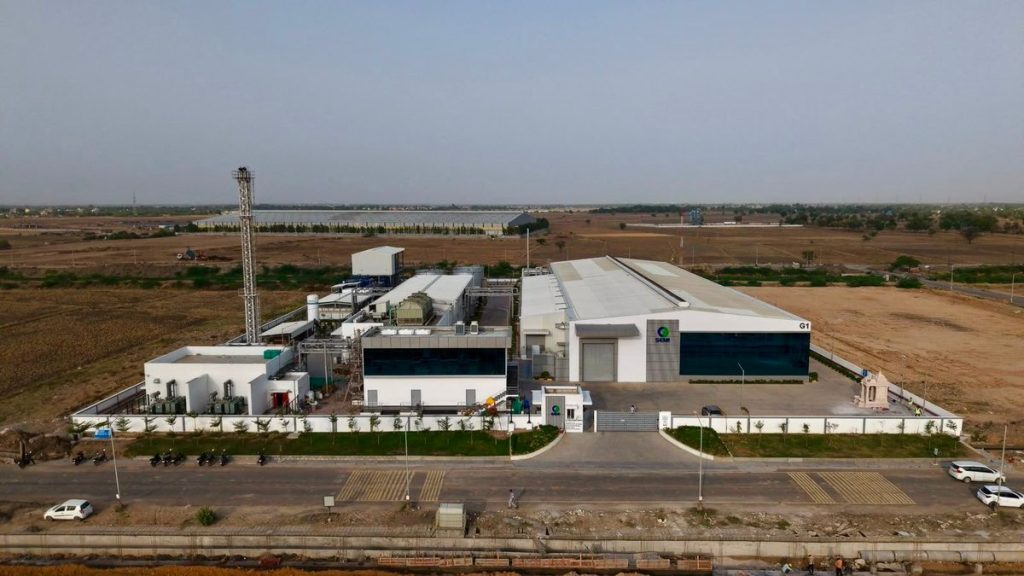
Prime Minister Narendra Modi on July 4 inaugurated the CG Semi Outsourced Semiconductor Assembly and Test (OSAT) facility in Sanand, Gujarat, marking the start of commercial production. The facility becomes India’s third semiconductor plant to enter operations in 2026 and is part of the country’s broader push to build a complete semiconductor manufacturing ecosystem.
The Prime Minister said the development reflects India’s steady progress under the “Design in India” and “Make in India” framework, aimed at strengthening the full electronics value chain from design to manufacturing.
He added that India’s semiconductor journey is a continuation of the electronics revolution over the past decade, moving from finished products to components and now to semiconductors.
Project timeline and execution
The facility has progressed rapidly from foundation to production:
- Foundation stone laid: March 2024
- Chip testing began: August 2025
- Commercial production: July 2026
- Execution timeline: ~27 months (as noted by Ashwini Vaishnaw)
PM Modi credited engineers, workers, and industry partners for the execution speed and also interacted with young professionals during the visit.
Investment, partnership and production capacity
The CG SEMI OSAT facility has been developed with over ₹7,600 crore investment in partnership with Renesas Electronics (Japan), along with collaboration between Indian, Japanese, and Thai partners.
Production capacity details:
- Current capacity: 20 crore units annually
- Planned expansion: up to 500 crore units annually
The chips will be used in automotive systems, scooters, and industrial equipment, with exports planned to Japan, the United States, and Europe.
Semiconductor cluster development in Sanand
PM Modi highlighted that semiconductor manufacturing depends on ecosystem-based growth rather than standalone units. Sanand is emerging as a semiconductor cluster similar to global hubs such as Silicon Valley, Hsinchu Science Park, and Tsukuba Science City.
Existing companies in the region include Micron, Kaynes, and CG Semi. The ecosystem is expected to expand further with supporting industries such as chemical suppliers, testing facilities, design centres, and semiconductor startups.
This cluster model is expected to create broader industrial growth and employment opportunities.
Electronics manufacturing growth and policy shift
India’s semiconductor push is linked to its wider electronics manufacturing expansion over the past decade. Since 2014, electronics production has increased nearly seven times, while exports have grown eleven times.
India has also become the world’s second-largest producer and exporter of mobile phones. The manufacturing approach has shifted from finished products to components and now semiconductors, marking the next phase of the Make in India initiative.
Semiconductor ecosystem and future technologies
The government aims to develop a complete semiconductor value chain covering chip design, fabrication, assembly and packaging, materials, and critical minerals.
PM Modi said this ecosystem will support emerging technologies such as artificial intelligence, robotics, and next-generation computing. He also noted that technology transitions typically generate employment across research, design, manufacturing, and supply chains.
India semiconductor sector: key developments
According to Union Minister Ashwini Vaishnaw and government data:
- 12 semiconductor projects approved
- 3 already in commercial production
- 2 more expected in coming months
- 5 total plants expected operational by end-2026
- 24 deep-tech semiconductor startups
- 70,000+ trained chip design professionals
- 315 universities offering semiconductor courses
- First semiconductor fab under development in Dholera
India’s electronics manufacturing sector is valued at around ₹13 lakh crore and supports more than 25 lakh jobs.
Employment and global integration
The CG SEMI facility has created employment opportunities across multiple states, including Jharkhand, Chhattisgarh, Madhya Pradesh, Bihar, Jammu & Kashmir, Kerala, and Gujarat.
Women employees at the facility were trained in Malaysia for semiconductor operations before joining production in India. Officials said such training programs are expected to increasingly be conducted domestically as the ecosystem develops.
PM visit and event highlights
During the inauguration, PM Modi visited the Experience Centre and Clean Room, interacted with engineers and operators, and unveiled the inauguration plaque. The first product from the facility was handed over to Renesas Electronics India.
Following the event, he shared updates on X, stating it was “wonderful” to return to Sanand for the inauguration and highlighting the facility’s role in strengthening India’s semiconductor ambitions.
Semiconductor roadmap and outlook
Union Minister Ashwini Vaishnaw said India has entered a new phase in semiconductor manufacturing with three operational plants in 2026.
- First plant inaugurated: February 28, 2026
- Second plant inaugurated: March 31, 2026
- Third plant: CG SEMI OSAT (July 2026)
He added that five semiconductor plants are expected to be operational by the end of 2026, strengthening India’s position in the global semiconductor value chain and supporting the Atmanirbhar Bharat mission.