

Anthropic has announced Claude Sonnet 5, a Sonnet-class model designed for agentic AI workflows. It is built to plan tasks, use tools such as browsers and terminals, and operate autonomously at a level that previously required larger and more expensive models.
The model follows Claude Sonnet 3.5, 3.6, and 3.7, which contributed to early agentic capabilities in coding and tool use. More recent advances in Anthropic’s model line have come from Opus models, and Sonnet 5 is positioned to reduce the gap while improving cost efficiency.
Claude Sonnet 5
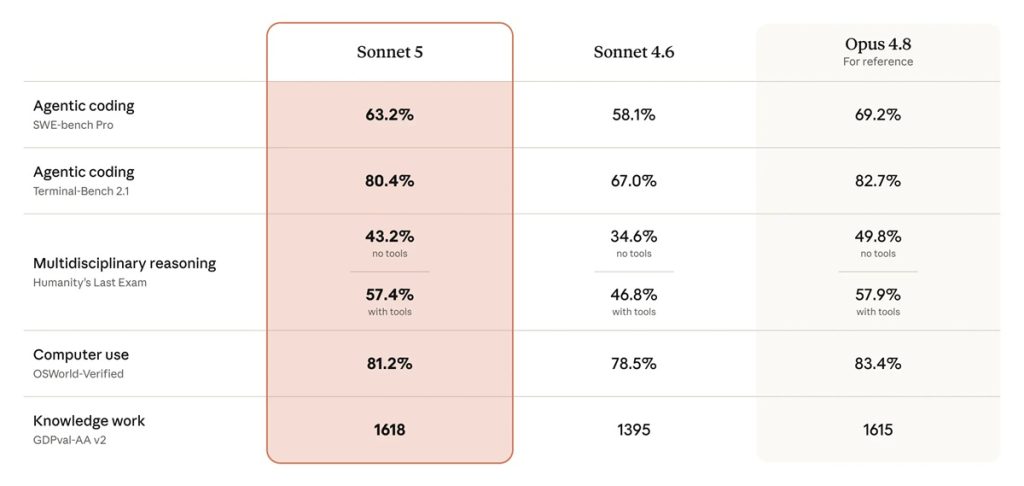
Claude Sonnet 5 delivers performance close to Claude Opus 4.8 while improving on Claude Sonnet 4.6 across core capability areas.
It focuses on:
- Reasoning and multi-step problem solving
- Coding and software development workflows
- Tool use, including browser and terminal interaction
- Knowledge work and information processing
- Autonomous task execution
Early access feedback highlights improved completion of complex multi-step tasks and increased self-verification of outputs during execution.
Key features
- Agentic task planning and execution
- Browser and terminal tool support
- Adjustable effort levels for workload control
- Stronger performance on BrowseComp and OSWorld-Verified benchmarks
- Self-checking behavior during execution
- Improved resistance to prompt injection and malicious requests
- Lower cybersecurity capability than Opus 4.8 and Mythos 5
- Cyber safeguards enabled by default
Performance and evaluation
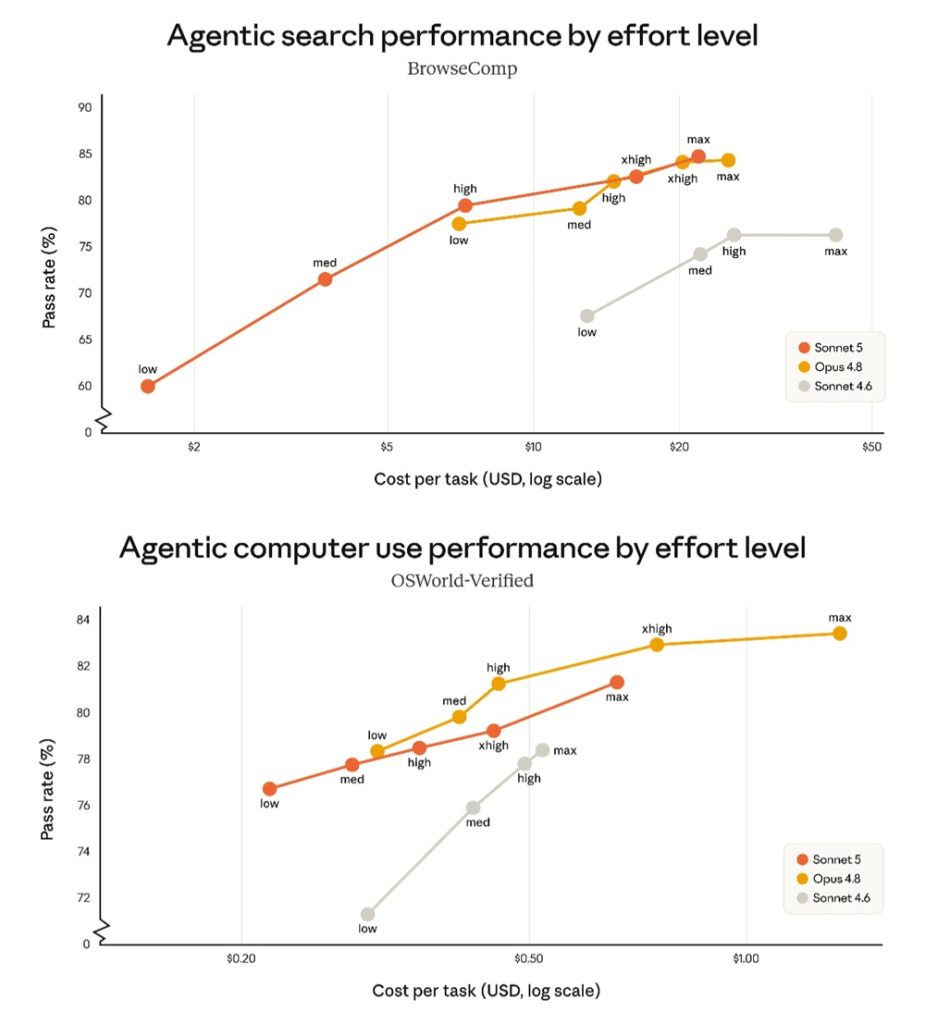
Anthropic evaluated Claude Sonnet 5 on BrowseComp and OSWorld-Verified benchmarks across multiple effort levels.
Key findings:
- Improvement over Sonnet 4.6 across all effort levels
- Wider cost-performance range than Claude Opus 4.8
- Higher cost efficiency at medium effort
- Higher-effort settings approaching Opus 4.8 performance on some tasks
- Effort levels adjustable based on cost and performance needs
Benchmark pricing reference:
- Claude Sonnet 5: $3 per million input tokens / $15 per million output tokens
- Introductory pricing (until August 31, 2026): $2 / $10 per million tokens
- Claude Opus 4.8: $5 per million input tokens / $25 per million output tokens
The “xhigh” setting refers to an extra-high effort mode used in evaluations.
Safety evaluation
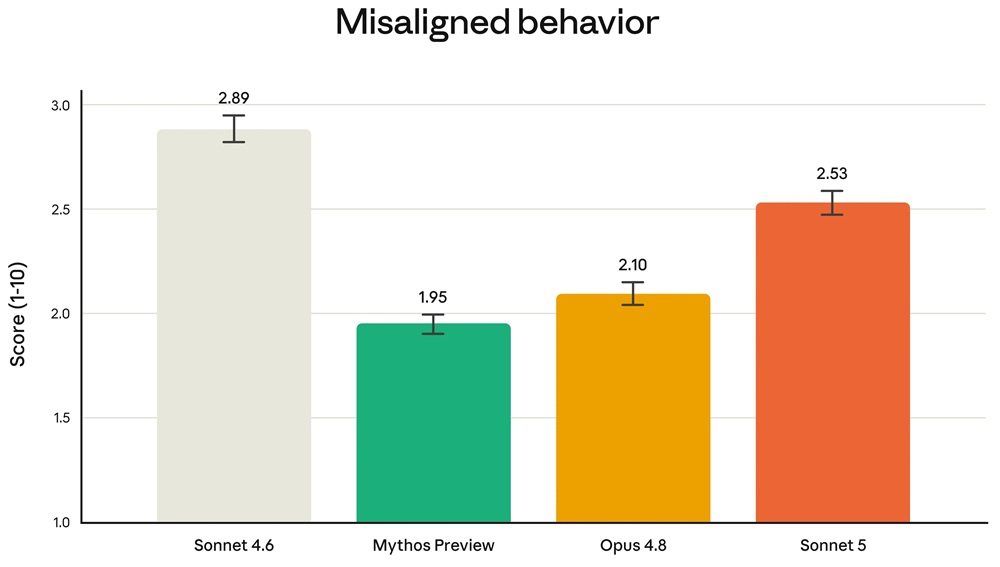
Claude Sonnet 5 shows improved safety compared to Sonnet 4.6.
Findings include:
- Better refusal of malicious requests
- Improved resistance to prompt injection
- Lower hallucination rates
- Lower sycophancy rates
- Reduced undesirable behavior in behavioral audits
In broader evaluations, Sonnet 5 performs better than Sonnet 4.6 but shows higher misaligned behavior rates than Claude Opus 4.8 and Claude Mythos Preview.
Cybersecurity evaluation and safeguards
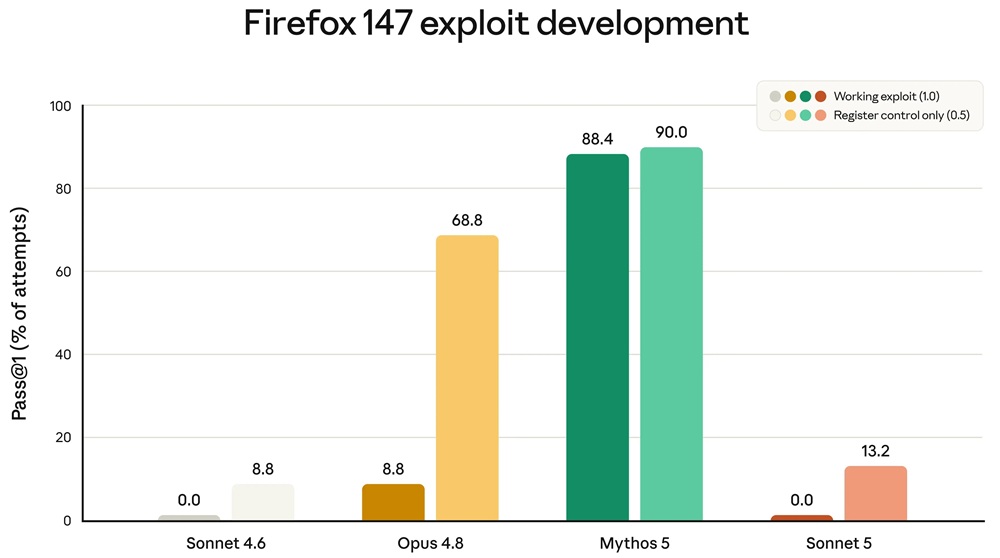
Claude Sonnet 5 was not specifically trained for cybersecurity tasks. It can perform routine security-related tasks but performs below Claude Opus 4.8 and Claude Mythos 5 on advanced cyber capability evaluations.
Mozilla-supported testing using Firefox 147 vulnerabilities found:
- No successful full exploit generation in Sonnet 5 or Sonnet 4.6
- 0.0% success rate for both models
- Slightly higher partial success rate in Sonnet 5
- Changes attributed to general capability improvements
- All vulnerabilities patched in Firefox 148
Cyber safeguards are enabled by default. They detect and block high-risk cyber activity in real time and align with protections used in Claude Opus 4.7 and 4.8. These safeguards are less restrictive than those used in higher-risk systems such as Fable 5 due to Sonnet 5’s lower assessed risk.
Pricing and availability
Claude Sonnet 5 is available across:
Availability:
- Default model for Free and Pro users
- Available to Max, Team, and Enterprise users
- Available in Claude Code and Claude Platform
- API access via
claude-sonnet-5
Pricing:
- Introductory (until August 31, 2026): $2 input / $10 output per million tokens
- Standard (from September 1, 2026): $3 input / $15 output per million tokens
Rate limits have been increased across Chat, Cowork, Claude Code, and Claude Platform. Users can select effort levels based on performance and cost requirements.