

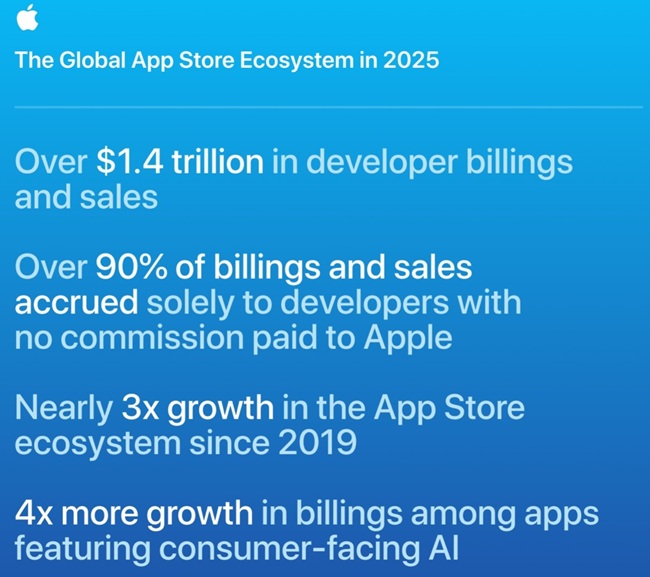
Apple has announced that the global App Store ecosystem facilitated over $1.4 trillion in developer billings and sales in 2025, according to a new study by economists at Analysis Group. The company states that for more than 90% of these billings and sales, developers did not pay any commission to Apple.
Since 2019, the ecosystem has nearly tripled in size while continuing to function as a global platform for discovering and downloading apps. Apple says it also supports developers building new experiences using emerging technologies, including artificial intelligence.
In 2025, more than 40 of the top 100 apps on the App Store included consumer-facing AI features, and these apps showed stronger billing growth compared to other top apps.
Global App Store economy at scale
The App Store ecosystem continues to operate as a large global commerce network connecting developers and users across 175 countries and regions, supporting purchases across physical goods, digital services, and advertising.
Total activity in 2025 reached $1.4 trillion, driven by multiple categories:
- $1.1 trillion — Physical goods and services (retail, groceries, food delivery, travel)
- $149 billion — Digital goods and services (games, enterprise apps, streaming)
- $151 billion — In-app advertising revenue
Across all markets, general retail remained the largest category, reflecting strong consumer activity through mobile apps.
User scale and platform reach
The ecosystem continues to grow in usage and reach, supporting both developers and consumers at a large scale.
- Over 850 million average weekly users
- Presence in 175 countries and regions
- More than 90% of billings and sales generated without Apple commission
Apple highlights that this structure allows developers to keep the majority of their earnings while accessing global distribution and discovery.
AI-driven growth across apps
Artificial intelligence is increasingly integrated into App Store apps and has become a major driver of growth in 2025. Apps with consumer-facing AI capabilities recorded 4x higher growth in billings compared to other top apps.
More than 40 of the top 100 apps now include AI-based features, and these apps are growing faster than non-AI apps in the same ranking.
AI is being used across several categories, including health and fitness, photo and video editing, and productivity tools. These applications use AI for personalised recommendations, content generation, and workflow automation.
Apple AI tools for developers
Apple continues to expand its AI capabilities across its development ecosystem. The Foundation Models framework enables developers to access on-device large language models powered by Apple Intelligence, allowing apps to run AI features offline with privacy-focused processing and no additional inference cost.
Apple is also integrating AI into development tools. With Xcode 26, agentic coding features help developers automate tasks, speed up workflows, and build apps more efficiently, making development more accessible to a wider range of creators.
Regional growth trends
The App Store ecosystem has expanded across all major regions, with particularly strong growth in China, the US, and Europe. Over the past six years, ecosystem value has more than doubled in China and more than tripled in the US and Europe.
While retail remains the top category globally, regional patterns vary based on local consumer behaviour:
- Travel is the second-largest category in the US, Europe, Japan, Australia, New Zealand, and Brazil
- Food delivery and pickup is second in Korea
- Grocery and food delivery are second and third in China
These trends reflect how the App Store supports both global commerce and local consumption patterns.
Developer ecosystem and support
Apple continues to invest in developer tools, infrastructure, and education programs that support app development across the full lifecycle. Developers use tools such as Xcode, TestFlight, and App Analytics, along with distribution features like custom product pages and App Store editorial placements.
Apple also continues expanding its global developer infrastructure, including centers in the US, China, India, and Singapore, with a new center planned in Berlin. The company operates nearly 20 Apple Developer Academies across multiple countries, along with Apple Foundation Programs focused on coding, AI, design, and marketing.
Support programs include online and in-person sessions such as Meet with Apple, technical labs, forums, and multilingual assistance in nine languages.
WWDC preview and upcoming updates
At Apple’s Worldwide Developers Conference next week, the company will introduce new features, APIs, and tools designed to further enhance app development across its platforms.
Developers and students will have access to more than 100 video sessions covering tools, design, and technologies, along with Group Labs and discussions on Apple Developer Forums. Apple says these updates will support developers in building more advanced and intelligent app experiences.
Developers are the heartbeat of the App Store, and this year’s remarkable milestone is a testament to their boundless creativity. We are deeply committed to providing developers with the tools, technologies, and trusted platforms they need to build for the future. Together, developers are creating apps that enrich the lives of users around the world.