
At CES 2026, Qualcomm Technologies outlined a unified artificial intelligence strategy spanning autonomous robotics and software-defined vehicles. The company announced new robotics processors, expanded automotive platform deployments, and deeper ecosystem collaborations, focusing on edge AI, centralized compute, and agentic AI for real-world applications.
Robotics platform scales from AMRs to full-size humanoids
Qualcomm introduced a next-generation general-purpose robotics architecture designed to support autonomous systems ranging from household robots to industrial autonomous mobile robots (AMRs) and full-size humanoids. The architecture integrates hardware, software, and compound AI to support deployment-ready robotics systems.
At the core of this platform is the Dragonwing IQ10 Series, Qualcomm’s latest robotics-specific processor. The IQ10 is positioned for industrial AMRs and advanced humanoid robots, delivering high-performance, energy-efficient edge compute for perception, motion planning, and real-time decision-making. Qualcomm described the processor as a step toward practical deployment beyond research and prototype environments.
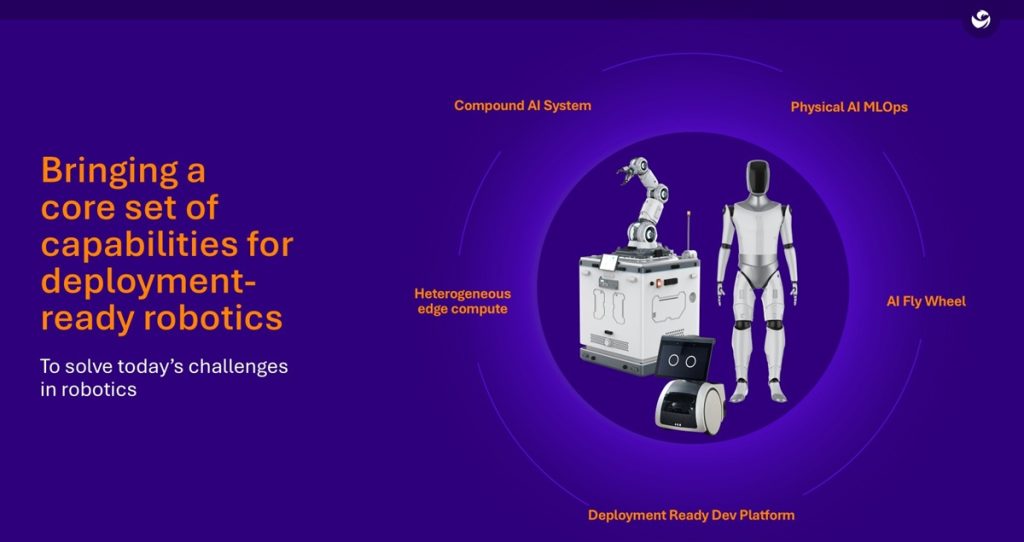
The robotics stack combines heterogeneous edge computing, mixed-criticality systems, machine learning operations, software frameworks, and an AI data flywheel. It supports end-to-end AI models, including vision-language and vision-language-action models, enabling generalized manipulation and human-robot interaction. The platform is designed to scale across multiple form factors while meeting industrial reliability requirements.
Qualcomm stated that its existing Dragonwing industrial processor roadmap already powers a range of general-purpose robotic platforms, including humanoid systems from Booster and VinMotion. The company also confirmed ongoing discussions with KUKA related to next-generation robotics solutions.
Snapdragon Digital Chassis adoption expands globally
Alongside robotics, Qualcomm highlighted continued global adoption of its Snapdragon Digital Chassis portfolio as vehicles transition toward software-defined and AI-driven architectures. The company reported growing deployment of its cockpit, automated driving, and connectivity platforms across multiple regions.
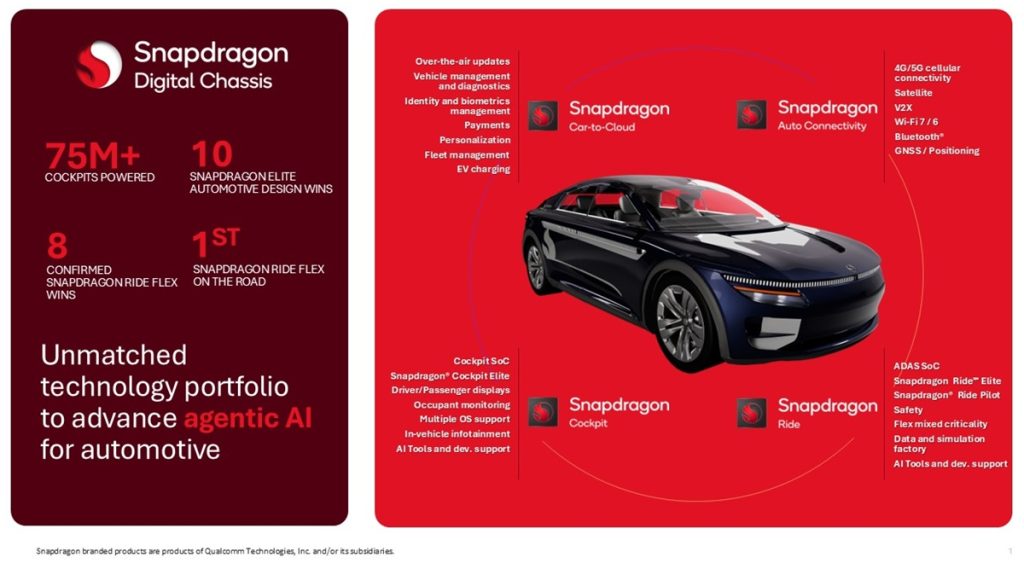
Snapdragon Cockpit Elite and Snapdragon Ride Elite platforms serve as centralized compute solutions for AI-defined vehicles, supporting digital cockpit functions and advanced driver assistance systems (ADAS). Qualcomm announced new and expanded collaborations with Li Auto, Leapmotor, Zeekr, Great Wall Motor, NIO, and Chery, bringing the total number of announced design programs to ten.
Leapmotor also introduced a high-performance automotive central computer built on dual Snapdragon Elite (SA8797P) platforms, which Qualcomm described as the first controller of its kind using this configuration.
Ride Flex and Snapdragon Ride advance centralized compute and AD
Qualcomm reported continued deployment of Snapdragon Ride Flex, its system-on-chip that unifies digital cockpit and ADAS workloads. The platform is already used in mass-produced vehicles across eight global programs. Chinese Tier-1 suppliers including Autolink, Desay SV, Hangsheng, and ZYT announced mass-production plans for integrated cockpit and driver-assistance solutions based on Ride Flex.
For automated driving, Qualcomm said it is advancing end-to-end AI algorithms through the Snapdragon Ride platform. The company is working with AD stack providers including DeepRoute.ai, Momenta, QCraft, WeRide, and ZYT, supporting multiple AI approaches and vehicle tiers. Qualcomm also reported nearly one million Snapdragon Ride system-on-chips shipped to date and confirmed new collaborations with ZF and Epec.
Qualcomm and Google expand automotive AI collaboration
Qualcomm and Google announced an expansion of their decade-long collaboration in automotive technology. The partnership integrates Snapdragon Digital Chassis platforms with Google’s automotive software to support agentic AI features across next-generation vehicles.
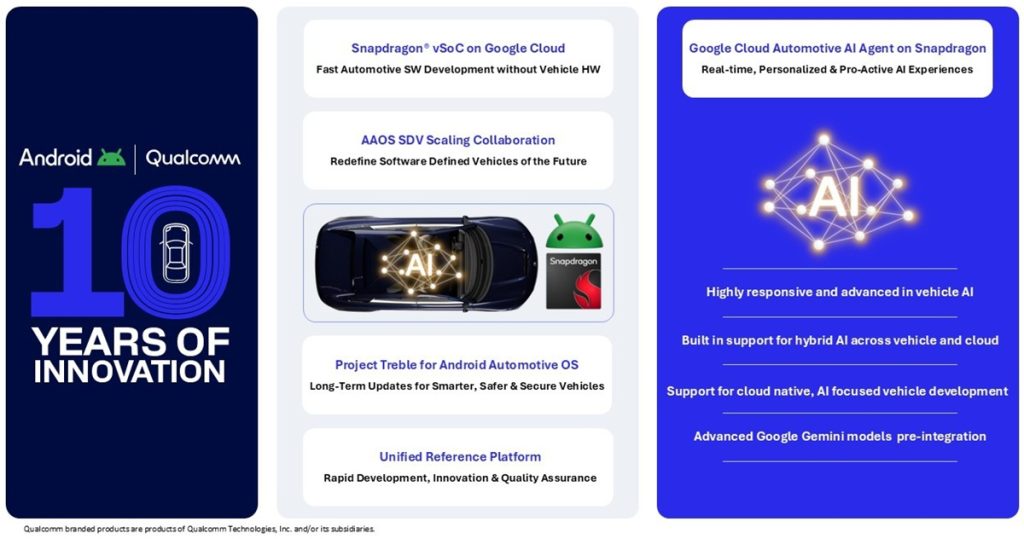
The collaboration builds on early work that enabled Snapdragon-powered Android infotainment systems, supported adoption of Android Automotive OS (AAOS), and helped introduce vehicles with Google built-in. It now extends to cloud-connected AI agents, including Gemini Enterprise for Automotive, combining on-device and cloud-based models to support real-time personalization, multimodal interfaces, and proactive in-vehicle assistance.
Unified AAOS platforms and cloud-based development
As part of the expanded partnership, Qualcomm and Google are aligning Snapdragon Cockpit Platforms with AAOS roadmaps starting from Android 17. This unified reference platform is intended to accelerate prototyping, validation, and production of in-vehicle infotainment and software-defined vehicle systems.
Qualcomm also introduced Snapdragon vSoC on Google Cloud, allowing automakers to design, test, and validate automotive software entirely in the cloud without physical vehicle hardware. Using Arm-based Axion bare-metal instances, the virtual platform is designed to provide high-fidelity validation and closer parity with in-vehicle system-on-chips, enabling faster and more scalable software development.
Android lifecycle support and connectivity updates
Qualcomm announced Project Treble for Android Automotive OS on Snapdragon Cockpit Platforms to simplify Android upgrades, reduce fragmentation, and strengthen security across multi-generation vehicle platforms. The initiative covers four generations of Snapdragon Cockpit Platforms and more than 14 system-on-chips, with a planned 10-year support window for critical software updates.
In connectivity, Qualcomm introduced the A10 5G Modem-RF, its first 5G Reduced Capability (RedCap) modem for automotive use. The modem is designed to provide lower power consumption and global LTE and 5G support for mission-critical vehicle services. Qualcomm also demonstrated new V2X technology with Hyundai Mobis to improve detection of non-line-of-sight hazards and enable earlier braking responses in scenarios where traditional sensors have limited visibility.
CES 2026 demonstrations and availability
At CES 2026, Qualcomm is showcasing multiple robotics and automotive demonstrations at its booth (#5001). These include VinMotion’s Motion 2 humanoid powered by the Dragonwing IQ9 Series, Booster’s K1 Geek humanoid, Advantech’s commercially available robotics development kit, and demonstrations of teleoperation tooling and an AI data flywheel for continuous skill training and deployment.
Demonstrations of Snapdragon Digital Chassis solutions, including cockpit, automated driving, and connectivity technologies, are available by appointment at the Qualcomm booth throughout CES 2026, running from January 6 to January 9.