
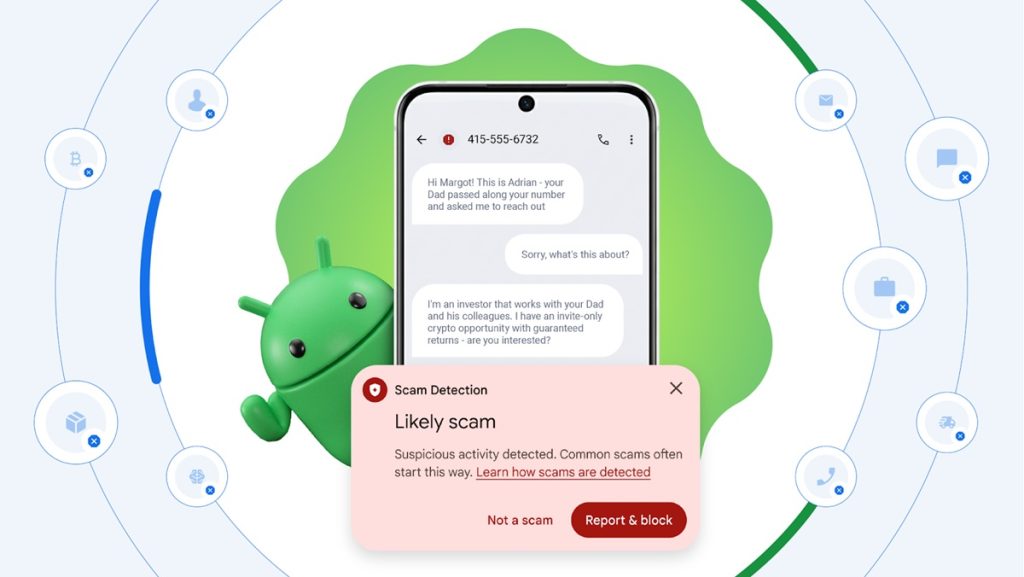
As Cybersecurity Awareness Month concludes, Google has shared how Android helps protect users from one of today’s most common digital threats — mobile scams. Over the past year, AI-assisted fraud has become increasingly sophisticated, resulting in more than $400 billion in global financial losses.
Android has long been at the forefront of combating such threats, using Google AI and multi-layered security systems to detect and block scams before they reach users. Each month, Android prevents over 10 billion suspected scam calls and messages, while Google’s RCS safety checks continue to block suspicious activity — including over 100 million numbers in the past month alone.
Survey shows higher user confidence in Android scam protection
To assess user experiences, Google and YouGov surveyed 5,000 smartphone users across the U.S., India, and Brazil.
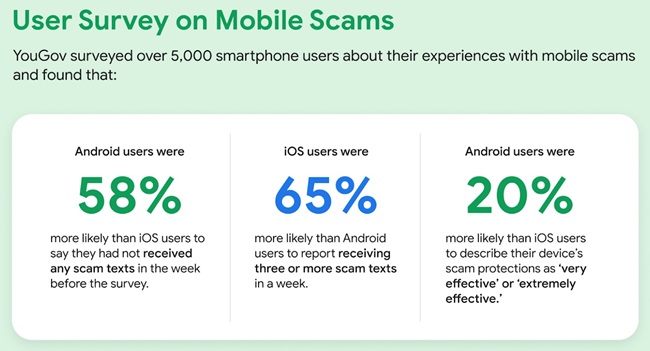
Key findings:
- Android users were 58% more likely than iPhone users to say they had not received any scam texts in the week prior to the survey.
- Pixel users were 96% more likely than iPhone owners to report zero scam texts.
- iOS users were 65% more likely than Android users to have received three or more scam texts in a week.
- Android users were 20% more likely than iOS users to describe their device’s scam protection as “very effective” or “extremely effective.”
- iPhone users were 150% more likely than Android users to indicate that their phone failed to stop scam or fraud attempts.
These results show that users feel more secure and encounter fewer scams on Android devices, particularly on Google Pixel phones.
Independent evaluations confirm Android’s AI-driven safeguards
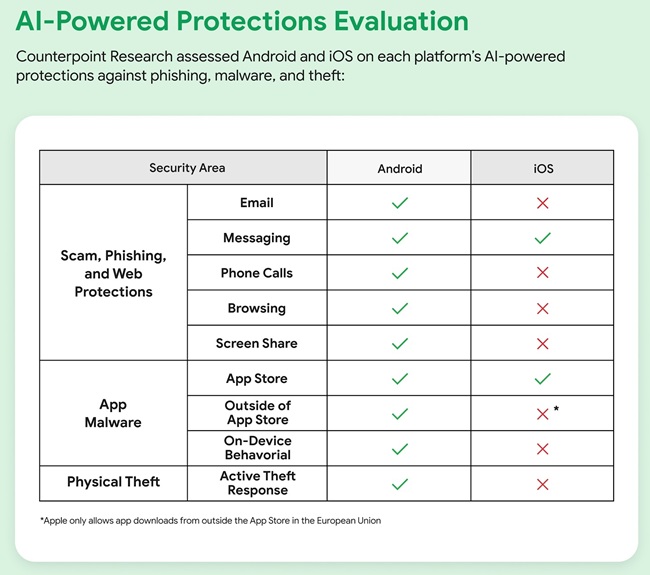
According to a Counterpoint Research evaluation, Android smartphones offer the broadest AI-powered protection, covering ten key areas such as email filtering, browsing safety, and behavioral detection. In contrast, iOS devices were found to use AI in only two protection categories.
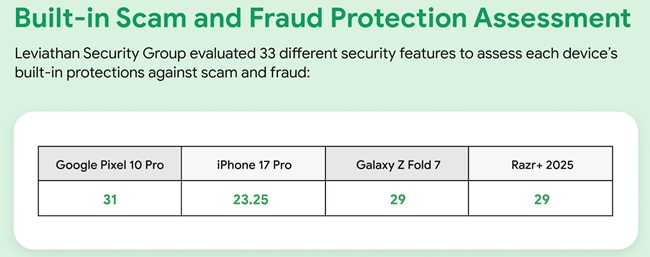
A separate assessment by Leviathan Security Group compared scam and fraud protection on the iPhone 17, Pixel 10 Pro, Moto Razr+ 2025, and Samsung Galaxy Z Fold 7. The study concluded that Android devices, led by the Pixel 10 Pro, provide the strongest default scam and fraud defense.
Highlights included:
- Call screening and real-time scam warnings powered by on-device AI
- Automatic authentication alerts during suspicious calls
- Blocking of high-risk actions such as installing untrusted apps or disabling security settings
These independent findings reinforce that Android’s AI-based protections are more comprehensive and adaptive than those on competing platforms.
How Android protects users from scams
Message protection
- Google Messages automatically filters and moves known spam to the Spam & blocked folder.
- On-device Scam Detection AI scans messages from unknown senders for conversational scam patterns and displays real-time alerts.
- The system also helps block malicious links identified as part of spam or scam messages.
Call protection
- Phone by Google automatically blocks known spam calls before they reach the user.
- Call Screen can answer unknown calls and identify potential fraud attempts.
- Scam Detection AI analyzes live call content locally on the device, offering real-time warnings without saving or sharing any call data.
- Android further prevents social engineering by blocking risky actions and alerting users if their screen is being shared unknowingly.
Broader ecosystem safety
- Google Play Protect continuously scans apps in real time for malicious behavior.
- Chrome’s Safe Browsing, now powered by large language models (LLMs), warns users about unsafe websites or downloads.
Together, these integrated layers form a proactive system designed to identify, block, and neutralize scams across apps, messages, calls, and web interactions.
Always evolving for stronger protection
Google continues to enhance Android’s built-in security with AI models that learn from global threat patterns, adapting automatically to new scam techniques. With ongoing improvements to scam detection, call screening, and Play Protect, Android users remain protected by intelligent, real-time defenses that evolve with emerging threats.