
Apple has introduced the M5 chip, delivering enhancements across AI processing, graphics, and general computing. Built on third-generation 3nm technology, M5 features a 10-core GPU with a Neural Accelerator in each core, offering over 4x peak GPU compute performance compared with M4. The GPU supports third-generation ray tracing, providing up to 45% higher graphics performance than M4.
M5 also includes a 10-core CPU with up to four performance cores and six efficiency cores, delivering 15% faster multithreaded performance than M4. The chip integrates a 16-core Neural Engine, a powerful media engine, and offers 153GB/s unified memory bandwidth, nearly 30% higher than M4 and over 2x M1.
CPU and GPU Features
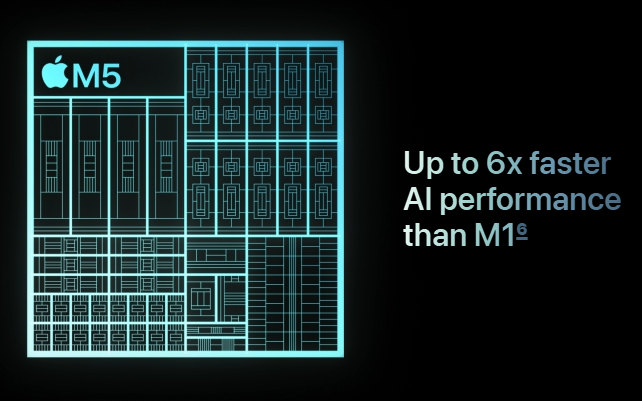
The 10-core GPU architecture in M5 is optimized for AI workloads, with each core containing a dedicated Neural Accelerator. It delivers over 6x peak GPU compute for AI compared with M1.
The GPU, combined with enhanced shader cores and second-generation dynamic caching, provides smoother rendering, faster graphics, and improved performance for complex 3D and graphics-intensive applications.
Key GPU and Developer Features:
- Graphics performance up to 30% faster than M4
- Graphics performance 2.5x faster than M1
- Ray-tracing-enabled apps see up to 45% performance uplift
- Renders 10% more pixels on Apple Vision Pro
- Supports refresh rates up to 120Hz on Apple Vision Pro
- Reduces motion blur and improves display fluidity on Apple Vision Pro
Developers can use Metal 4, Core ML, Metal Performance Shaders, and Tensor APIs to access Neural Accelerators or get automatic performance improvements in supported frameworks
Accelerates AI-driven workflows, including running diffusion models in apps like Draw Things and executing large language models locally using platforms like webAI
Neural Engine and AI Features
The 16-core Neural Engine works alongside CPU and GPU Neural Accelerators to handle AI workloads efficiently. On Apple Vision Pro, it supports AI-powered tasks such as transforming 2D photos into spatial scenes in the Photos app and generating a Persona.
On-device AI tools, including Image Playground, run faster, and Apple Intelligence models experience improved performance. Developers using the Foundation Models framework also benefit from accelerated AI computation.
Memory, Performance, and Energy Efficiency
M5 provides 153GB/s unified memory bandwidth, enabling devices to run larger AI models entirely on-device. With support for up to 32GB memory, users can run multiple creative applications like Adobe Photoshop and Final Cut Pro simultaneously while performing cloud uploads in the background.
The chip is designed for energy-efficient operation, contributing to reduced overall power consumption in devices. This aligns with Apple 2030 carbon neutrality goals, which focus on reducing emissions from materials, electricity, and transportation.
Availability
The M5 chip is included in the 14-inch MacBook Pro, new iPad Pro, and Apple Vision Pro, with pre-orders starting today.
Speaking about it, Johny Srouji, Apple’s senior vice president of Hardware Technologies, said:
M5 ushers in the next major leap in AI performance for Apple silicon. With the introduction of Neural Accelerators in the GPU, M5 delivers a significant boost to AI workloads. Combined with a substantial increase in graphics performance, the world’s fastest CPU core, a faster Neural Engine, and even higher unified memory bandwidth, M5 brings far more performance and capabilities to MacBook Pro, iPad Pro, and Apple Vision Pro.