The Union Cabinet, chaired by Prime Minister Shri Narendra Modi, approved four new semiconductor manufacturing projects under the India Semiconductor Mission (ISM), the Ministry of Electronics and Information Technology (MeitY) announced today in an official release.
Four New Projects Approved
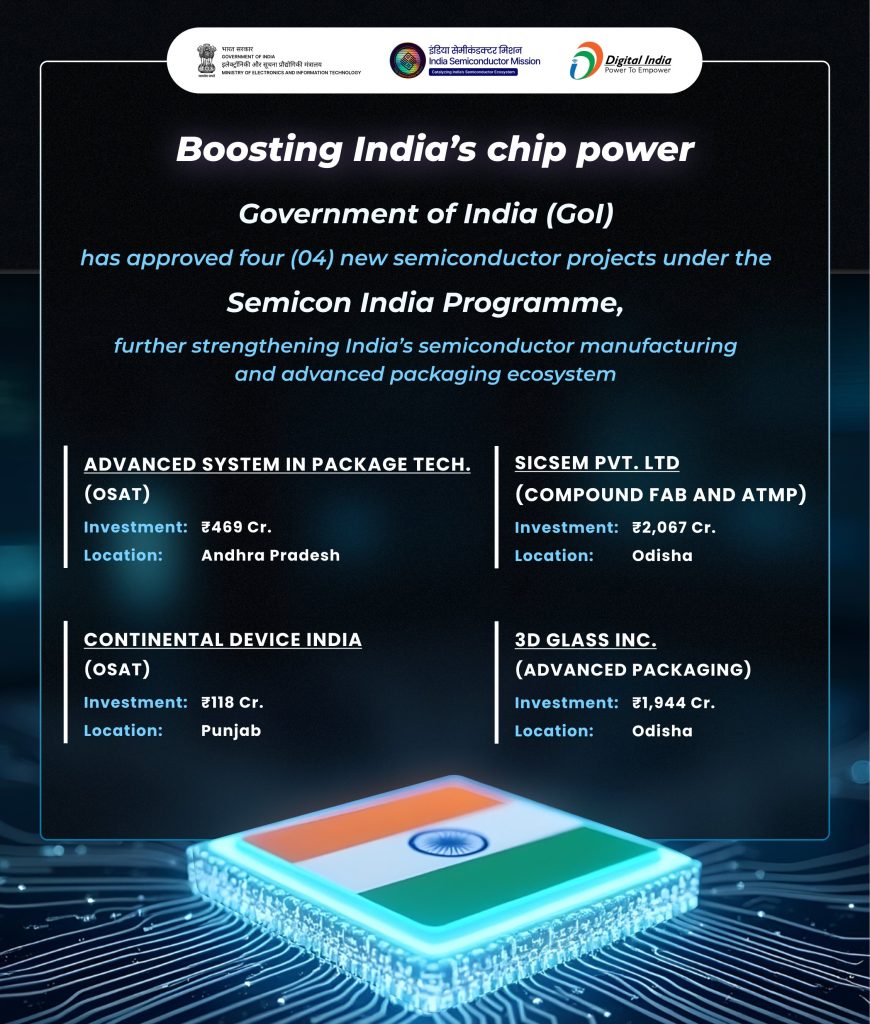
The release stated that with six projects already underway, these four proposals—from SiCSem, Continental Device India Limited (CDIL), 3D Glass Solutions Inc., and Advanced System in Package (ASIP) Technologies—will involve a combined investment of approximately Rs. 4,600 crore.
The projects are expected to generate employment for around 2,034 skilled professionals and stimulate further indirect job creation in the electronics manufacturing sector.
Semiconductor Demand Drives ISM Projects to 10
With this addition, the total number of approved ISM projects reaches ten, with cumulative investments of about Rs. 1.60 lakh crore across six states, the release noted.
Highlighting rising demand for semiconductors in telecom, automotive, data centers, consumer electronics, and industrial sectors, the Ministry emphasized these projects’ role in advancing Atmanirbhar Bharat.
Project Locations and Overview
According to the official release, the new semiconductor projects will be set up across three states as follows:
SiCSem Project in Odisha
SiCSem Private Limited, in collaboration with UK-based Clas-SiC Wafer Fab Ltd., is setting up India’s first commercial SiC semiconductor fab at Info Valley, Bhubaneswar. The facility will process 60,000 wafers and package 96 million units annually for use across defense, EVs, railways, chargers, data centers, appliances, and solar inverters.
3D Glass Solutions Project in Odisha
3D Glass Solutions Inc. will establish a facility at Info Valley, Bhubaneswar, specializing in advanced semiconductor packaging and embedded glass substrates. Using technologies like glass interposers, silicon bridges, and 3DHI modules, the plant will produce 69,600 glass panels, 50 million units, and 13,200 3DHI modules annually for defense, AI, RF, automotive, and photonics applications.
ASIP Technologies Project in Andhra Pradesh
Through a technology collaboration with APACT Co. Ltd. (South Korea), ASIP Technologies will establish a semiconductor facility in Andhra Pradesh. With an annual output of 96 million units, the plant will serve mobile, automotive, and consumer electronics markets.
CDIL Expansion in Punjab
Continental Device India Limited (CDIL) is expanding its semiconductor facility in Mohali, Punjab to produce high-power discrete devices like MOSFETs, IGBTs, Schottky diodes, and transistors using silicon and SiC technologies. The upgraded plant will manufacture 158.38 million units annually for EVs, renewable energy, industrial systems, and communications.
Strengthening the Semiconductor Ecosystem
The Ministry’s release highlighted that these projects include India’s first commercial compound semiconductor fab and an advanced glass substrate packaging unit, reinforcing the country’s semiconductor capabilities.
These initiatives complement government-supported growth of chip design infrastructure across 278 academic institutions and 72 startups.
Additionally, over 60,000 students have benefited from talent development programs aimed at building skilled manpower for the semiconductor sector, the release concluded.
Regarding this, Prithvideep Singh, General Manager, Continental Device India Ltd. (CDIL), said:
For 60 years, CDIL has quietly built the backbone of India’s semiconductor industry. Our Mohali facility, continues its expansion, earlier under the SPECS scheme, and now the ISM approval represents the next major milestone. With this investment, we would expand our installed capacity of 600 million units to over 760 million units annually and sharpen our focus on Silicon and Silicon Carbide chips. We are deeply grateful for the Government of India’s continued trust in our vision, as we remain committed to driving this upward trajectory and contributing to India’s self-reliance in the global semiconductor ecosystem.