
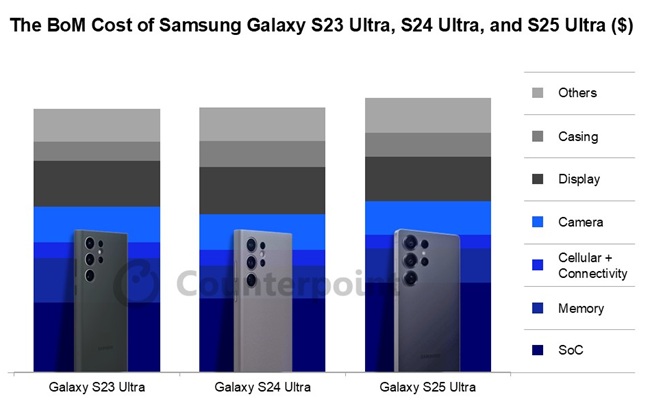
The bill of materials (BoM) for Samsung’s Galaxy S25 Ultra (12GB + 512GB variant) is estimated to be 3.4% higher than that of the Galaxy S24 Ultra, according to the latest report by Counterpoint Research. While the S24 Ultra had seen a modest rise over the S23 Ultra, the S25 Ultra’s cost increase is more significant—primarily due to higher SoC costs.
SoC Costs: Major Driver of BoM Increase
Each model experienced higher SoC expenses, but the Galaxy S25 Ultra’s increase was the most significant.
- The SoC transitions from Snapdragon 8 Gen 2 (TSMC N4) in the S23 Ultra to Snapdragon 8 Gen 4 “Elite” (TSMC N3E) in the S25 Ultra.
- The new process allows higher performance and efficiency, integrating around 16 billion transistors.
- It also introduces Qualcomm’s Oryon CPU, a custom in-house architecture aimed at improving CPU performance.
Because of these changes, the SoC expenses increase by 21% from the S24 Ultra to the S25 Ultra.
Memory Costs: Fluctuating Trends
- From the S23 Ultra to the S24 Ultra, memory costs declined due to market conditions.
- For the S25 Ultra, memory costs increased slightly, reflecting recent supply-demand shifts.
Casing: Titanium Cost Peaks Then Drops
- The S24 Ultra replaced aluminum with titanium alloy for the middle frame, increasing casing costs by ~32%.
- In the S25 Ultra, casing costs declined by ~8% due to improved production techniques for titanium frames.
Display: Cost Rises, Then Drops
The S24 Ultra’s display was 4% more expensive than the S23 Ultra’s, due to:
- Higher peak brightness (2600 nits vs 1750 nits)
- Anti-reflective cover glass coating
- Flat glass replacing curved design
The S25 Ultra introduces only minor display changes, and benefits from falling OLED panel prices, resulting in a slight cost reduction.
Camera: Upgrades with Lower Costs
- The Galaxy S24 Ultra swapped the older 10MP (1/3.52″) sensor for a 50MP periscope (1/2.52″) but cut optical zoom from 10x to 5x, balancing costs.
- In the S25 Ultra, the ultrawide sensor was boosted to 50MP (1/2.4″) from 12MP (1/2.55″).
The rest of the camera system remained unchanged, while lower lens and module prices led to an 8% overall camera cost drop.
RF Components: Continued Decline
- The S23 Ultra used two SDR735 transceivers for 5G FR1.
- The S24 Ultra replaced these with a single SDR875, cutting RF costs significantly.
The S25 Ultra further reduced RF costs by over 10%, due to continued maturation of 5G solutions.
What This Means
The Galaxy S25 Ultra’s BoM increase is mainly driven by higher SoC costs due to the shift to TSMC’s N3E process and Qualcomm’s in-house Oryon CPU. Savings in casing, RF, camera, and display components partially offset this rise.
This reflects a significant change in Samsung’s component strategy, signaling ongoing innovation that may affect future pricing.