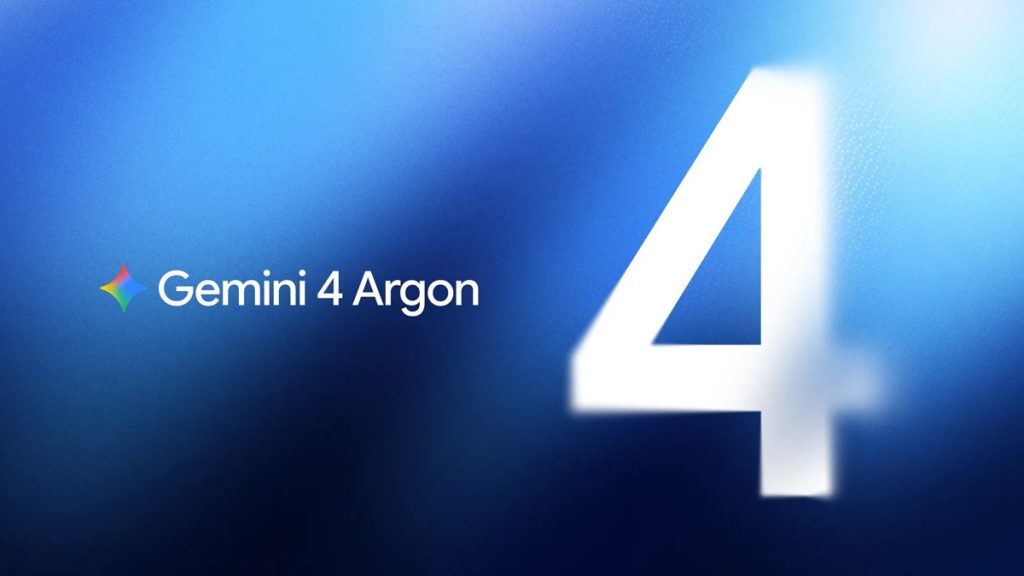
Google has introduced Gemini 4 Argon, its latest AI model for complex, multi-step tasks across coding, finance, legal work, cybersecurity and scientific research. Google says it outperforms other frontier models across several benchmarks and ranks first on the Vals Index, which evaluates AI performance in critical economic sectors such as finance, coding, legal and tax work.
Gemini 4 Argon
Argon combines advanced reasoning, multimodal understanding and expanded domain knowledge. Google has highlighted its use in software engineering, professional workflows, scientific research and robotics, along with improvements to safety measures for advanced AI systems.
Engineering and coding
Google reports that its engineering teams have used Argon to work on difficult software problems. In internal testing, the model increased agentic code submissions in Antigravity by more than 35% and reduced rollbacks by nearly a third. Its applications span large codebases, developer tools and model inference, with the following results:
- Chrome: Helped refactor hundreds of files in Chromium’s 40-million-line codebase, separating core webpage handling from a legacy folder containing around 6 million lines. The work took weeks instead of months and supports moving live webpages between tabs, side panels and floating windows without reloading.
- Agent Development Kit (ADK): Optimizations in the
google/adk-pythonrepository reduced in-memory session preparation time by 40% and cold imports by 21%. - xTB quantum chemistry package: Changes contributed to the official GitHub repository improved molecular structure predictions by up to 2.3x and conformer searches by up to 1.8x.
- Gemma 4 E2B: Inference through vLLM on an NVIDIA A100 achieved a 2.85x end-to-end speedup, raising throughput from around 37,900 to more than 108,000 tokens per second, with 100% token parity and no quality drop.
Google also reports improvements in spatial reasoning, mathematical precision and visual coding compared with previous Gemini models. Its teams use custom skills and multi-agent workflows to develop 3D visualizations, high-fidelity games and interactive animations rendered directly in a browser.
Business and cybersecurity
Argon is intended for professional workflows requiring reasoning across complex documents and datasets. Google says it follows style instructions more consistently than previous Gemini models and communicates more directly, with less hedging, repetition and reliance on clichés. Its applications include legal and financial analysis, scientific research, longitudinal data analysis and interactive analytical tools.
Google highlighted several cybersecurity applications. Under a long-running program with a federal agency, Argon helped identify and remediate a security gap that risked exposing sensitive data and government infrastructure, including critical security-sector development details and specialized models.
In healthcare, it helped uncover a chain of vulnerabilities involving a public file-download bypass that exposed a master key and could grant administrator access. The issues were fixed, helping protect hundreds of thousands of patient records. Wiz is also using Argon in its Scan for Good initiative.
Scientific research
Google highlighted applications in quantum computing, nuclear fusion, rare-disease research and enzyme engineering.
- Quantum computing: Argon translated an internal version of Google’s AlphaQubit quantum error-correction decoder into an optimized hardware kernel, nearly doubling inference throughput. It also produced a formally verified
arcsinquantum subroutine that reduced spacetime cost by more than 100x compared with a published quantum CORDIC baseline. - Nuclear fusion: Google researchers and University of Maryland professor Matt Landreman identified a broader class of counterexamples to Grad’s conjecture, which had suggested that exact mathematical solutions for stellarator magnetic fields were impossible. The resulting solutions provide benchmarks for testing stellarator simulation codes.
- Rare diseases: Gamow Labs used Argon to examine de-identified genomes from newborns with rare developmental lung disorders. In one case, it identified a chromosomal rearrangement that routine software had missed for years and explained why. Private evaluations reported 57% on RareBench for rare-disease diagnosis assistance and 52.2% on LabBench for wet-lab reasoning.
- Enzyme engineering: Argon assembled data, tuned a model and applied biochemistry-inspired filters to produce five new serine esterase designs in hours. Laboratory testing confirmed robust catalytic activity across all five designs. Serine esterases break ester bonds and have applications in recycling and the manufacture of pharmaceuticals, biofuels and detergents.
Robotics
Argon scored 87% on the Embodied Reasoning benchmark (ERQA), which evaluates physical and spatial reasoning in 3D environments. Google says the result outperformed other frontier models in its comparison and relied on reasoning rather than direct interaction with the environment.
In an internal experiment, Argon analyzed video of a person playing cornhole, mapped spatial coordinates and calculated whole-body joint movements before generating simulation code. Google transferred the resulting approach to an Apptronik Apollo humanoid robot, which made seven consecutive shots in a real-world trial. Its Video-to-Sim-to-Real pipeline aims to reduce manual simulation modelling from weeks to hours.
Safety and security
Google says Argon includes protections against harmful requests, agent misalignment and prompt injection, in which malicious instructions hidden in webpages, emails or code attempt to redirect an AI system.
- External biological red-teaming found that Argon could complete fewer than 1% of the tested biological subtasks assessed in the evaluation.
- Policy violations on Google’s adversarial test set fell by nearly 2x compared with previous Gemini models.
- On a coding benchmark measuring attempts to take shortcuts, Argon recorded a 2% rate, the lowest among the Gemini models in Google’s comparison.
- Its attack success rate on the Gray Swan Indirect Prompt Injection benchmark was 0.7% across 15 adaptive attempts.
An automated monitor checks reasoning and actions for unintended workarounds. Google says Argon is trained to respect system boundaries, report negative findings honestly and seek human confirmation before irreversible actions. Further details are available in Google’s Model Card.
Gemini 4 Argon x Gemini app integration
Gemini 4 Argon provides more direct responses and more frequent progress updates on longer tasks. On macOS, users can switch between chat and Antigravity tasks from the main chat window, allowing tasks to continue while they are away from their computer.
Gemini connects with more than 40 apps, including Instacart, OpenTable, Adobe and Shopify, supporting tasks such as grocery shopping, restaurant reservations, design and business-building.
Gemini 4 Argon: Pricing and availability
Gemini 4 Argon is rolling out globally across Google’s developer, enterprise and consumer products:
- Developers: Available through the paid Gemini API tier in AI Studio and Android Studio. Google AI Ultra subscribers can also access it through Antigravity and AI Studio.
- Enterprises: Available through Gemini for business, the Gemini API and Antigravity.
- Consumers: Available in the Gemini app and AI Mode in Search for Google AI Pro and Ultra subscribers.
- Scientists: Google is offering 10,000 scientists six months of free access to the highest Antigravity usage tier. Applications are open, with rolling onboarding subject to eligibility, capacity and selection.
- Cybersecurity defenders: Eligible participants can apply to the Fairwind Program for access without cyber guardrails, with onboarding on a rolling basis.
The Gemini API costs USD 2 per million input tokens and USD 10 per million output tokens, with cached input tokens discounted by 95%. Argon supports a unified 1-million-token input and output limit. Google provides documentation on the continuation protocol and setup requirements, and says additional Gemini 4 family models will follow.