
OpenAI has announced ChatGPT for Academic Researchers, a new program that will provide 100,000 researchers at selected academic institutions with free access to its frontier AI models and tools through 2027. The initiative is designed for scientists, mathematicians, and engineers, supporting research activities across disciplines, from hypothesis generation and coding to grant writing, publishing, and scientific analysis.
ChatGPT for Academic Researchers: Features
Participants will receive free access to ChatGPT, ChatGPT Work, and Codex, including GPT-5.6 Sol Pro at launch and the broader GPT-5.6 family of models.
Key highlights include:
- GPT-5.6 Sol Pro at launch
- Expanded Deep Research capabilities
- Higher usage limits
- Larger context windows
- Business-grade privacy and security protections
- Data not used to train OpenAI’s models by default
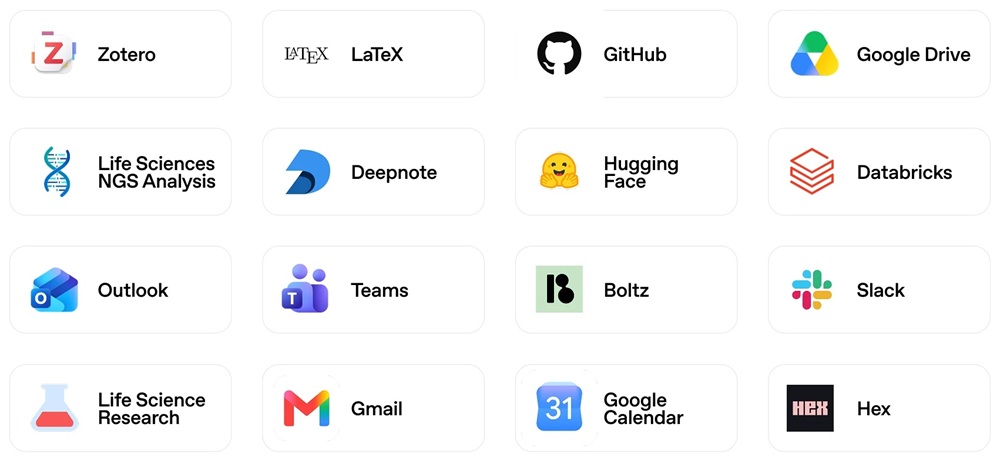
Researchers can also access more than 75 life science skills covering genetics, genomics, sequencing, single-cell analysis, protein modeling, and drug discovery. Connectors provide access to scientific literature, public genomic and clinical databases, satellite imagery, computational notebooks, data platforms, and reference managers.
Together, these capabilities support scientific reasoning, agentic execution, and research workflows across disciplines.
AI adoption in scientific research
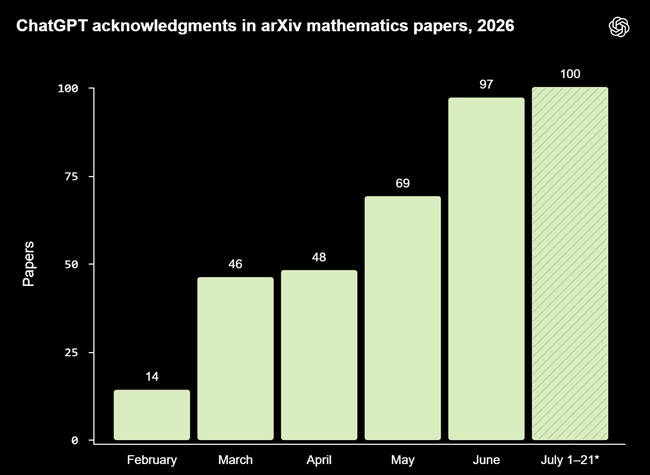
According to OpenAI, around 1.3 million people use ChatGPT for advanced science and mathematics every week, generating approximately 8.4 million messages. The company also noted that acknowledgements of ChatGPT in arXiv mathematics papers have increased over the past six months, reflecting wider adoption of AI in mathematical research.
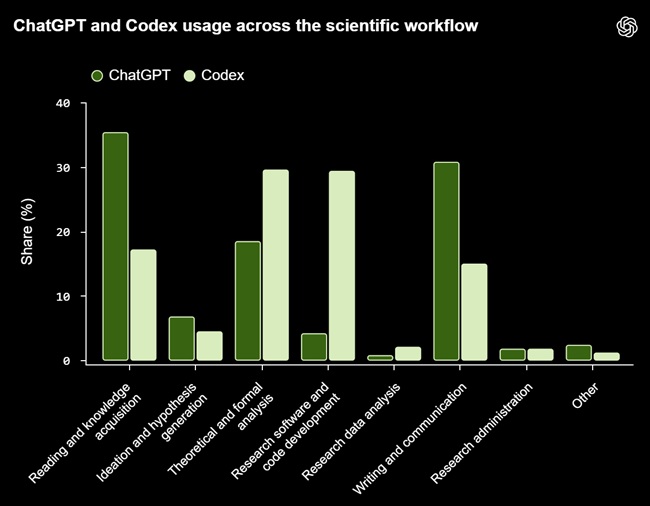
OpenAI said researchers are using ChatGPT and Codex across nearly every stage of scientific work.
Some supported use cases include:
- Interrogating ideas and acquiring knowledge
- Hypothesis generation
- Literature reviews
- Coding, debugging, and data analysis
- Grant proposal preparation
- Manuscript drafting and publishing
- Building reproducible research workflows
- Creating materials to communicate research findings
ChatGPT primarily supports idea exploration, literature reviews, hypothesis generation, and communicating research findings, while Codex focuses on research execution and formal analysis. ChatGPT Work is designed for longer projects such as finding funding opportunities, preparing grant applications, reviewing literature, drafting manuscripts, and creating materials to communicate research results.
OpenAI highlighted several research examples. Physicist Rogerio Jorge and his team are using AI to develop open-source fusion research software used by industry and national laboratories to design fusion energy devices. In theoretical computer science, Barna Saha, Yinzhan Xu, and Christopher Ye used GPT-5.5 Pro to develop a proof establishing new limits on how efficiently computers can solve high-dimensional geometry problems before validating and refining the results themselves.
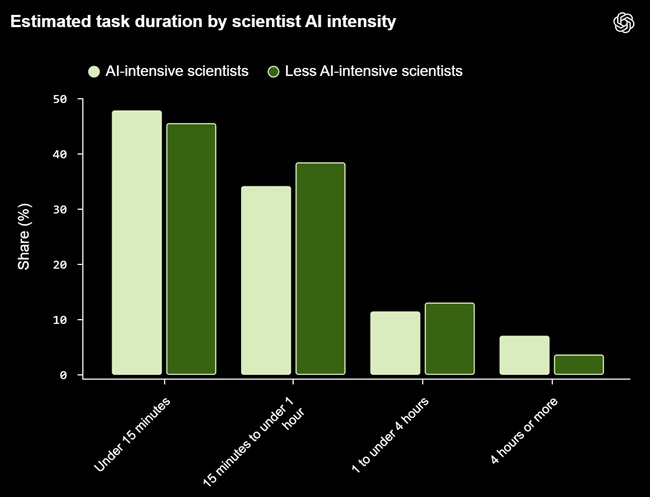
Researchers in the top 20% of AI usage within their field are also nearly twice as likely as their peers to assign AI tasks estimated to take four hours or longer, accounting for nearly 7% of their requests compared with 3.5% among other researchers in the same field.
GPT-5.6 models and benchmark performance
The GPT-5.6 family includes:
- GPT-5.6 Terra for everyday research tasks
- GPT-5.6 Luna for faster responses on lighter workloads
- GPT-5.6 Sol for advanced scientific and mathematical reasoning
According to OpenAI:
- GPT-5.6 Sol scored 83% on FrontierMath Tier 4, which measures research-level mathematical reasoning, compared with 72.5% for GPT-5.5.
- GPT-5.6 Sol Pro solved 31.5% of tasks on GeneBench Pro, which evaluates complex biological data analysis and scientific reasoning.
Training and support
The program includes training tailored to different levels of AI experience, ranging from first-time users to researchers developing advanced AI applications. Participants will also receive hands-on support from specialists familiar with research workflows, including assistance with integrating the tools into their research. OpenAI also plans to provide opportunities for researchers to share practical use cases and feedback.
Availability
The initial rollout begins this summer with 10,000 researchers, with access already available at the Institute for Advanced Study (IAS) and École normale supérieure (ENS). OpenAI plans to expand the program to 100,000 researchers by 2027.
To apply:
- Researchers must belong to a qualifying, degree-granting academic institution with a high level of research activity.
- Applicants must verify their institutional affiliation.
- Applicants must provide details about their active research and intended scientific use.
- Approved participants can invite up to four collaborators from the same institution, with each collaborator required to verify their affiliation and counting toward the program’s total number of accounts.
For institutions using ChatGPT Edu, access provided through the program will be coordinated through the institution’s existing workspace. Applications are open now.