
OpenAI has announced the general availability of the GPT-5.6 family of artificial intelligence models, introducing GPT-5.6 Sol, GPT-5.6 Terra, and GPT-5.6 Luna. The company has also introduced ChatGPT Work for research and long-form deliverables while expanding Codex capabilities for software development workflows.
GPT-5.6 family
The GPT-5.6 lineup includes three models designed for different workloads. GPT-5.6 Sol is the flagship model focused on coding, knowledge work, cybersecurity, scientific research, and complex reasoning tasks. GPT-5.6 Terra is designed as a balanced model for everyday workloads, while GPT-5.6 Luna targets faster and lower-cost usage.
| Model | Positioning |
|---|---|
| GPT-5.6 Sol | Flagship model for advanced reasoning, coding, science, cybersecurity, and knowledge work |
| GPT-5.6 Terra | Balanced model for everyday tasks |
| GPT-5.6 Luna | Faster and more affordable model |
GPT-5.6 introduces additional reasoning options for complex workflows. The max setting provides more compute time to explore alternatives, run checks, and refine responses. The ultra setting coordinates four AI agents in parallel by default, allowing them to work on different parts of a task simultaneously.
Developers can also build similar workflows using the beta multi-agent capability in the Responses API. Through Programmatic Tool Calling, GPT-5.6 can write and execute lightweight in-memory programs that coordinate tools, process intermediate results, monitor progress, and determine the next steps during a workflow.
According to OpenAI, Programmatic Tool Calling reduces the number of model interactions required for tool-based tasks and supports Zero Data Retention (ZDR).
GPT-5.6 benchmark results
OpenAI reported performance improvements across coding, knowledge work, agentic tasks, cybersecurity, and scientific evaluations. Key benchmark results include:
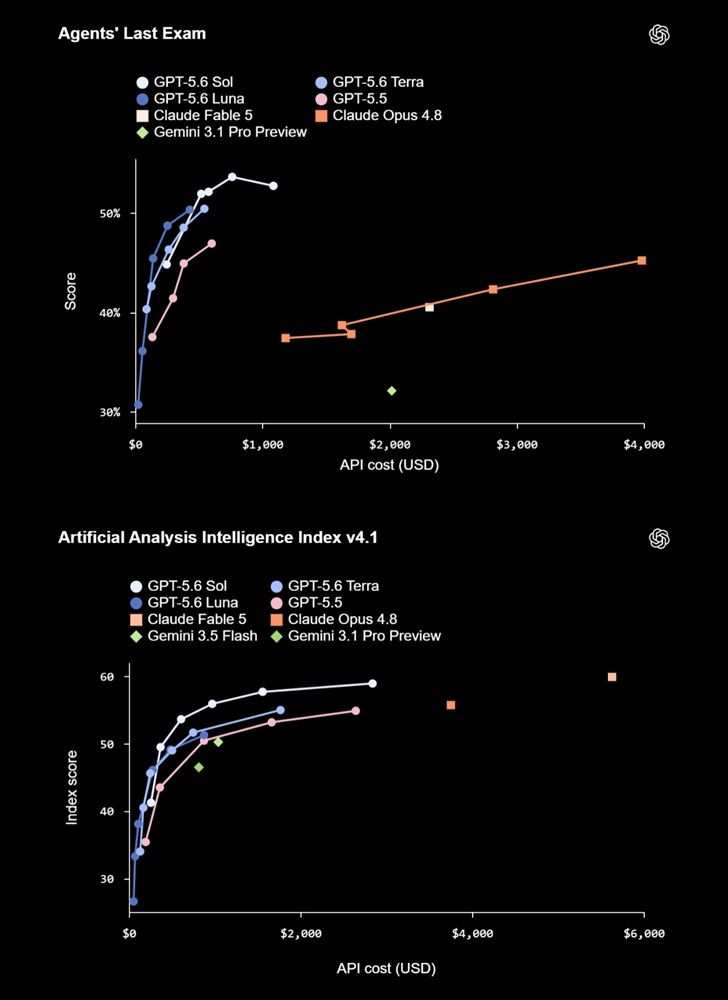
| Evaluation | GPT-5.6 Sol result | Comparison / details |
| Agents’ Last Exam | 53.6 | 13.1 points higher than Claude Fable 5 (adaptive reasoning) |
| Artificial Analysis Intelligence Index | Within 1 point of Fable 5 | Completed tasks 61% faster at around half the estimated cost |
| Artificial Analysis Coding Agent Index | 80 | 2.8 points above Fable 5 with fewer output tokens and lower cost |
| BrowseComp | 92.2% | New high score according to OpenAI |
| OSWorld 2.0 | 62.6% | Surpassed Opus 4.8 while using 85% fewer output tokens |
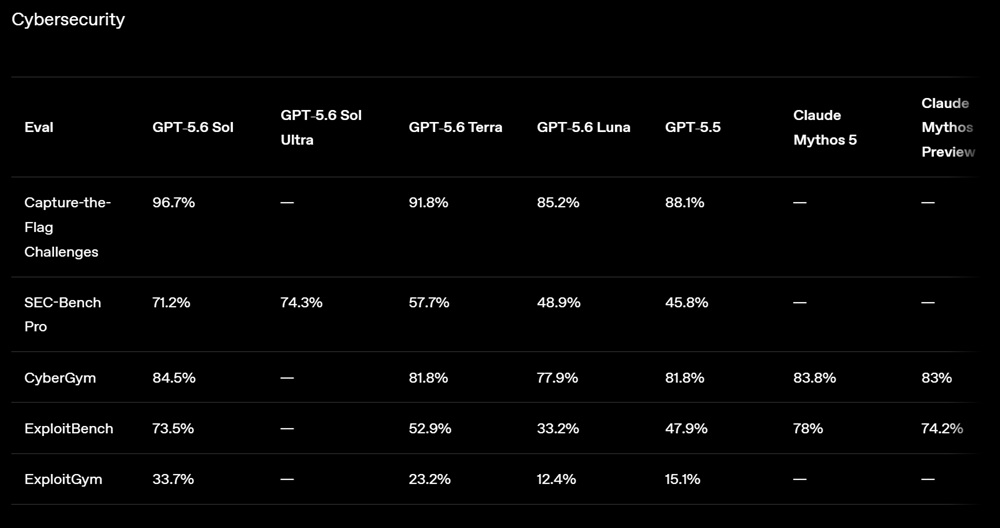
| ExploitBench2 | 73.5% | GPT-5.5 scored 47.9% at a comparable output-token budget |
| ExploitGym3 | 24.9% (2-hour cap) / 33.7% (6-hour cap) | GPT-5.5 peak pass rate was 15.1% |
| SEC-Bench Pro | 71.2% | GPT-5.5 scored 45.8% |
Computer use and knowledge work
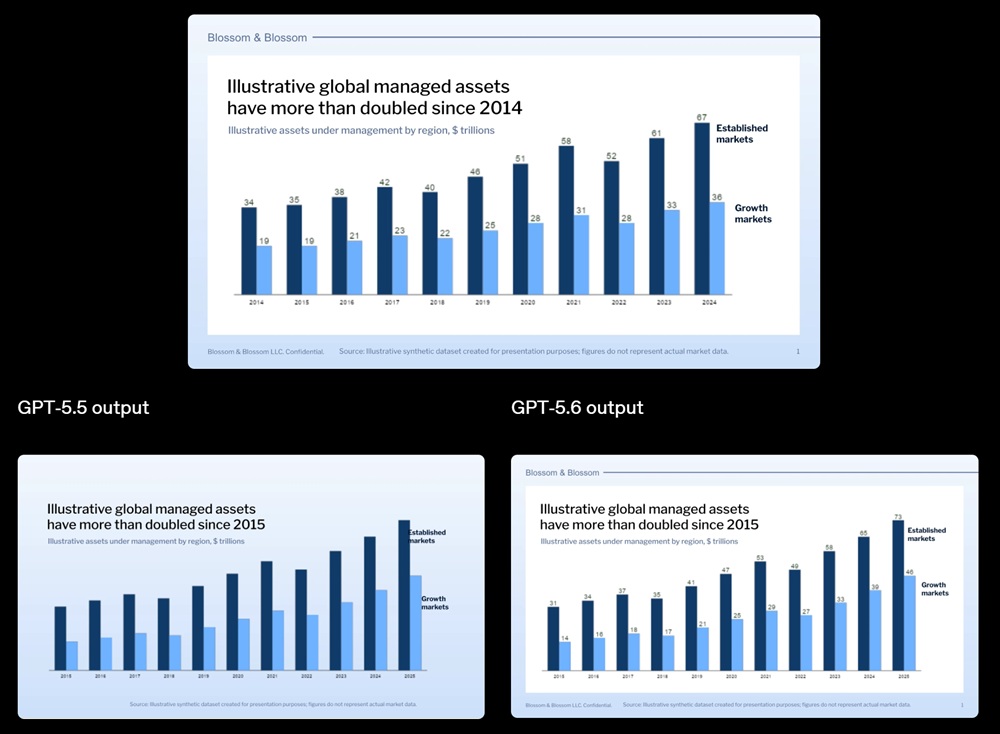
GPT-5.6 Sol improves computer-use capabilities by allowing the model to inspect rendered outputs instead of only generating code or content. This enables it to identify visual and functional issues and refine results before completion.
The model can also generate interfaces from natural-language prompts and create interactive explanations and visualizations within ChatGPT Work.
Key computer-use capabilities include:
- Inspecting rendered outputs before completion.
- Identifying visual and functional issues.
- Refining generated results.
- Creating interactive interfaces and visual explanations.
For professional workflows, GPT-5.6 can work with information from services including Slack, Notion, Microsoft 365, and Google Drive to create reports and other shareable content.
The model can generate fully editable presentations from scratch, along with documents, spreadsheets, reports, and Sites. It can also follow reference files and templates by applying layouts, typography, spacing, colors, and Slide Master rules.
The knowledge work improvements include:
- Creating editable presentations from prompts and source material.
- Following reference decks and templates more accurately.
- Maintaining formatting elements such as layouts, typography, and spacing.
- Improving document structure and worksheet layouts.
- Handling equations and financial models with better precision.
Cybersecurity and science
GPT-5.6 supports defensive cybersecurity workflows, including:
- Secure code review.
- Vulnerability validation.
- Patching.
- Threat modeling.
- Malware analysis.
- Blue teaming.
- Detection engineering.
- Patch validation.
Advanced cybersecurity capabilities are available through OpenAI’s Trusted Access for Cyber program. Individuals can request access after identity verification, while organizations can apply for access for their teams.
OpenAI said individual members using Trusted Access must enable Advanced Account Security with hardware-backed passkeys by September 1 to retain access to advanced cybersecurity models. Users without hardware-backed passkeys can receive preferred pricing from Yubico.
GPT-5.6 also improves scientific workflows across biology, life sciences, and chemistry. OpenAI noted that the models remain below its internal Critical capability threshold for both biology and cybersecurity while supporting research and defensive security activities.
ChatGPT Work and Codex
Alongside GPT-5.6, OpenAI has introduced ChatGPT Work, an experience designed for research, analysis, and creating long-form deliverables. Work can create documents, spreadsheets, presentations, reports, and Sites, while Codex continues to focus on software development tasks such as writing and debugging code, running tests, reviewing changes, and working with repositories.
Users can choose between three ChatGPT experiences:
- Chat: For conversations, brainstorming, search, and quick assistance.
- Work: For research, analysis, and creating deliverables.
- Codex: For coding and technical workflows.
Users can switch between Chat, Work, and Codex from the desktop app. On mobile, users can switch between Chat and Work, while supported Codex desktop tasks can be accessed through the Remote tab in the ChatGPT mobile app.
ChatGPT Work is rolling out to eligible users across web, mobile, and supported desktop apps. On desktop, Work can access local files and desktop applications with user permission, while web and mobile versions run in the cloud and cannot directly access files stored on a user’s computer.
Work also supports:
- Projects to organize related conversations, files, and instructions.
- Scheduled Tasks that can run once, repeat on a schedule, trigger automatically, or monitor for changes.
OpenAI said Work conversations created on web or mobile remain in the cloud and can continue across supported cloud platforms. Desktop Work conversations and local files remain on that computer, while Codex desktop tasks do not appear in web or mobile history.
Safety updates
GPT-5.6 uses a layered safety system that combines model-level protections with real-time checks, continuous monitoring, account-level enforcement, and a reasoning monitor designed to identify potentially harmful requests.
The safety system includes:
- Additional protections for higher-risk cybersecurity capabilities.
- Trusted Access controls for advanced cybersecurity features.
- Monitoring and account-level enforcement.
- Bug bounty programs and rapid remediation processes.
OpenAI said GPT-5.6 Sol blocks around 10 times more potentially harmful cybersecurity activity compared with previous models. If users encounter restrictions in ChatGPT or Codex, they can retry prompts using lower-capability models.
Before general availability, OpenAI tested GPT-5.6 through human red teaming, external expert evaluations, automated testing, and approximately 700,000 A100e GPU hours of automated red teaming.
API pricing
OpenAI has announced the following API pricing per one million tokens:
| Model | Input | Output |
|---|---|---|
| GPT-5.6 Sol | $5 | $30 |
| GPT-5.6 Terra | $2.50 | $15 |
| GPT-5.6 Luna | $1 | $6 |
GPT-5.6 also introduces updated prompt caching features, including explicit cache breakpoints and a minimum cache lifetime of 30 minutes.
For GPT-5.6 and later models:
- Cache writes are billed at 1.25× the uncached input rate.
- Cache reads continue to receive a 90% cached-input discount.
Availability
GPT-5.6 is rolling out globally across ChatGPT, ChatGPT Work, Codex, and the OpenAI API, with the rollout continuing gradually toward full availability over the next 24 hours.
| Platform | Availability |
| Chat | Plus, Pro, Business, and Enterprise users can access GPT-5.6 Sol through medium and higher effort settings. Pro and Enterprise users also get GPT-5.6 Sol Pro. |
| ChatGPT Work and Codex | Free and Go users receive GPT-5.6 Terra. Plus, Pro, Business, and Enterprise users can choose between GPT-5.6 Sol, Terra, and Luna. |
| Reasoning modes | max is available to users with GPT-5.6 access. ultra is available to Pro and Enterprise users in ChatGPT Work and Plus or higher plans in Codex. |
| API | Developers can access GPT-5.6 Sol, Terra, and Luna with Programmatic Tool Calling and beta multi-agent support. |
OpenAI said ChatGPT Work is gradually rolling out to eligible accounts over the coming days.