

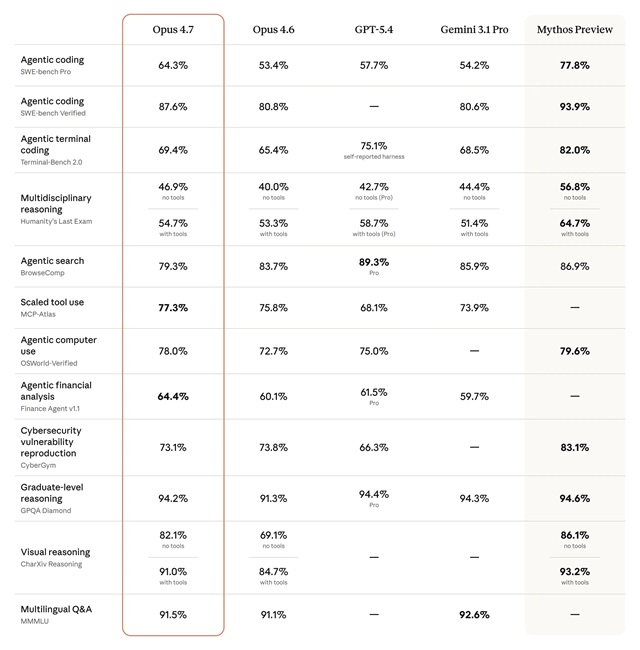
Anthropic has introduced Claude Opus 4.7, now generally available across Claude products and major cloud platforms. The model is a direct upgrade over Opus 4.6, delivering stronger performance in advanced software engineering, long-running AI agent tasks, instruction accuracy, multimodal vision, and real-world knowledge work.
Claude Opus 4.7
Claude Opus 4.7 is designed for complex, long-running workflows that require consistency, accuracy, and structured reasoning. It improves performance in advanced coding, multi-step tasks, and professional knowledge work.
The model shows stronger instruction following, better self-verification, improved memory usage, and enhanced multimodal capabilities. It can now handle difficult coding and analysis tasks with reduced supervision, while remaining less broadly capable than Claude Mythos Preview.
Key features
- Major gains in advanced software engineering and complex coding tasks
- Better handling of long-running, multi-step AI agent workflows
- More precise and literal instruction following
- Improved self-verification before final outputs
- Enhanced multimodal vision with support for images up to 2,576 pixels on the long edge (~3.75 MP)
- Stronger understanding of dense screenshots, diagrams, and visual data
- Improved quality in UI design, slides, and professional documents
- Better performance in finance, legal, and enterprise knowledge work
- Strong results on Finance Agent evaluation and GDPval-AA benchmarks
- Improved file system-based memory across multi-session workflows
- Reduced need for repeated context in long tasks
Safety and alignment
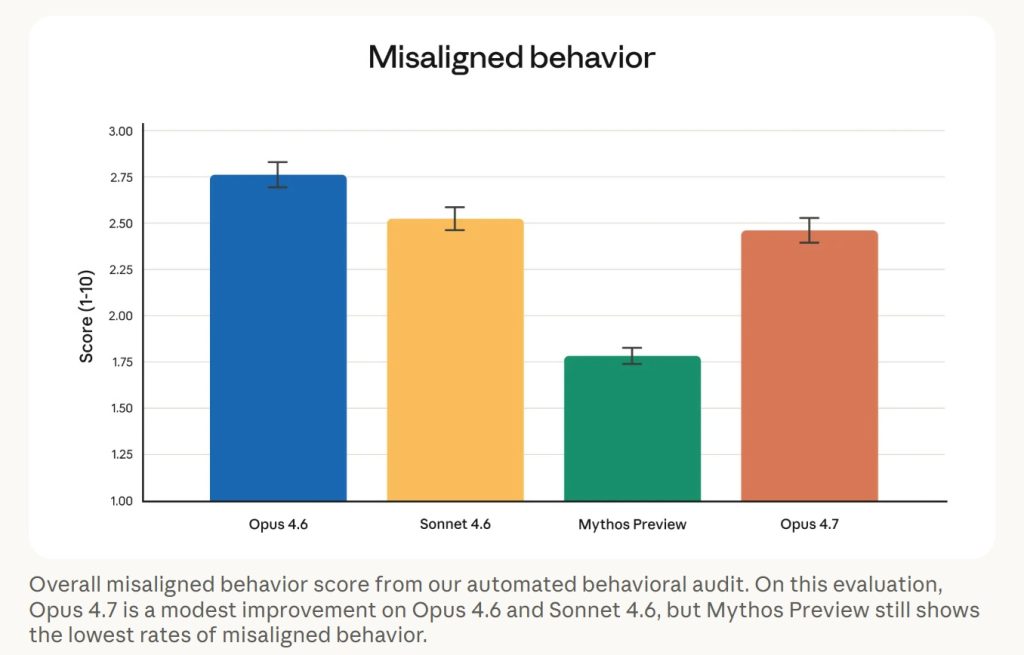
Claude Opus 4.7 maintains a safety profile similar to Opus 4.6, with targeted improvements in honesty and resistance to prompt injection attacks.
Key points include:
- Improved prompt injection resistance
- Better response honesty and reliability
- Similar overall safety profile compared to Opus 4.6
- Some regression in overly detailed responses in sensitive harm-reduction contexts
Anthropic also notes that Opus 4.7 has reduced cybersecurity capability compared to Claude Mythos Preview under Project Glasswing, with built-in safeguards that block high-risk cybersecurity requests.
Security professionals can apply for the Cyber Verification Program for legitimate use cases such as vulnerability research and red-teaming.
New developer tools and platform features
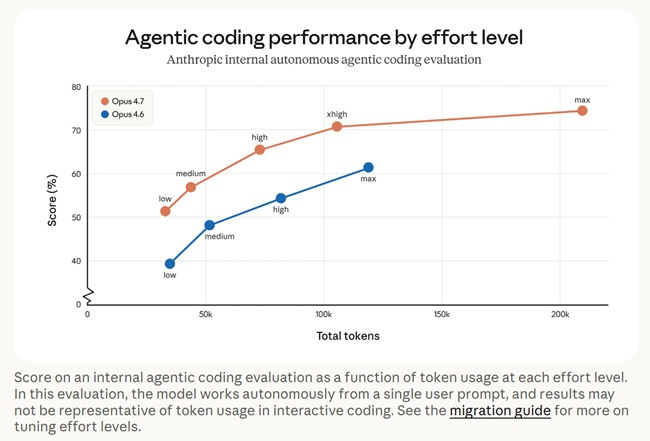
- xhigh effort mode: New reasoning level between high and max for better control of performance vs latency
- Claude Code updates: Default effort level increased to xhigh across plans
- /ultrareview command: Deep code review tool that detects bugs and design issues
- Auto mode improvements: Claude can make permission decisions in long workflows
- API task budgets (beta): Control token usage in long-running tasks
- Improved support for higher-resolution image inputs in API workflows
Migrating from Opus 4.6 to Opus 4.7
Key changes developers should consider:
- Updated tokenizer may increase token usage by 1.0–1.35× depending on input
- Higher reasoning effort produces more detailed outputs in agent workflows
- Increased output tokens due to deeper reasoning in long tasks
- Usage can be controlled via:
- Effort parameter (including xhigh)
- Task budgets in API
- Concise prompting strategies
Anthropic recommends testing real workloads before full migration due to changes in token behavior.
Pricing and availability
Claude Opus 4.7 is available now across:
- Claude apps
- Claude API (model:
claude-opus-4-7) - Amazon Bedrock
- Google Cloud Vertex AI
- Microsoft Foundry
Pricing remains unchanged:
- $5 per million input tokens
- $25 per million output tokens