

At the Augmented World Expo (AWE) 2026, Qualcomm Technologies, Inc. announced the launch of its Snapdragon® Reality Elite Platform. Designed to power immersive spatial computing, the new platform targets a spectrum of form factors, including high-performance all-in-one video-see-through (VST) headsets and lightweight tethered optical-see-through (OST) glasses.
The platform introduces notable architectural enhancements over previous generations, specifically focusing on integrated on-device artificial intelligence, visual fidelity, and thermal efficiency
On-Device Generative AI Performance
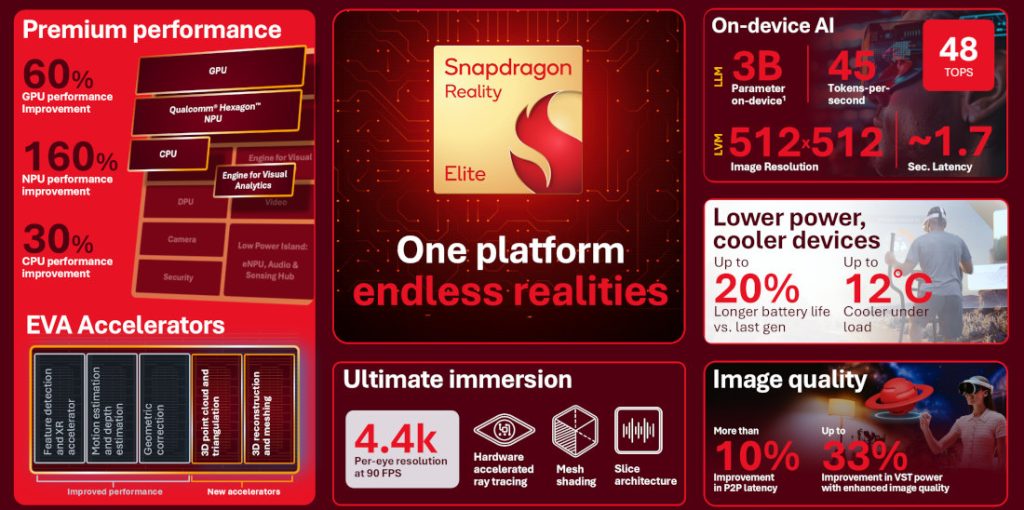
The Snapdragon Reality Elite architecture emphasizes localized AI processing, delivering up to 48 TOPS (Trillion Operations Per Second) of performance via its integrated Qualcomm® Hexagon™ NPU. This localized computing power is engineered to run complex large language models (LLMs) and large vision models (LVMs) directly on-device without relying entirely on cloud processing.
For comparison, internal documentation notes this compute capability outpaces competing hardware solutions, such as the Apple Vision Pro’s 38 TOPS capacity.
Key AI capabilities and benchmarks supported by the platform include:
- Model Compatibility: Optimized for on-device execution of models such as Llama 3B (delivering up to 45 tokens per second with a 0.8-second time-to-first-token) and Stable Diffusion for image resolution at an estimated 1.7-second latency.
- Contextual Experiences: Powers real-time LVM-driven object generation, interactive agents/NPCs, and photorealistic avatars utilizing Gaussian Splatting.
- Tracking and Interaction: Enhances environmental awareness, head and hand tracking, and VST responsiveness to enable more natural user interactions.
Graphical and Processing Benchmarks
Compared to the previous-generation Snapdragon XR2+ Gen 2 chipset, the Reality Elite platform delivers significant generation-over-generation hardware improvements:
| Metric | Improvement vs. XR2+ Gen 2 |
|---|---|
| NPU Performance |
Up to 160% higher performance at equivalent power |
| GPU Performance |
Up to 60% higher performance at equivalent power |
| CPU Performance |
Up to 30% higher performance at equivalent power |
| Power Consumption |
Up to 64% lower GPU power and 45% lower CPU power at identical performance |
The platform supports display resolutions up to 4.4K per eye at 90 frames per second (FPS), supplemented by advanced graphics features including hardware-accelerated ray tracing, mesh shading, and a slice architecture. To optimize bandwidth, the architecture also features a 30% increase in DDR bandwidth.
Hardware Acceleration via the EVA Block
To handle resource-heavy spatial computing tasks smoothly, Qualcomm integrated an updated Engine for Visual Analytics (EVA) block. This hardened hardware accelerator unloads complex computer vision workloads from the main processing units. The dedicated XR accelerators within the EVA block manage:
- Motion and depth estimation
- Feature detection and geometric correction
- 3D point cloud generation, triangulation, reconstruction, and meshing
By delegating 3D reconstruction tasks to dedicated hardware, the system maintains lower overall power draw during spatial mapping. Additionally, advancements in the VST pipeline have yielded an over 10% reduction in peer-to-peer (P2P) latency and up to a 33% improvement in VST power consumption while concurrently enhancing image quality.
Efficiency and Ecosystem Integration
Thermal management and battery life remain critical design constraints for head-worn wearables. Qualcomm indicates that the Snapdragon Reality Elite delivers up to 20% longer battery life under identical workloads compared to prior generations. Furthermore, the chipset operates up to 12 degrees Celsius cooler under load, providing manufacturers with greater flexibility to design lighter, slimmer, and more comfortable consumer headsets and glasses.
The platform is built to integrate cleanly with the broader XR software ecosystem, including Android XR. At launch, the Snapdragon Reality Elite serves as the foundational hardware platform for upcoming consumer hardware, including XREAL’s “Project Aura” and Play for Dream’s next-generation mixed reality devices.
Ziad Asghar, Senior Vice President and General Manager of XR, Wearables and Personal AI, said:
XR adoption continues to expand, with more than 60 million devices already in the market and growing momentum across industries. As more advanced and integrated XR platforms are developed, demand is increasing for XR technologies that deliver higher performance, greater intelligence, and improved power efficiency. Snapdragon Reality Elite is designed to meet those demands with powerful on-device AI, enabling faster, longer-lasting, and more immersive experiences and reinforcing our leadership in VR and MR as we build purpose-built XR chipsets from the ground up.