

Ookla today published a report indicating that in-flight Wi-Fi is becoming a key factor in airline choice, with low-Earth orbit (LEO) satellite networks—particularly Starlink—driving measurable changes in performance.
The report states that as passengers increasingly depend on connectivity for work, streaming, and communication, airlines are placing greater focus on Wi-Fi quality. In-flight connectivity is now positioned as a core part of the travel experience and is influencing customer satisfaction and airline selection.
Performance gap widens with LEO connectivity
The report identifies a widening performance gap between airlines using LEO satellite systems and those relying on geostationary orbit (GEO) infrastructure. Using a benchmark of 25 Mbps download and 3 Mbps upload, it evaluates how consistently airlines deliver usable connectivity for typical onboard use cases such as HD streaming and cloud-based applications.
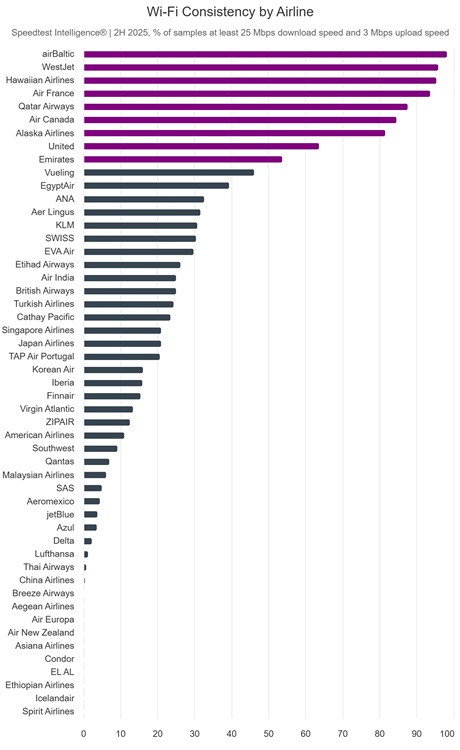
Airlines with Starlink-based connectivity lead in consistency:
Top performers (consistency):
- airBaltic — 98.3%
- WestJet — 95.8%
- Hawaiian Airlines — 95.3%
- Air France — 93.7%
Other high performers:
- Qatar Airways — 87.6%
- Air Canada — 84.6%
- Alaska Airlines — 81.6%
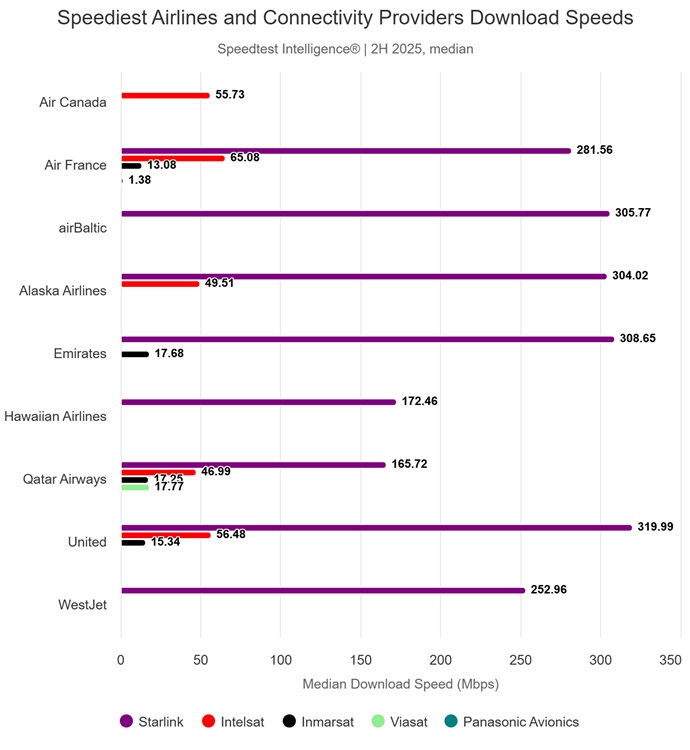
Airlines below the 50% consistency level generally do not have Starlink integration, indicating a clear divide in performance levels.

Speed comparison across providers
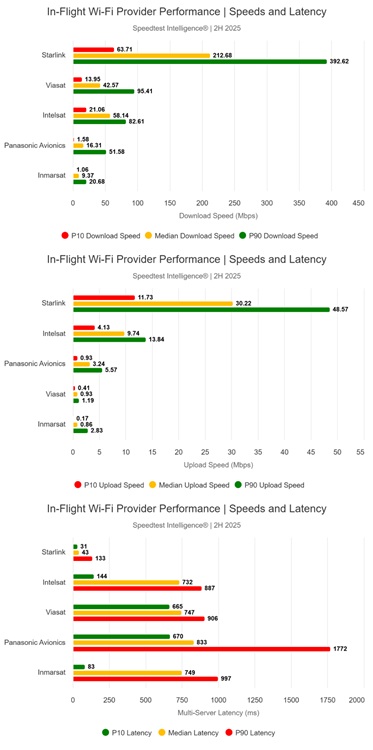
Median download speed data shows differences between connectivity providers.
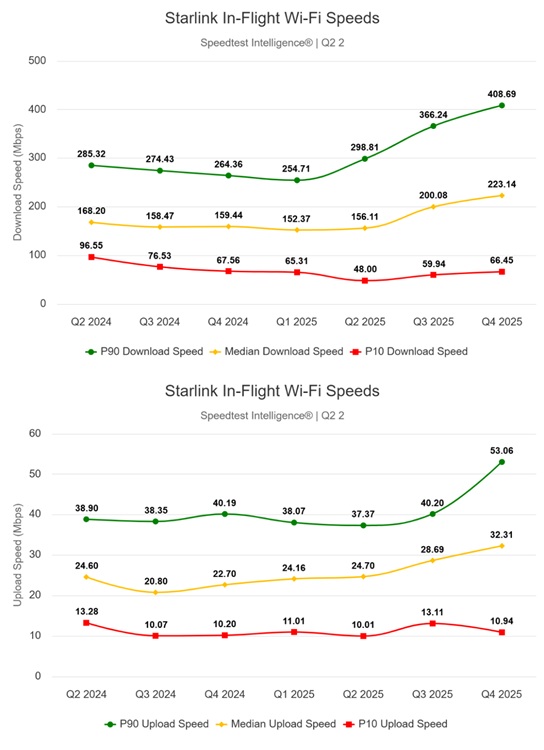
Starlink performance:
- Median speeds — above 100 Mbps
- Peak median — above 300 Mbps
No airline using Starlink falls below the 100 Mbps median level.
Other providers:
- Intelsat — approximately 47–65 Mbps
- Viasat — approximately 56 Mbps
Lower-performing providers include:
- Inmarsat
- Panasonic Avionics
- Deutsche Telekom
The report also notes that lower-end Starlink performance levels remain higher than the average speeds recorded on competing networks.
Adoption trends and market shift
Adoption trends reflect the performance differences across providers.
Market share (Speedtest samples, late 2025):
- Starlink — 47.8%
- Viasat — 25.1%
- Panasonic Avionics — 12.8%
- Others (including Inmarsat and Intelsat) — remaining share
Airlines including United Airlines, Emirates, British Airways, Southwest Airlines, and Scandinavian Airlines are in the process of adopting or expanding Starlink-based connectivity.
At the same time, additional LEO-based competition is expected. Amazon’s Project Kuiper is planned for future deployment, with JetBlue and Delta Air Lines indicating adoption timelines. Aircraft manufacturers Boeing and Airbus are also enabling modular integration of connectivity systems to support upgrades.
What drives in-flight Wi-Fi performance
The report outlines three primary factors influencing performance: satellite system, onboard router technology, and aircraft-level hardware configuration.
LEO satellites operate significantly closer to Earth than GEO systems—approximately 50 times closer compared to more than 3,000 times—resulting in lower latency and improved speed performance.
Router technology also impacts consistency outcomes.
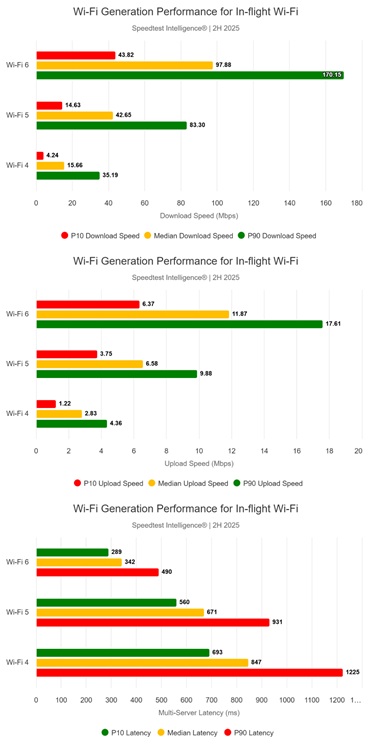
Wi-Fi generation impact (consistency rates):
- Wi-Fi 4 — 14.9%
- Wi-Fi 5 — 28.8%
- Wi-Fi 6 — 56.9%
Performance variation can occur across aircraft within the same airline due to differences in installed hardware and connectivity providers.
Onboard hardware impact
The report notes that onboard hardware continues to influence real-world performance.
Current usage trends:
- Wi-Fi 5 — majority share
- Wi-Fi 6 — increasing adoption
- Wi-Fi 4 — still present in some aircraft
Newer Wi-Fi standards deliver higher speeds and lower latency compared to older systems. Upgrading onboard hardware alongside satellite connectivity is identified as an important factor in improving overall in-flight Wi-Fi performance.
Outlook
The report indicates that in-flight Wi-Fi is transitioning from an additional feature to a central component of the airline experience, with connectivity performance increasingly influencing passenger satisfaction and airline choice.
Starlink currently leads in both speed and consistency, creating a measurable gap between airlines that have adopted LEO-based connectivity and those that continue to rely on older systems.
As more airlines upgrade satellite systems and onboard hardware, and with new entrants such as Amazon’s Project Kuiper expected to enter the market, overall in-flight connectivity performance is likely to improve. However, differences in adoption timelines and fleet upgrades are expected to sustain the current performance gap in the near term.