
Every year, 1.19 million people lose their lives in road accidents across the globe. For anyone between the ages of 5 and 19, a traffic crash is the most likely cause of death. These are not just numbers from a World Health Organization report, they are a stark reminder of a global crisis that demands immediate and effective action. In response, governments worldwide are adopting a strategy called “Vision Zero,” which holds that no loss of life on the road is acceptable. A key aspect of this modern safety approach is a technology known as Vehicle-to-Everything, or V2X.
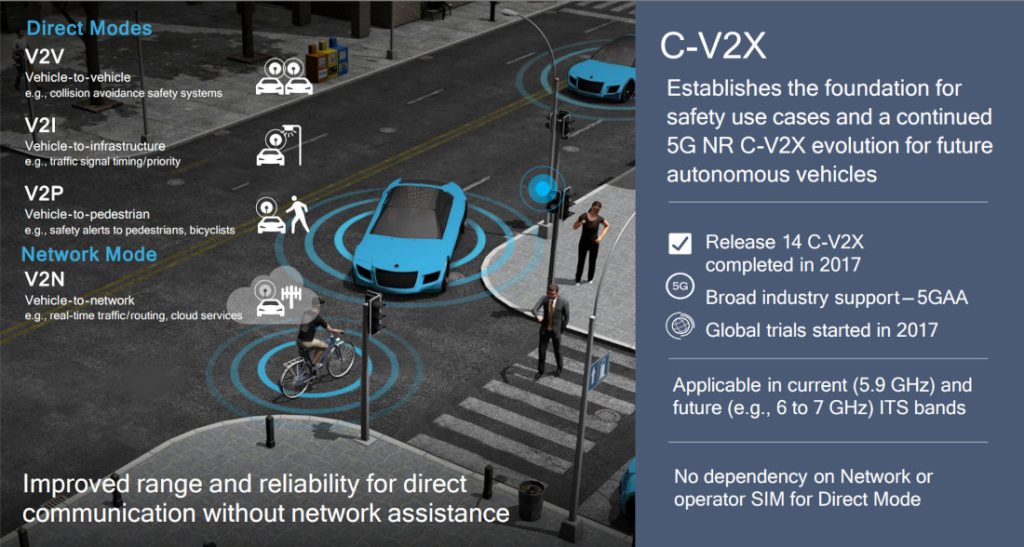
While it may sound complex, the concept is straightforward. V2X is a communication system that allows vehicles to talk to each other (Vehicle-to-Vehicle, or V2V), to infrastructure like traffic signals (Vehicle-to-Infrastructure, or V2I), and even to pedestrians and cyclists carrying compatible devices (Vehicle-to-Pedestrian, or V2P). This creates a seamless, 360-degree awareness bubble around a vehicle, enabling it to see things a human driver, or even a camera, cannot.
This technology operates on a dedicated short-range frequency of 5.9 GHz, a channel set aside globally specifically for road safety. This is crucial because it means V2X does not rely on cellular towers or public Wi-Fi, ensuring that its life-saving alerts are delivered instantly and without interference. It works in any weather, and its signals can see around corners and through other vehicles. Think of it as a sixth sense for your car. This isn’t a subscription service or a luxury add-on; it’s being implemented as a fundamental safety feature, a digital seatbelt for the 21st century.
How V2X Makes Roads Safer
The practical applications of V2X are what make it so transformative. The technology can alert a driver to a vehicle braking suddenly several cars ahead or one approaching a blind intersection, providing crucial seconds to react and avoid a collision. It also provides drivers with real-time notifications of approaching ambulances or fire trucks, allowing them to clear a path and enabling emergency services to reach their destination faster. For a country like India, its role in protecting vulnerable road users, like two wheelers, is especially critical. A low-cost V2X transmitter on a motorcycle or scooter makes the rider “visible” to all V2X-equipped cars, dramatically reducing the risk of collisions that account for a huge portion of our road fatalities.
Beyond direct safety, V2X contributes to better traffic and congestion management by communicating with signals to optimize traffic flow, reduce idling times, and provide drivers with routes to avoid congestion, saving both time and fuel.
In India, Mahindra is leading the way with real-world V2X demonstrations. As part of its collaboration with Qualcomm, the company has deployed vehicle-to-vehicle communication capabilities in test fleets to show how cars can share real-time data; from hazard alerts to intersection warnings, even in dense traffic conditions. This makes Mahindra the first OEM in the country actively showcasing how V2X works on the ground, setting an example for wider industry adoption.
A Proven Technology Being Deployed Globally
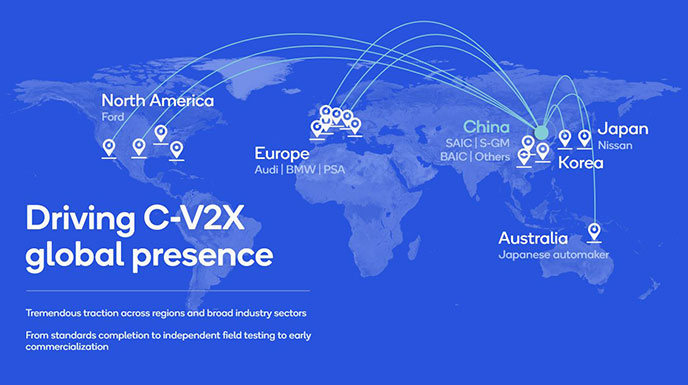
This is not a future-facing concept, V2X is being deployed at scale today. China, as part of a national strategy for intelligent vehicles, has committed over $1.4 trillion to building out the necessary 5G and V2X infrastructure. Over 20,000 roadside communication units have already been installed in more than 90 cities. Automakers like BYD, Volkswagen, and Audi are already launching V2X-enabled vehicles, and the country is on track to add 30 million new V2X cars to its roads every year by 2034.
In Europe, Volkswagen was an early adopter, launching its popular Golf 8 with V2X as a standard feature. By mid-2025, it’s estimated that millions of V2X-equipped vehicles will be active on European roads, driven by the continent’s own Vision Zero goals.
The Clear and Present Case for India
In 2022, India officially reported 168,491 road fatalities and 443,366 injuries. The real injury count is estimated to be as high as 3 million. These numbers are staggering and demand a decisive technological intervention. C-V2X (the ‘C’ stands for Cellular, indicating the technology’s evolutionary path) is a powerful and proven tool that can directly address this crisis.
India has a unique opportunity to not just catch up, but to become a leader in V2X deployment, particularly given its massive number of two-wheelers, which account for 44.5% of road fatalities. For this to become a reality, a clear policy framework is essential. The first and most critical step is for the government to make the 5.9 GHz band available for V2X communications without licensing fees, which is the global standard for a public safety service of this nature. Secondly, including C-V2X testing in the BNCAP safety rating system will create a strong market incentive for automakers to adopt the technology as a standard feature. Finally, a targeted push to equip high-risk categories with V2X would have an immediate impact. This means incentivizing the adoption of cost-effective, transmit-only units on all new two-wheelers, which would simply broadcast their position, speed, and heading. Following this, equipping emergency vehicles and heavy commercial trucks should be a priority.
Road safety is a complex challenge that requires improvements in infrastructure, enforcement, and driver education. However, technology like V2X offers the most powerful and immediate opportunity to reduce fatalities. The automotive industry is ready. The technology is proven. The public sector must now create the policy environment to unlock its potential and build a safer future for everyone on India’s roads.