
Anthropic has introduced Claude Sonnet 5.5, the second model in its Claude 5.5 family. It follows Claude Opus 5.5, which is intended for complex work requiring careful judgment, while Sonnet 5.5 is positioned for well-scoped everyday tasks. Claude Haiku 5.5, aimed at high-volume and cost-sensitive applications, will join the Claude 5.5 family in the coming weeks.
Claude Sonnet 5.5
Sonnet 5.5 improves on Sonnet 5 across performance, coding, knowledge work, long-horizon tasks, image understanding, collaboration, speed, and efficiency. Anthropic reported the following results:
- Terminal-Bench 4.0: 70.6% for Sonnet 5.5, compared with 10.3% for Sonnet 5.
- GDPval-AA: Sonnet 5.5 scores two points below Opus 5.5.
- Long-horizon work: Sonnet 5.5 outperforms Sonnet 5 and GPT-6 Sol on long-horizon knowledge work.
- Image understanding: It is the first Sonnet model to beat Pokémon Red while working only from screenshots.
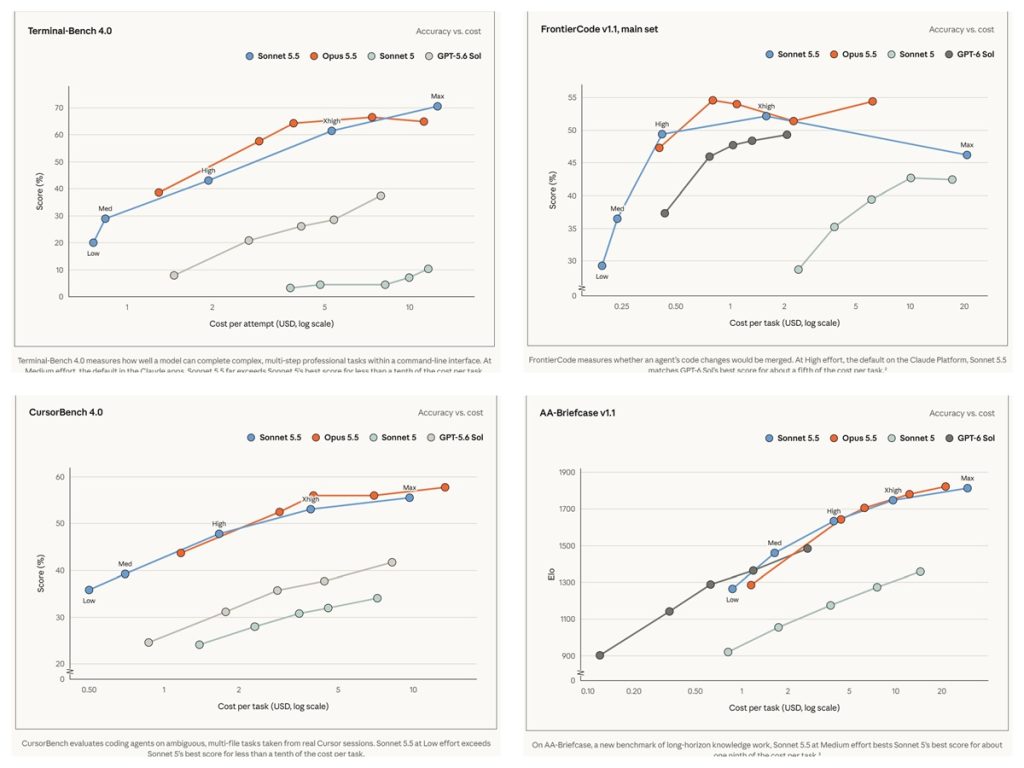
Sonnet 5.5 can operate at different effort levels, which changes the balance between cost, speed, and output quality. On several evaluations, Sonnet 5.5 at Max effort can perform comparably to Opus 5.5, while at Low or Medium effort, Anthropic said it can beat Sonnet 5’s best score on several benchmarks at around one-tenth of the cost per task.
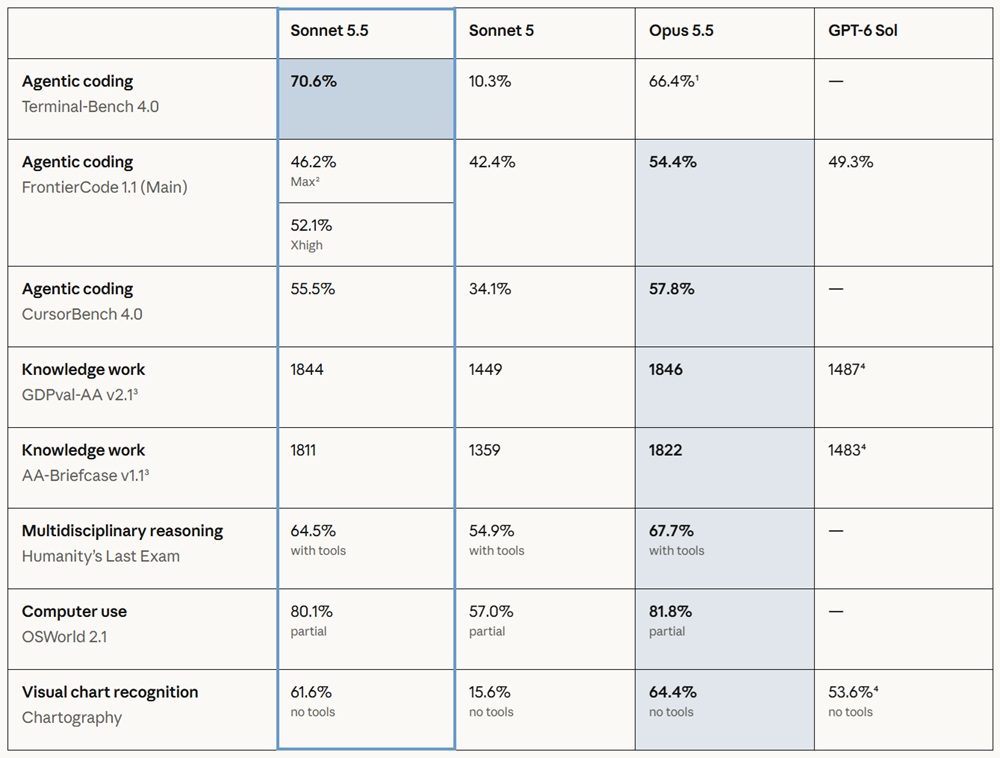
At higher effort settings, Sonnet 5.5 can also perform comparably to Opus 5.5 at a similar cost on some evaluations. However, Anthropic said Opus 5.5 remains stronger in its testing and external testing for complex, open-ended work requiring sustained judgment.
Coding
Anthropic also reported the following coding results for Sonnet 5.5:
- FrontierCode: At High effort, it scores 10 points higher than Sonnet 5 at the same setting, at about one-fifteenth of the cost per task.
- CursorBench: Its best score is within about two points of Opus 5.5 on tasks from real Cursor coding sessions.
Early testers reported that Sonnet 5.5 could understand a codebase quickly. In head-to-head testing, it also batched tool calls more often than Sonnet 5, resulting in fewer steps and lower costs.
Knowledge work
Sonnet 5.5 also improves across several areas of knowledge work. Anthropic reported that it scores nearly level with Opus 5.5 on GDPval-AA, which covers real-world tasks across 44 occupations and nine major industries, and about 400 points above Sonnet 5.
The model is also close to Opus 5.5 in computer use and chart recognition. Anthropic said it outperforms Sonnet 5 and GPT-6 Sol on long-horizon knowledge work. Early testers also reported changes in conversation and design-related tasks, including following slide templates when creating presentation decks.
In one internal test, Anthropic provided a public company’s quarterly earnings materials and call transcripts, together with a slide template, and asked Sonnet 5.5 to create a 10-slide operating review. Two experts judged the first draft ready to send without further editing.
Cost and speed
Sonnet 5.5 uses the same token pricing as Sonnet 5, but Anthropic said it typically requires fewer tokens to complete the same work. In the company’s testing, this results in task costs of up to 30% less than its predecessor.
The token pricing is:
| Price per 1M tokens | Claude Sonnet 5.5 | Claude Opus 5.5 |
|---|---|---|
| Cache reads | $0.20 | $0.20 |
| Cache writes | $2.50 | $5 |
| Input tokens | $2 | $4 |
| Output tokens | $10 | $20 |
Sonnet 5.5 generates outputs more than 30% faster than Sonnet 5. Anthropic identifies it as the fastest Sonnet model to date. Users can adjust the effort level to balance cost, speed, and output quality.
The default effort settings are:
- Claude Code: Medium
- Anthropic apps: Medium
- Claude Platform: High
At lower settings, the model responds faster and uses fewer tokens. At higher settings, it reasons for longer and checks its work more thoroughly.
Safety and alignment
Anthropic said Sonnet 5.5 does not advance the frontier of its models’ capabilities, so its alignment assessment focused on risks relevant to models across capability levels. The assessment covered risks including:
- Acting against users’ interests
- Misleading users
- Cooperating with high-stakes misuse
Anthropic’s automated behavioral audit covers roughly 1,850 scenarios. Sonnet 5.5 improves on or matches Sonnet 5 on most measures of alignment, resistance to misuse, and honesty.
In newer containment evaluations, Sonnet 5.5 came close to Opus 5.5 in how rarely it attempted to escape its sandbox. Anthropic also said Sonnet 5.5 was the least likely of its models tested to probe the limits of its containers.
Across the full audit, Opus 5.5 performed slightly better overall. Anthropic said it found no evidence that Sonnet 5.5 pursues goals that conflict with the user’s intention, while noting that no set of evaluations can reliably detect every possible failure and that the model may have tendencies the company has not identified.
Safeguards
Sonnet 5.5’s cybersecurity capabilities are a large improvement over Sonnet 5’s and are comparable to those of Opus 5. Anthropic is therefore deploying the model with safeguards similar to those used for Opus 5.5.
For cybersecurity, the safeguards include:
- Routine software development and bug fixing remain supported.
- Higher-risk cybersecurity tasks fall back to Sonnet 5.
- Cyberdefenders will soon be able to apply to the expanded Cyber Verification Program.
- The program provides tiered access to advanced capabilities on Sonnet 5.5, Opus 5.5, and Claude Mythos models.
For biology, Sonnet 5.5 uses the same safeguards as Sonnet 5. These target harmful requests, while most research, education, and clinical work remains unaffected. Anthropic noted that some microbiology and virology requests may be incorrectly flagged.
Organizations can apply to the Life Sciences Verification Program for access to safeguards designed to support the full range of biology-related work.
Distillation
Anthropic also addressed the risk of distillation, in which thousands of fake accounts can be used to extract a model’s capabilities at industrial scale. This can allow attackers to create capable models without the safeguards built into Claude.
Because Sonnet 5.5 is substantially more capable than its predecessor, it is the first Sonnet model to launch with safety classifiers that prevent reasoning extraction. It also expands preserved thinking so that Claude’s thinking cannot be decoupled from the account that created it.
The measures include:
- Safety classifiers: Prevent reasoning extraction from Sonnet 5.5.
- Preserved thinking: Claude’s thinking cannot be decoupled from the account that created it.
Most developers will not notice a change. However, moving conversations between accounts can be affected, including switching accounts during a Claude Code session. Anthropic has provided further details in its documentation.
Pricing and availability
As with Opus 5.5 and Sonnet 5, Claude Sonnet 5.5 is available with zero data retention. The model is now available across all platforms, including:
- Amazon Web Services
- Google Cloud
- Microsoft Azure
- Claude Platform
Developers can start using Sonnet 5.5 on the Claude Platform with the model identifier claude-sonnet-5-5.
For developers migrating from Sonnet 5:
- If thinking is turned off, switch to the new
between_toolssetting before moving to Sonnet 5.5. - The setting keeps up-front thinking disabled.
- Anthropic has also provided a migration guide for the transition.
Claude Haiku 5.5, aimed at high-volume and cost-sensitive applications, is expected to join the Claude 5.5 family in the coming weeks.