
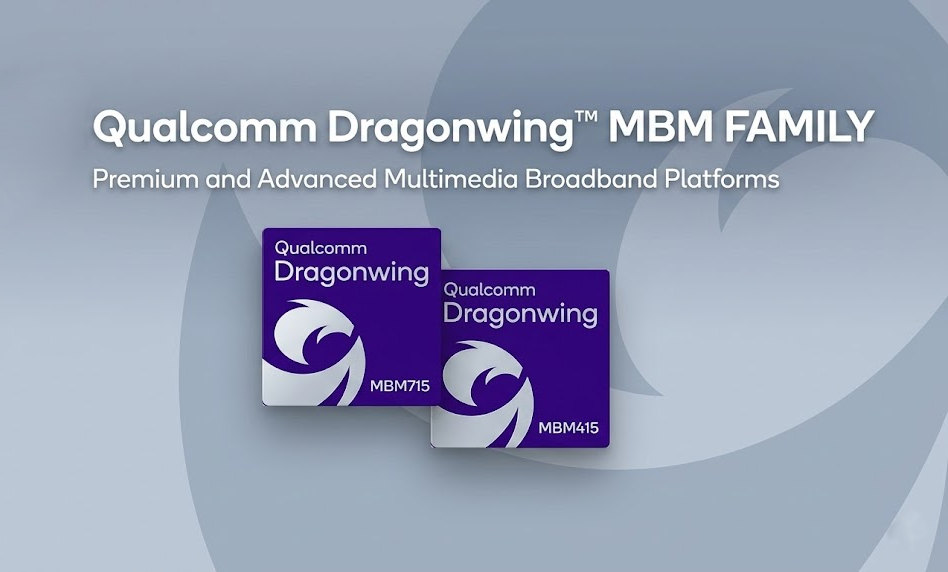
Qualcomm has expanded its hardware portfolio with the introduction of the Dragonwing MBM (Mobile Broadband Multimedia) Family. Positioned alongside existing Dragonwing MBB (Mobile Broadband) and FWA (Fixed Wireless Access) products, this new product line introduces dedicated on-device AI, high-end imaging pipelines, and robust UI rendering capabilities directly into the broadband tier.
Shifting From Connectivity to Interaction
Historically, broadband platforms like the Dragonwing MBB and FWA series were built to act as conduits—optimizing data throughput for hotspots, consumer routers, and industrial gateways. The MBM Family departs from this purely utilitarian blueprint.
By tightly integrating display, camera, graphics, and AI hardware subsystems, these platforms are engineered for interactive, experience-driven use cases, moving broadband devices into the realm of personal multimedia hubs.
Tier Comparison: Dragonwing MBM715 vs. MBM415
The MBM lineup debuts with two tiers: the premium Dragonwing MBM7 Series (headlined by the MBM715) and the mainstream Dragonwing MBM4 Series (featuring the MBM415). Both series utilize an efficient 4 nm process node but target distinct performance and hardware integration brackets.
| Feature / Specification | Premium Tier: Dragonwing MBM715 | Mainstream Tier: Dragonwing MBM415 |
| Target Application | Premium, AI-accelerated multimedia broadband | Cost-efficient, robust multimedia connectivity |
| Max CPU Clock Speed | Up to 2.8 GHz (Qualcomm Kryo) | Up to 2.0 GHz (6x Kryo Efficiency Cores) |
| Cellular Peak Downlink | 4.2 Gbps (Global sub-6 GHz, SA/NSA) | 2.5 Gbps (Global sub-6 GHz, Multi-SIM) |
| Wi-Fi Generation | Wi-Fi 7 (320 MHz channels, 4K QAM) | Wi-Fi 6E / Wi-Fi 5 |
| Wi-Fi Peak Speed | 5.8 Gbps | – |
| Bluetooth Version | Bluetooth 6.0 (LE Audio, Channel Sounding) | Bluetooth 5.3 |
| On-Device AI Engine | Hexagon Processor with Tensor/Vector Accelerators | Qualcomm AI-Enhanced Signal Boost (Modem-focused) |
| Camera Configuration | Triple 12-bit AI ISP; up to 200 MP single capture | Dual 12-bit ISP; up to 64 MP single capture |
| Video Capture / Playback | 4K @ 60 fps (HDR10, HDR10+, HLG, AV1) | 1080p recording / H.264 & H.265 support |
| Max Display Support | On-Device WQHD+ @ 144 Hz; External 4K @ 60 Hz | On-Device FHD+ @ 120 Hz |
| Memory Standards | LPDDR5x (4200 MHz) / LPDDR4x | LPDDR5 / LPDDR4x |
Next-Gen Wireless Integration
The MBM715 leverages the Qualcomm FastConnect Mobile Connectivity System to introduce Wi-Fi 7 capabilities to the broadband market. Utilizing 320 MHz channel spacing and 4K QAM modulation, it reaches peak local wireless speeds of 5.8 Gbps, minimizing latency for real-time applications.
Furthermore, the integration of Bluetooth 6.0 brings Channel Sounding and LE Audio to the ecosystem. These protocols enable precise proximity-based access control and high-fidelity, power-efficient audio streaming directly from the gateway unit.
Hardware-Accelerated Generative AI
A defining element of the MBM7 Series is the inclusion of a dedicated Qualcomm Hexagon Processor architecture. Featuring a Fused AI Accelerator layout that pairs scalar, tensor, and vector engines with a dedicated power delivery envelope, the MBM715 natively hosts Large Language Models (LLMs) and local generative assistants.
Developers can optimize and deploy models onto the platform via the Qualcomm AI Hub, decoupling interface responsiveness from cloud latencies and protecting user privacy via local data execution.
Immersive AV Pipelines
The multimedia subsystems on these chips are structured to run parallel display, camera, and graphics workloads:
- The MBM715 includes a 12-bit Triple Spectra AI ISP capable of running low-light capture, computational HDR, and video super-resolution algorithms concurrently at 4K resolution. It handles intensive graphical rendering via the Qualcomm Adreno GPU, targeting fluid WQHD+ displays refreshing at 144 Hz.
- The MBM415 fields a dual ISP setup designed for straightforward imaging needs alongside 120 Hz FHD+ display outputs, making it ideal for standard smart displays, interactive service terminals, and retail interfaces.
Flexible OS and System Configuration
Recognizing the fragmented nature of network equipment deployment, Qualcomm built the MBM family to remain platform-agnostic. Both the MBM715 and MBM415 offer unified driver support across both Android and Linux kernel distributions.
This multi-OS flexibility allows original equipment manufacturers (OEMs) to customize UI design, modify background network stacks, and pick the precise memory type (LPDDR4x or LPDDR5/5x) necessary to meet specific price-to-performance windows. This versatility ensures optimal power efficiency across diverse industrial, commercial, and residential use cases.