
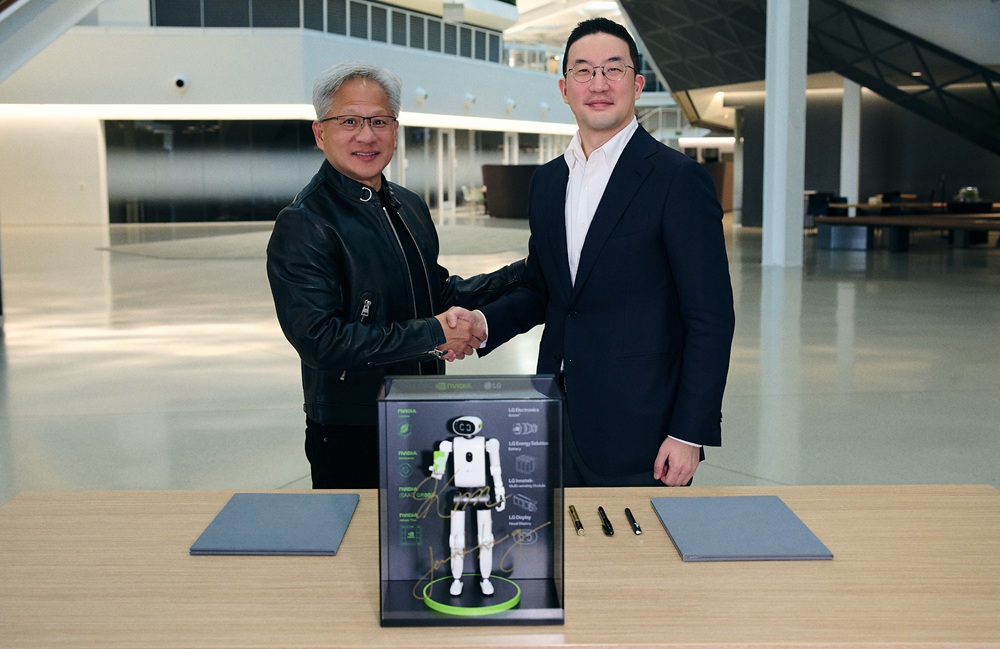
LG is developing a next-generation bipedal humanoid robot using NVIDIA Isaac GR00T, NVIDIA’s open reasoning humanoid foundation model, with plans to publicly unveil it in the first quarter of 2027. The company is also working with NVIDIA on robotics, AI factory infrastructure, and a next-generation AI-defined vehicle platform.
LG and NVIDIA signed a memorandum of understanding (MoU) on August 13 at NVIDIA’s headquarters in Santa Clara, California. LG Corp Chairman and CEO Kwang Mo Koo and NVIDIA Founder and CEO Jensen Huang attended the signing.
Under the agreement, LG and NVIDIA will collaborate across three areas:
- Robotics: Develop and validate humanoid and wheel-based robots, along with the data systems needed for physical AI.
- AI Factory: Build AI factory reference sites using NVIDIA DSX and NVIDIA Vera Rubin.
- Future Mobility: Develop an AI-defined vehicle platform based on NVIDIA DRIVE Hyperion.
Robotics
LG’s next-generation bipedal humanoid will use NVIDIA Jetson Thor for onboard computing, advanced reasoning, and control. It is being developed using NVIDIA Isaac GR00T and NVIDIA Halos for Robotics.
The robot will combine “One LG” capabilities from LG Electronics, LG Innotek, and LG Energy Solution, including:
- Actuators
- Sensors
- Batteries
LG plans to publicly unveil the humanoid in the first quarter of 2027. Alongside this development, the company will deploy LG CLOiD, its wheel-based robot, at LG Electronics’ washing machine manufacturing line in Tennessee within 2026 for validation in a real-world production environment.
Based on the validation results, LG plans to refine the robots’ performance and utility before expanding deployment to global production facilities, homes, and commercial spaces.
Robot data factory
The collaboration also includes work on a robot data factory powered by LG CNS PhysicalWorks, LG’s robot data platform. PhysicalWorks will support an on-site physical AI data factory covering:
- Continuous data collection
- Synthetic data generation
- Robotics training
- Verification
The robot data and manufacturing-site validation experience from the collaboration will also be used in the development of LG’s in-house Robot Foundation Model (RFM), which is currently under development. LG plans to use NVIDIA Isaac GR00T while continuing to advance its own AI model capabilities.
LG and NVIDIA will operate a joint task force comprising technical and business experts. The task force will work across R&D, site validation, and commercialization.
AI Factory
LG is using the NVIDIA DSX AI factory architecture together with “One LG” capabilities across AI infrastructure, including thermal management, power, design, and operations.
The company has outlined two key stages for its AI factory plans:
- First half of 2027: Build an AI factory reference site powered by NVIDIA Vera Rubin.
- First half of 2028: Construct an 80 MW-scale LG AI Factory in Cheonan, Chungcheongnam-do.
The AI Factory is intended to advance physical AI and robot foundation models (RFMs). Through these projects, LG also plans to validate a “One LG” end-to-end AI factory solution based on the NVIDIA DSX platform, covering design, construction, and operations.
LG plans to use the validated solution to pursue business opportunities in the global AI infrastructure market, including turnkey “One LG” package solutions for global big tech customers.
Future Mobility
LG plans to develop a high-performance computing (HPC) platform for next-generation AI-defined vehicles (AIDVs) based on NVIDIA DRIVE Hyperion. The platform will integrate LG’s in-vehicle infotainment (IVI) and automotive software capabilities.
The platform will use NVIDIA’s AI-based autonomous driving technologies and vehicle computing capabilities. Through this work, LG plans to expand its existing vehicle component business, which is centered on IVI, into the autonomous driving domain.
LG plans to provide global OEMs with automotive solutions that combine:
- Autonomous driving features
- In-cabin AI services
Speaking on the development, Kwang Mo Koo, Chairman and CEO of LG Corp., said,
As our discussions have moved fast, our tasks and goals in AI Factory and Physical AI have become clear. We will accelerate the spread of AI by building industry-leading references.
Commenting on the collaboration, Jensen Huang, founder and CEO of NVIDIA, said,
The defining opportunity of physical AI is to give every machine the ability to understand the real world, reason and act safely alongside people — reshaping everyday life from the home and factory floor to the road. Building on years of collaboration, LG and NVIDIA are combining LG’s leadership in product engineering and manufacturing with NVIDIA technology to accelerate the next era of robots, AI factories and autonomous vehicles.