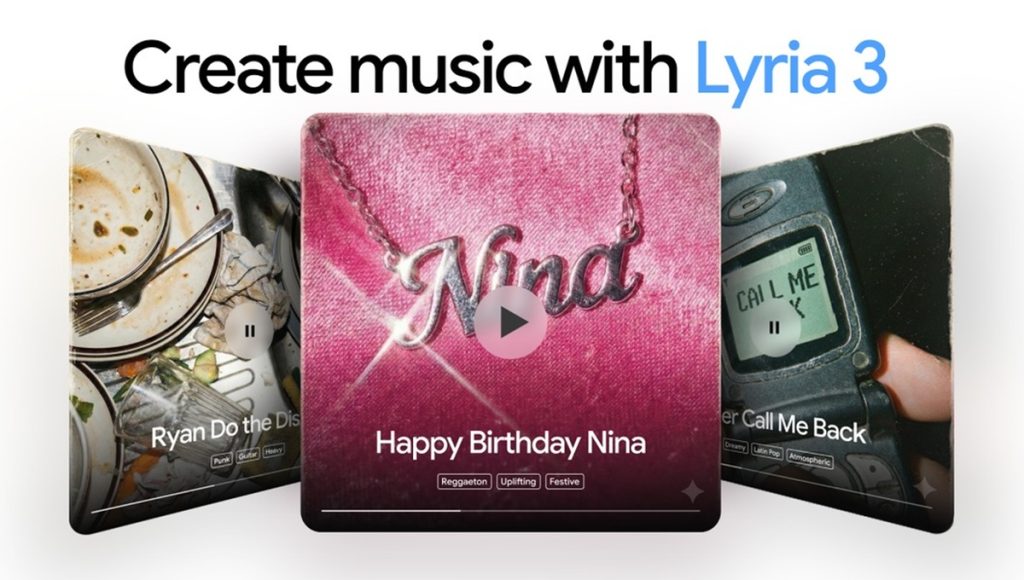
Google has added AI-powered music creation to the Gemini app. The feature uses Lyria 3, the latest generative music model from Google DeepMind, and is rolling out in beta.
Users can generate 30-second tracks by describing an idea or uploading a photo or video. For example, a prompt such as a comical R&B slow jam about a sock finding its match can be turned into a complete track within seconds. Gemini can also take broader creative inspiration from uploaded content, producing lyrics or instrumentals based on the request.
Lyria 3 features and creation modes
Lyria 3 introduces three improvements over earlier versions:
- Automatic lyric generation based on prompts
- Greater control over genre, mood, tempo and vocal style
- More realistic and musically complex output
Music can be created in multiple ways:
- Text to track: Describe a genre, mood, memory or inside joke, such as a nostalgic afrobeat song about childhood memories and home-cooked meals.
- Photo or video to track: Upload visuals and generate music and lyrics aligned with the theme, such as a song about a dog hiking in the woods.
- Inspiration-based prompts: Ask Gemini to creatively interpret uploaded content rather than directly describe it.
Each track includes custom cover art generated by Nano Banana and can be downloaded or shared using a direct link.
Lyria 3 is also available through Dream Track on YouTube, initially in the U.S. and expanding to creators in other countries. It supports enhanced Shorts soundtracks, including lyrical verses and backing tracks.
Verification and safeguards
All tracks generated in Gemini are embedded with SynthID, Google’s watermarking technology for identifying AI-generated content. The Gemini app now supports audio verification alongside image and video. Users can upload a file and ask whether it was created using Google AI tools. Gemini checks for SynthID markers and applies additional analysis before responding.
Google states that Lyria 3 is intended for original music creation and not for imitating specific artists. If an artist is named in a prompt, the system treats it as general stylistic inspiration. Filters compare outputs against existing works, and users can report potential rights violations.
Since introducing Lyria in 2023, Google has worked with the music community and conducted experiments such as Music AI Sandbox. The company says copyright considerations and partner agreements were taken into account during Lyria 3’s training. Users must follow Google’s Terms of Service and generative AI use policies.
Availability
Lyria 3 music generation is available in beta in the Gemini app for users aged 18 and above, supporting English, German, Spanish, French, Hindi, Japanese, Korean and Portuguese.
The rollout starts on desktop with mobile support following in the coming days; Google AI Plus, Pro and Ultra subscribers receive higher limits, and the feature is accessible at gemini.google.com.