The European Commission has informed Meta of its preliminary view that the company may have breached EU antitrust rules by excluding third-party artificial intelligence (AI) assistants from WhatsApp. The move escalates an investigation launched in late 2025 and could lead to interim measures aimed at preventing potential harm to competition while the broader probe continues.
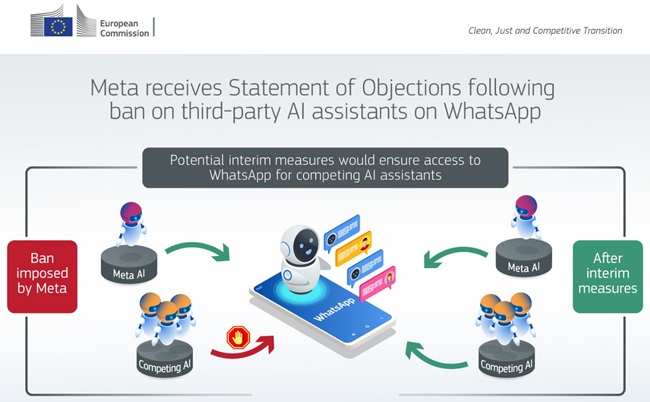
Regulators are examining Meta’s policy restricting how AI providers access WhatsApp’s business tools, which they say may limit competing AI assistants while allowing Meta’s own AI service to remain available on the platform.
Background
In October 2025, Meta announced updated WhatsApp Business Solution terms that prevent AI providers from offering general-purpose AI assistants as their primary service through the platform. Businesses are still allowed to use AI for ancillary or support roles, such as automated customer service, but independent AI assistants cannot operate as standalone services within WhatsApp.
The European Commission opened a formal antitrust investigation in December 2025 to assess whether the policy could breach EU competition rules by limiting third-party AI providers’ ability to reach users in the European Economic Area (EEA).
Meta implemented the updated terms in stages:
- Restrictions applied to new AI providers beginning 15 October 2025
- Existing AI providers were required to comply from 15 January 2026
- Since that date, Meta AI has been the only general-purpose AI assistant directly available within WhatsApp in the EEA
The investigation covers the EEA except Italy, where the Italian Competition Authority initiated separate proceedings to consider interim measures concerning Meta’s conduct.
Commission action and investigation
In February 2026, the Commission issued a Statement of Objections outlining its preliminary assessment that Meta’s policy may violate EU competition law. Regulators warned that excluding competing AI assistants could cause serious and irreparable harm by raising barriers to entry and limiting market access for smaller providers.
The Commission’s early findings indicate that Meta is likely dominant in the EEA market for consumer communication applications, particularly through WhatsApp, which regulators view as an important gateway for AI assistants to reach users.
According to the Commission’s preliminary assessment:
- Meta likely holds a dominant position in EEA consumer messaging services
- WhatsApp serves as a key access channel for AI assistants
- Excluding competitors may amount to abuse of dominance
- The restrictions risk irreversibly harming competition before the investigation concludes
Based on these concerns, the Commission signaled its intention to consider interim measures that could temporarily reverse or suspend the policy while the investigation continues.
If confirmed, the conduct may fall under EU rules prohibiting abuse of a dominant position, including Article 102 of the Treaty on the Functioning of the European Union and Article 54 of the EEA Agreement. The case forms part of the Commission’s broader monitoring of AI markets following consultations launched in January 2024 and a policy paper published in September 2024.
The Statement of Objections does not represent a final decision. Meta has the opportunity to respond and exercise its rights of defence before any measures are adopted.
Outlook
The investigation remains ongoing, and the Commission has emphasized that its preliminary conclusions do not prejudge the final outcome. Meta’s response will be reviewed before any interim or final measures are decided.
Next procedural steps include:
- Meta submitting its formal response to the Commission
- Regulatory assessment of potential interim measures
- Continuation of the full antitrust investigation
Regulators say the immediate priority is preserving competitive conditions while the legal process continues. The outcome may influence how AI services integrate with major digital platforms in Europe and clarify how existing competition rules apply to emerging AI markets.
Speaking on the matter, Teresa Ribera, Executive Vice-President for Clean, Just and Competitive Transition, said:
Artificial intelligence is bringing significant innovations to consumers, and one of these is the emerging market of AI assistants. We must protect effective competition in this vibrant field, which means we cannot allow dominant tech companies to illegally leverage their dominance to give themselves an unfair advantage. AI markets are developing at a rapid pace, so we also need to be prompt in our action. That is why we are considering quickly imposing interim measures on Meta, to preserve access for competitors to WhatsApp while the investigation is ongoing, and avoid Meta’s new policy irreparably harming competition in Europe.