
Anthropic has introduced Claude Opus 5.5, the first model in its new Claude 5.5 family. The company says it performs at the level of Claude Fable 5.1 on most work while costing 40% less to run than Claude Opus 5.
Claude Opus 5.5
Opus 5.5 is also Anthropic’s first model release since its call for pacing frontier AI development. Before release, the model was evaluated by external organizations including METR and Frontier Design, along with Anthropic’s internal safety and alignment testing.
Performance and coding
Anthropic tested Opus 5.5 across coding, computer use and long-running tasks. In one evaluation, the model completed a 680,000-line code migration in less than a day, compared with an estimated several weeks for an engineering team.
Other performance and coding tests included:
- A web application load-time task where Opus 5.5 succeeded in 39 of 40 attempts.
- A game created from a single prompt, where it scored higher than other Claude models based on graphics and polish.
- A 200,000-line codebase audited and fixed in under three hours, compared with more than 20 hours for Opus 5.
- A HAProxy C-to-Rust rewrite completed in 9.5 hours, versus 12 hours for Fable 5.1, at 51% lower cost.
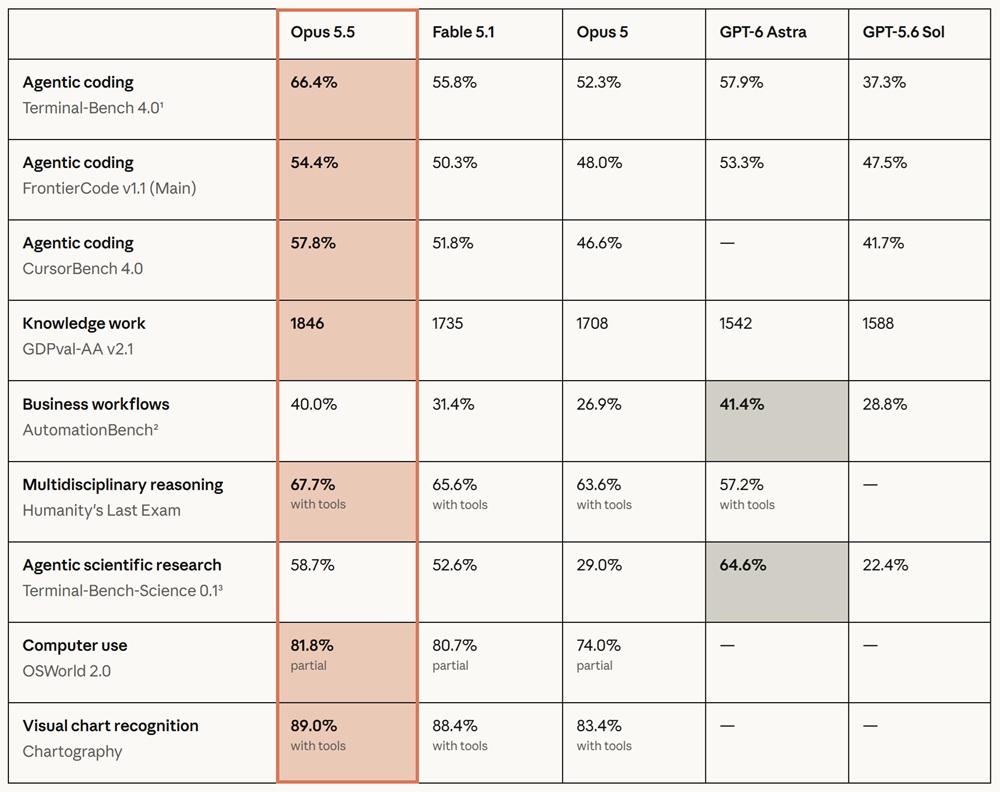
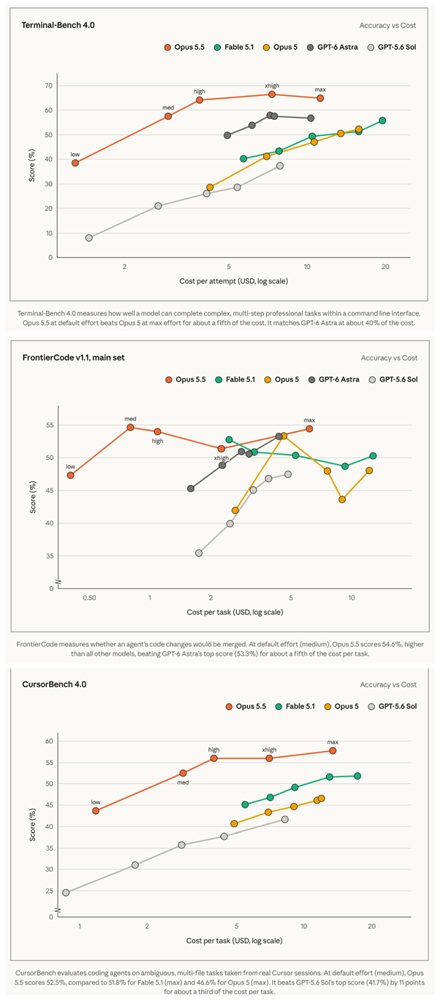
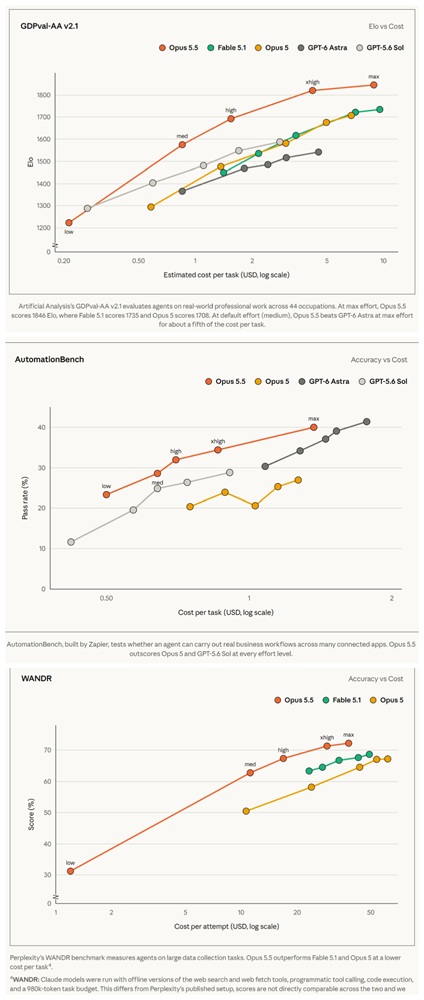
- On FrontierCode, it beat GPT-6 Astra at roughly 20% of the cost per task at default effort.
- On Terminal Bench 4.0, it matched GPT-6 Astra at about 40% of the cost.
- On CursorBench, it scored 11 points higher than GPT-5.6 Sol at about one-third of the cost.
Knowledge work
Anthropic also evaluated Opus 5.5 on research, financial analysis and business workflows. In a quarterly-report task, 16 of 18 reports cleared the company’s quality bar after an automated grader checked every figure and quote.
The knowledge-work evaluations also included:
- Walleye Capital: Opus 5.5 largely solved its evaluation suite at the lowest setting and identified an error in the evaluation instructions that other models had not previously caught.
- Merger analysis: Opus 5.5 and Opus 5 reached the same conclusion after preparing a financial model and executive presentation. Opus 5.5 took 63 minutes versus 93 minutes for Opus 5, at 50% lower cost.
- GDPval-AA v2.1: Opus 5.5 scored 1846 Elo across 44 occupations, ahead of Fable 5.1 and Opus 5.
- GPT-6 Astra comparison: At default medium effort, Opus 5.5 beat Astra at maximum effort at about one-fifth of the cost per task.
Neither Fable 5.1 nor Opus 5 cleared the quarterly-report quality bar in any attempt. Anthropic also notes that benchmark differences at these capability levels do not always directly represent differences in real-world workloads.
Communication
Anthropic has changed Opus 5.5’s communication based on feedback from Opus 5. The model puts important information earlier in responses and uses less jargon and fewer unusual phrases.
The company also reported improvements in the following areas:
- Following user-provided writing rules.
- Keeping responses easier to understand during longer sessions.
- Reducing idiosyncratic wording.
- One early tester described the change as, “it writes the way I do.”
Safety and alignment
Anthropic’s automated behavioral audit covered nearly 2,000 scenarios, including tests for honesty and misaligned behavior. The company says Opus 5.5 improved over recent Claude models on nearly every measured misalignment behavior.
Additional testing covered:
- Containment boundaries: 85% fewer attempts than Opus 5 or Claude Mythos 5.1, with every observed attempt being low severity and self-reported.
- Prompt injection: Matched or exceeded Opus 5 across coding, tool use, computer use and web browsing.
- Alignment testing: Expanded to longer tasks, impossible tasks and scenarios modeled on real incidents.
- Evaluation limitations: Anthropic says models can recognize when they are being tested, making real-world behavior harder to assess.
Safety safeguards
Opus 5.5 uses safeguards covering cybersecurity, biology and model distillation. Anthropic says its cybersecurity and biology safeguards are similar to those used for Fable 5.1.
The safeguards and verification programs include:
- Cybersecurity: Most cybersecurity tasks are routed to Opus 4.8, while routine software development bug identification and fixing remains supported.
- Cyber Verification Program: Expanding to Opus 5.5 with three tiers of increasingly permissive trusted access.
- Biology: Anthropic says Opus 5.5 exceeds Opus 5 and matches or exceeds Claude Mythos 5.1 across several areas.
- Dyno Therapeutics: Testing showed improvements in long-horizon molecular prediction and design.
- Life Sciences Verification Program: Vetted academic labs, startups and pharmaceutical companies can apply for access.
- Distillation protection: Preserved-thinking prevents API users from editing prior context to extract model reasoning.
The preserved-thinking safeguard applies to Fable 5.1 and Opus 5.5 for API accounts created on or after August 31, 2026. Anthropic also says Opus 5.5 supports zero data retention and includes watermarking measures for EU AI Act compliance.
Frontier AI safety
Anthropic says its current approach combines alignment testing, external evaluations and safeguards matched to model capabilities. The company also tracks model risks through its Responsible Scaling Policy.
For future models, Anthropic is working on tighter reinforcement-learning environments, improved alignment rewards, automated safety scenarios, stronger security and monitoring, and interpretability-based evaluation. The company says models capable of fully automating AI research would require a higher safety standard than current systems.
Pricing and availability
Claude Opus 5.5 is priced lower than Opus 5 for standard API usage. Anthropic lists the following rates:
- Input: $4 per million tokens
- Output: $20 per million tokens
- Cache reads: $0.20 per million tokens
- Fast mode input: $8 per million tokens
- Fast mode output: $40 per million tokens
Input and output pricing is 20% lower than Opus 5, while cache reads are 60% lower. Anthropic says cache reads account for the majority of costs in agentic and coding workloads, while typical workloads cost 40% less.
| Metric (Per 1M Tokens) | Claude Opus 5.5 | Claude Opus 5 |
| Cache Reads | $0.20 | $0.50 |
| Input Tokens | $4.00 | $5.00 |
| Output Tokens | $20.00 | $25.00 |
| Cache Writes | $5.00 | $6.25 |
Output generation is more than 30% faster than Opus 5, while Fast mode in Claude Code and Claude Platform offers up to 2.5x speed. Five-hour usage limits have also increased for Pro, Max, Team and seat-based Enterprise plans, with subscription users able to save a rate-limit reset for later use.
Claude Opus 5.5 is available through Anthropic’s platforms, including AWS, Google Cloud and Microsoft Azure, using the claude-opus-5-5 model ID on the Claude Platform. Anthropic says Claude Sonnet 5.5 and Claude Haiku 5.5 will follow in the coming weeks.