

Anthropic has introduced Claude Fable 5, a Mythos-class model designed for general use with safety safeguards, and Claude Mythos 5, a restricted-access version for cybersecurity defenders and scientific research partners. Both models share the same underlying system, with Mythos 5 operating under reduced safeguards in controlled environments.
Claude Fable 5 and Claude Mythos 5
Mythos-class models sit above the Opus class in capability, following earlier models introduced through Project Glasswing. The first model in this tier, Claude Mythos Preview, was released in April.
Model positioning and overview
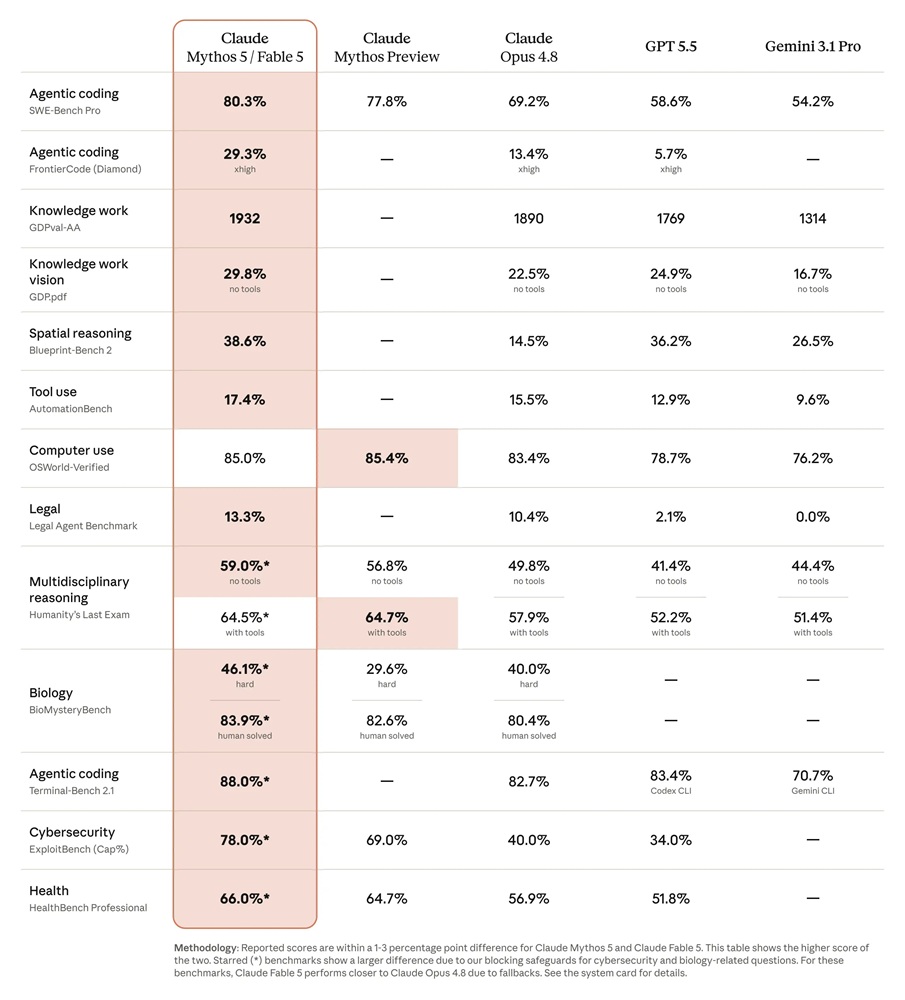
Claude Fable 5 is positioned as Anthropic’s most capable generally available model. It shows strong performance across AI benchmarks, including software engineering, knowledge work, vision tasks, and scientific research. Performance improves further as task complexity increases, with larger gains on long and multi-step workflows.
Claude Mythos 5 is built on the same underlying system as Fable 5 but is deployed with reduced safeguards for approved users. It is currently limited to cybersecurity defenders and selected infrastructure and research partners.
Core capabilities and performance
Software engineering
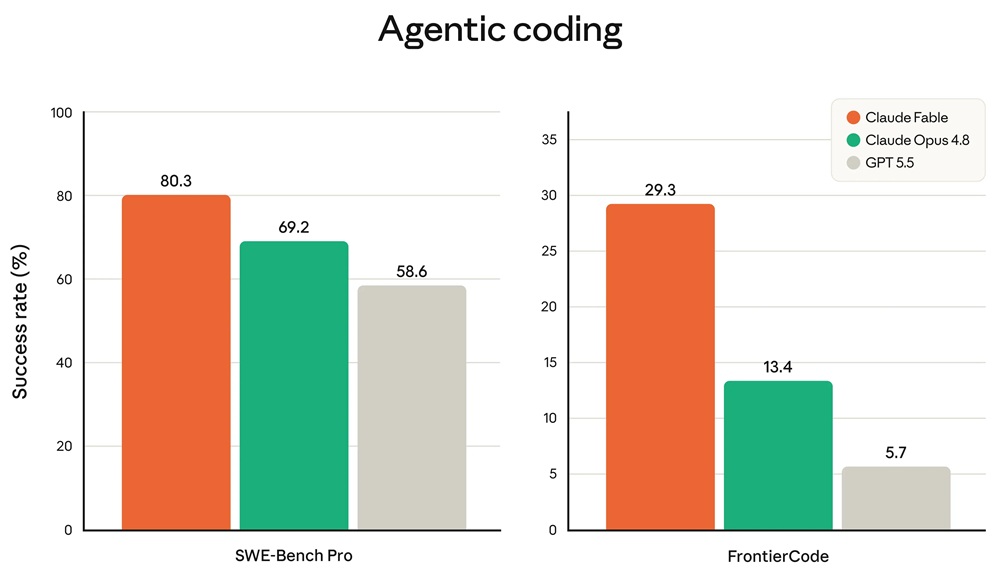
Claude Fable 5 delivers strong improvements in software engineering tasks, including large-scale codebase migrations and system-wide changes. In early evaluations, it completed engineering work that previously required months in a significantly shorter time. It also shows improved efficiency on production-grade coding benchmarks, including Cognition’s FrontierCode evaluation.
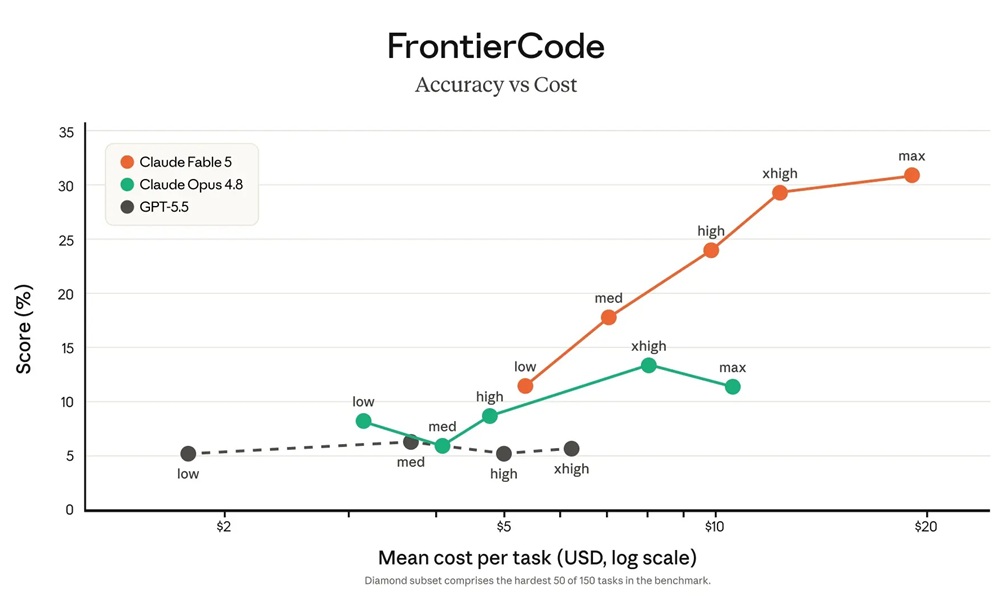
In testing, Stripe reported that Fable 5 compressed months of engineering work into days, including a migration across a 50-million-line Ruby codebase.
Knowledge work and reasoning
The model performs strongly in structured reasoning tasks such as financial analysis, document interpretation, chart and table understanding, and multi-step problem solving.
On Hebbia’s Finance Benchmark, Fable 5 achieved leading performance in senior-level reasoning tasks. IMC evaluations reported strong results across trading analysis tasks, including factual lookup, conceptual reasoning, root-cause analysis, and expected-value analysis.
Vision capabilities
Claude Fable 5 improves visual understanding tasks, including extracting precise values from scientific figures, interpreting complex charts, and reconstructing application code from screenshots.
It also requires less external scaffolding compared to earlier models. In testing scenarios, it successfully completed tasks such as playing Pokémon FireRed using a minimal vision-only setup, where earlier models required additional tooling.
Memory and long-context processing
The model supports extended context handling across multi-million-token inputs while maintaining coherence in long-running tasks. It improves outputs using persistent memory and self-generated notes.
In experimental gameplay scenarios such as Slay the Spire, adding persistent file-based memory improved performance three times more than earlier models, with significantly higher success in reaching later stages.
Scientific research and advanced applications (Mythos 5)
Claude Mythos 5 is used in controlled scientific environments and demonstrates advanced capabilities in biological and computational research, including:
- Protein and drug design workflows
- Binding site selection and bioinformatics tool execution
- End-to-end autonomous research task execution
- Large-scale genomics analysis across millions of cells and 138 animal species
- Generation of novel biological hypotheses
In evaluations, Mythos 5 performed multi-step research workflows with minimal human input and matched or exceeded skilled human operators in specific tasks.
Novel research outcomes
Mythos 5 has contributed to several scientific findings, including:
- Molecular biology hypotheses, with some advanced to experimental testing
- A validated hypothesis involving a novel mechanism in an E. coli protein
- Genomics research using single-cell datasets across 138 animal species
- Machine learning models identifying equivalent cell types across distantly related organisms
- Research outputs that in some cases outperform recently published models, including a model published in Science
Some results are planned for publication, while others remain under active evaluation.
Alignment and behavior assessment
Internal assessments indicate that Mythos 5 shows low levels of misaligned behavior, including reduced deceptive outputs and limited cooperation with misuse scenarios. Its behavior is reported to be similar to earlier Opus-class models.
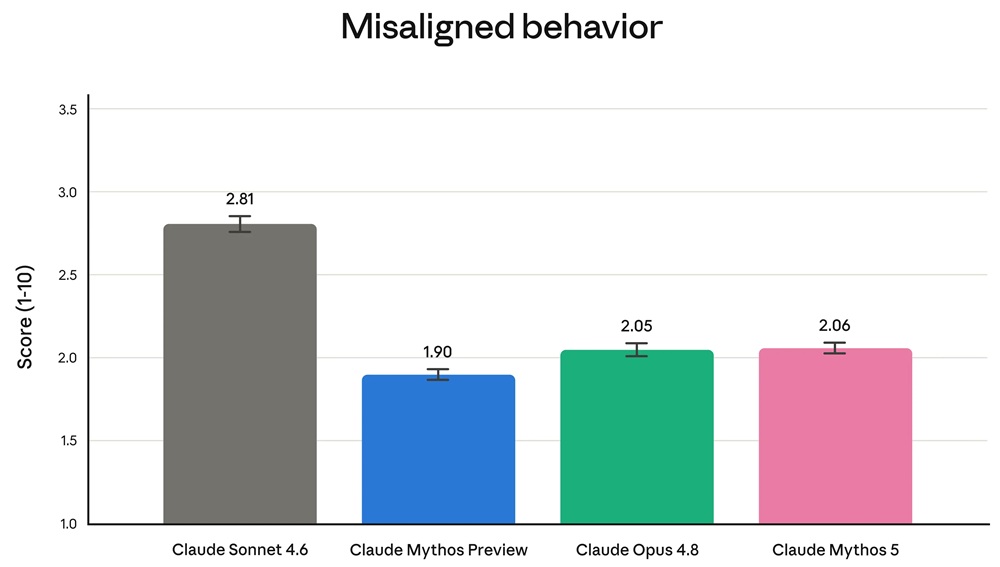
Because Fable 5 is built on the same underlying system, its alignment characteristics are expected to be similar.
Safety systems and safeguards
Claude Fable 5 includes expanded safety systems designed to reduce misuse risks while maintaining usability.
Safety classifier system
The model uses AI-based classifiers to detect sensitive or potentially harmful requests. When triggered, responses may be routed to Claude Opus 4.8 instead of Fable 5.
These systems cover cybersecurity, biology and chemistry, and model distillation-related risks. Most user sessions do not trigger fallback behavior.
Cybersecurity safeguards
Fable 5 includes protections against offensive cybersecurity use cases such as vulnerability exploitation and multi-step attack workflows, including reconnaissance, discovery, and lateral movement.
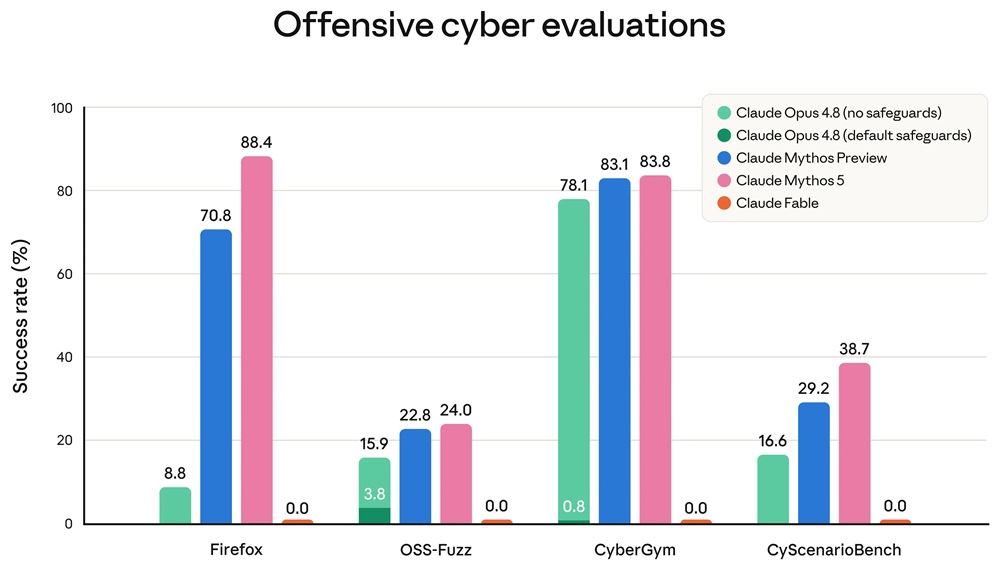
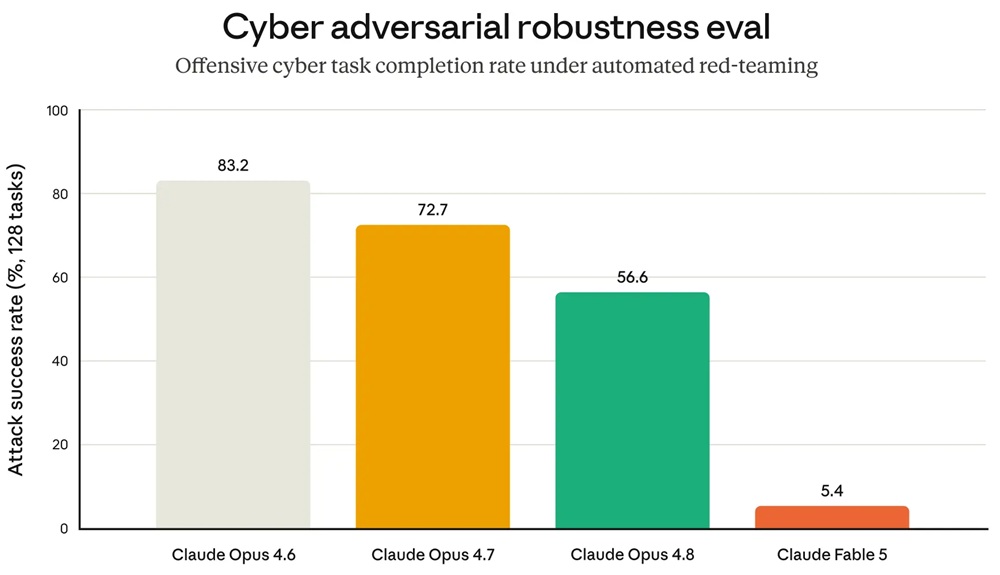
Extensive red-teaming, internal evaluations, and external bug bounty testing report strong resistance to jailbreak attempts, including attempts using known public techniques.
Biology and chemistry safeguards
Stronger filtering is applied to sensitive biological and chemical research tasks due to increased model capability in these domains. These safeguards are broader than earlier systems and may occasionally flag benign requests.
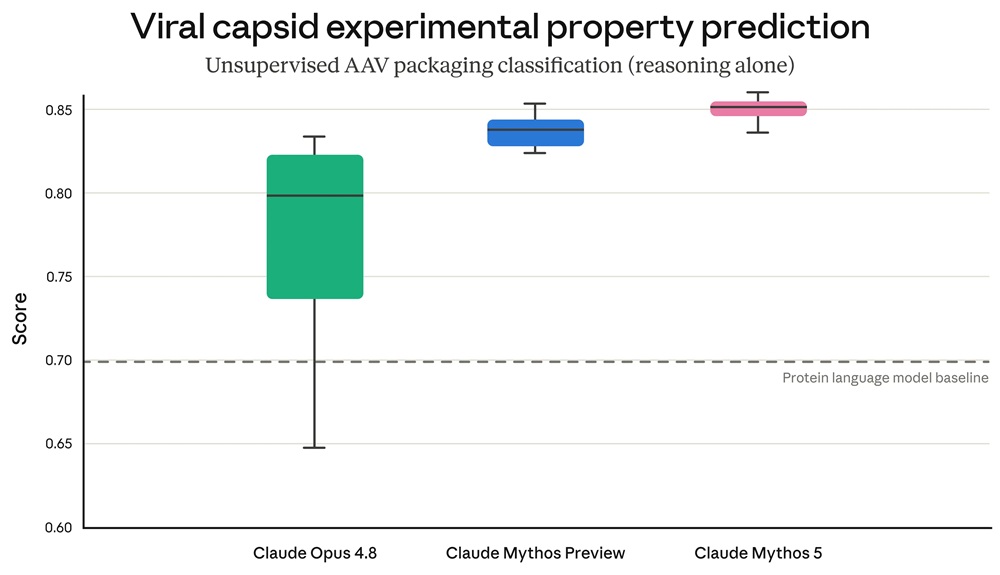
A tested example includes adeno-associated virus (AAV) design tasks, where models demonstrated strong predictive ability in genetic modification impact analysis, highlighting both scientific potential and dual-use risk.
Distillation protection
Systems are designed to detect attempts to extract or replicate model behavior for training competing models. Flagged requests may be redirected to safer responses.
Data retention policy
Anthropic applies a 30-day retention policy for business traffic involving Mythos-class models.
- Data is not used to train new models
- Access is strictly logged and monitored
- Data is deleted after 30 days in most cases
- Retention is used only for safety monitoring and abuse prevention
Availability, pricing, and subscription rollout
Claude Fable 5 is available broadly through API access and subscription plans with staged rollout based on capacity.
During the initial rollout phase, it is included in Pro, Max, Team, and Enterprise plans at no additional cost. After this period, access will move to a usage-credit model, with possible extensions depending on capacity. Long-term plans aim to restore Fable 5 as a standard subscription feature once infrastructure stabilizes.
Claude Mythos 5 remains restricted to trusted users, including cybersecurity partners and selected research organizations, with expansion planned through structured access programs for both cybersecurity and biomedical research.
Both models are priced at:
- $10 per million input tokens
- $50 per million output tokens