

OpenAI has introduced Astra for Law, a new AI foundation for law firms and legal technology companies to build AI products and workflows around their expertise. It combines GPT-6 Astra with settings, tools, and context tailored for professional legal work.
API customers including Harvey and Legora will be able to build on Astra for Law and bring it into their own products and workflows. As OpenAI advances its frontier models, it said it will bring these legal capabilities to its latest models.
Legal research
Astra for Law combines GPT-6 Astra with a legal search index and instructions for legal analysis and writing. The search index helps with finding relevant authorities, locating passages, and assessing their relevance and whether they are binding in a particular situation.
The index covers the following U.S. legal materials across a corpus of more than 230 million URLs, with sources added daily:
- Case law
- Statutes
- Regulations
- Court rules
- Administrative decisions
In addition, OpenAI’s work with Free Law Project, the nonprofit behind CourtListener, brings CourtListener’s case-law collection covering more than 99.9% of published U.S. precedential case law into the research experience.
The legal search index complements licensed content and specialist products that law firms use from providers such as Thomson Reuters.
Legal research performance
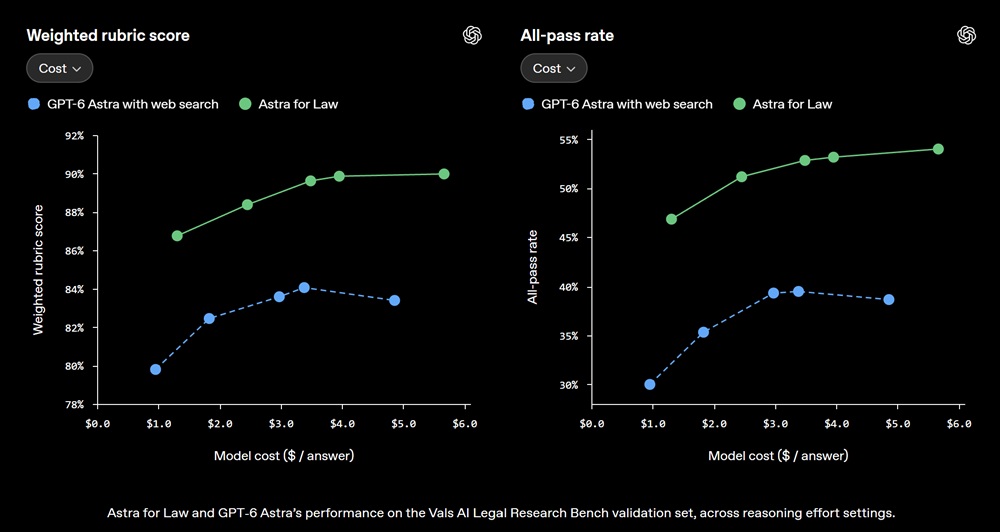
To evaluate the configuration, OpenAI tested Astra for Law’s complete setup on 200 U.S. legal research questions from the private validation set of Vals AI’s Legal Research Bench. The benchmark measures how well the model finds relevant sources and passages and how well its research answers meet the evaluation criteria.
At the highest reasoning effort for both systems, Astra for Law passed the evaluation’s overall correctness check on 54.0% of questions, compared with 38.7% for GPT-6 Astra using web search alone. OpenAI said this represents a 40% relative improvement, while Astra for Law also produced more comprehensive answers.
The evaluation also found that Astra for Law:
- Found 24% more reference cases on case-law-focused questions than GPT-6 Astra using web search alone at the highest reasoning effort.
- Retrieved up to 54% more relevant passages from the correct court opinions on an audited set of target passages when compared at the same reasoning effort.
- Could pinpoint relevant precedent and match fact patterns better than other frontier models when prompted to identify good law with similar fact patterns.
Legal workflows
Beyond research, custom instructions for legal analysis and writing guide Astra for Law in applying research to client facts, developing arguments or deal terms, and identifying weaknesses and uncertainty. They can also guide the system to:
- Distinguish a court’s holding from its other observations.
- Address cases that weaken an argument.
- Explain how a contract exception shifts risk between parties.
OpenAI’s forward-deployed engineers have worked with selected firms to adapt ChatGPT Enterprise with custom interfaces and integrations to proprietary data for specific workflows.
Sullivan & Cromwell built an agreement analyzer using its negotiating playbooks and selected precedents. It helps lawyers identify risks that emerge when provisions are read together and turns those findings into proposed redlines and draft client advice that lawyers can challenge and refine.
Ropes & Gray built a deal diligence system around how its lawyers work through a data room and determine what matters to a deal. It traces findings back to their sources and identifies questions that could affect an acquisition, such as whether key customer contracts require notice or consent.
Cooley built GO Public around its capital markets expertise for preparing companies to go public. It covers work from drafting the IPO filing to identifying risks that require management’s attention. When a deal changes, it carries those changes across the filing so lawyers can review the implications together. OpenAI said firms can define permitted sources and review processes for the work.
Privacy and governance
To address confidential client work, OpenAI has created a Trusted Access Program for eligible law firms. The program gives lawyers and people working under their supervision access to Astra for Law for professional legal work.
For eligible firms, the offering includes:
- Zero Data Retention (ZDR) on the API
- ChatGPT Enterprise usage excluded from human review by default
OpenAI is also working with Latham & Watkins on information permissions, ethical walls, client instructions, and firm oversight.
Plugins and ChatGPT for Word
OpenAI is launching 26 partner-built plugins that connect ChatGPT with specialist tools used by law firms. The plugins cover the practice and business of law and include tools such as Relativity and Clio.
Some of the integrations include:
- iManage: Lawyers can draft a negotiation brief in ChatGPT and save it to the matter file.
- Intapp: It can surface activities that may need a time entry for review.
- DeepJudge: It can bring prior deals into a comparison.
- Thomson Reuters: It is bringing HighQ matter context into ChatGPT and previewing a forthcoming CoCounsel Legal connector.
The launch also includes nine community plugins from lawyers and legal engineers at LegalQuants, LECG, and Skills.law. These plugins provide 47 custom skills that practitioners can adapt, extend, or draw inspiration from for their work in ChatGPT.
Meanwhile, ChatGPT for Word is generally available, allowing lawyers to proofread documents, receive suggested edits, and flag formatting issues in Word.
Availability
Astra for Law will initially be offered to selected law firms through Trusted Access in ChatGPT and Codex. OpenAI said it is coming soon to the API. In ChatGPT, Astra for Law will appear in the model picker as “GPT-6 Astra Law,” while the API model name is gpt-6-astra-law.
Ongoing development
OpenAI said firms can use specialist products, bring their own tools and knowledge, and adapt community-built skills to their practices. Partners can continue developing their own applications and workflows, while firms can decide how these capabilities fit together.
OpenAI will continue developing Astra for Law’s model, settings, tools, and instructions based on:
- Evaluations
- Feedback from lawyers
- Feedback from legal technology partners
The company is also working with Wachtell, Lipton, Rosen & Katz, bringing the firm’s litigation and corporate expertise together with OpenAI’s research and engineering to explore how AI can support work involving sophisticated legal judgment.