
Ookla has published new Speedtest Intelligence® data comparing Wi-Fi performance across major 2025 flagship smartphones, including Apple’s iPhone 17 lineup powered by the in-house N1 Wi-Fi chip.
The dataset shows clear improvements over the Broadcom-based solution in the iPhone 16 series and provides a detailed regional breakdown against leading Android devices from Samsung, Google, Xiaomi, HUAWEI, vivo, and OPPO.
The analysis also examines percentile performance, regional variations, and the impact of Wi-Fi 7 and 6 GHz networks as adoption increases.
Performance gains: Apple N1 vs Broadcom Wi-Fi
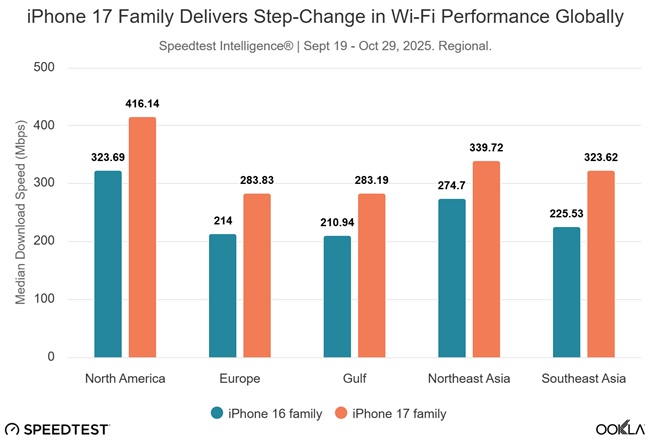
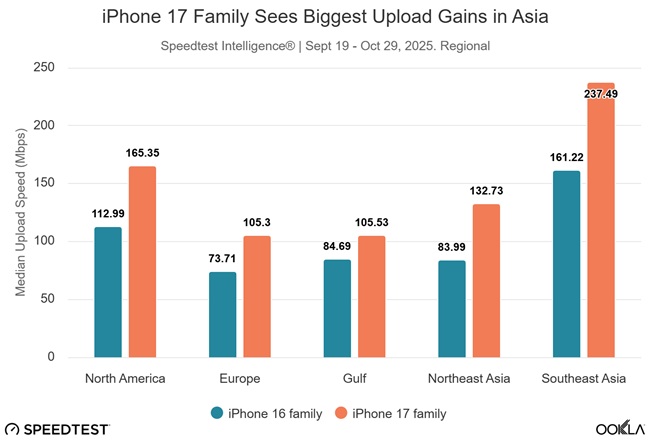
Ookla’s measurements show that the iPhone 17 lineup records higher download and upload speeds across all percentiles compared with the iPhone 16 family. The uplift appears globally and stays consistent throughout the first six weeks of availability.
Global medians:
- Download: iPhone 17 at 329.56 Mbps, iPhone 16 at 236.46 Mbps
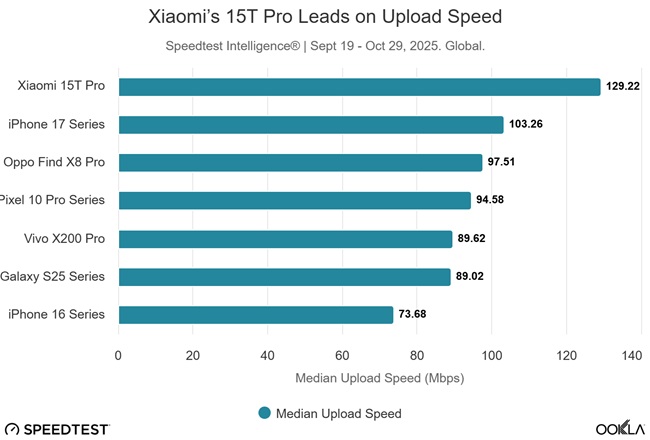
- Upload: iPhone 17 at 103.26 Mbps, iPhone 16 at 73.68 Mbps
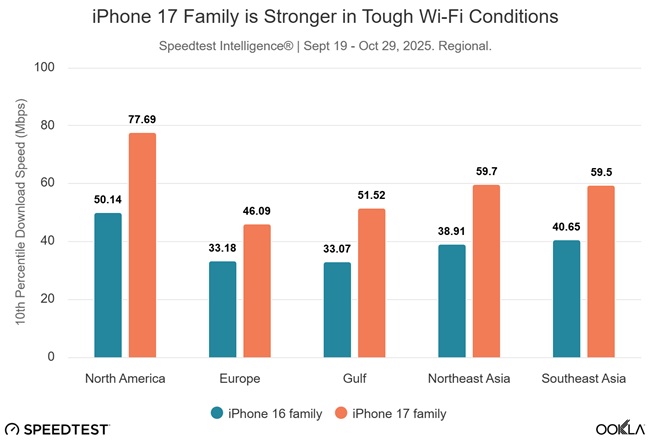
A significant jump is visible at the 10th percentile, where the iPhone 17 sees over 60% higher speeds, indicating stronger performance under weak Wi-Fi conditions.
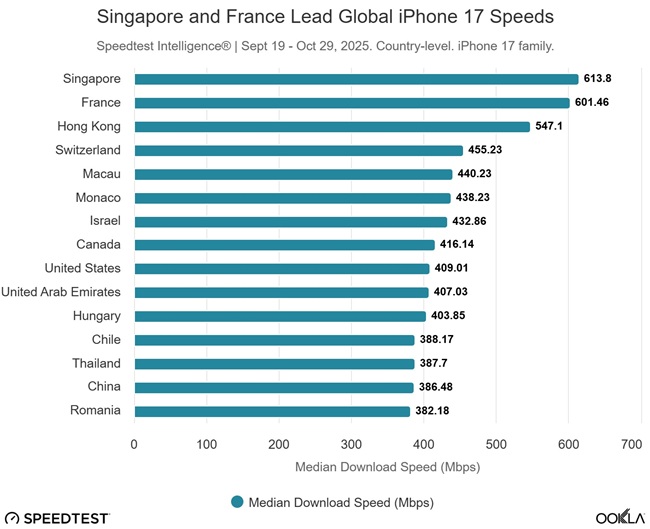
This trend is consistent across the United States, United Kingdom, Germany, Italy, Japan, India, France, and Singapore, suggesting device-side improvements rather than early-adopter effects.
India market performance
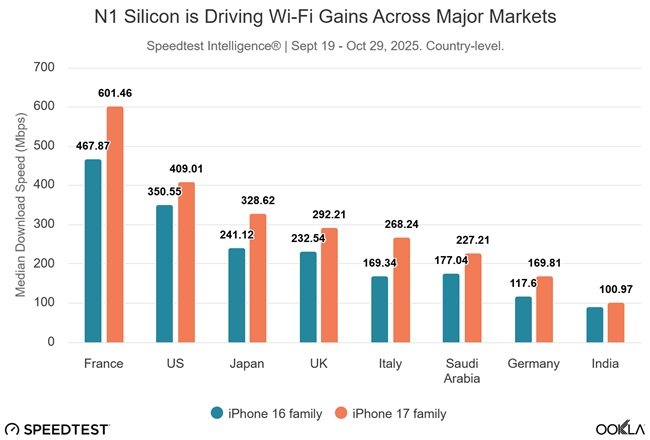
India is among the regions showing a clear uplift with Apple’s new Wi-Fi architecture. Ookla’s figures indicate that the iPhone 17 series meaningfully outperforms the Broadcom-based iPhone 16 lineup.
India highlights:
- iPhone 17 median download: 100.97 Mbps
- Improvement vs iPhone 16: 10%+ higher
- Consistent uplift visible across percentile levels
- Similar trends seen in China (386.48 Mbps, +35%) and Japan (328.62 Mbps, +36%)
These results reinforce the broader trend of stronger real-world performance with the N1 radio platform.
Apple N1 chip architecture and real-world impact
The N1 represents Apple’s shift to in-house wireless silicon. It combines Wi-Fi 7, Bluetooth 6, and Thread within a single-die radio. The chip supports 160 MHz channels, not 320 MHz, which many high-end Android devices now include.
Despite this, current networks limit practical benefits of 320 MHz bandwidth due to early-stage Wi-Fi 7 router deployments and limited environmental availability. North America data supports this:
- Highest regional median download: 416.14 Mbps
- Highest 90th-percentile download: 976.39 Mbps
These results suggest integration quality and tuning are major factors in achievable throughput.
Comparison with Android flagships
Ookla’s dataset evaluates devices with Qualcomm, MediaTek, Broadcom, and proprietary Wi-Fi silicon. Performance differs across median speeds, 90th-percentile results, uploads, and latency.
Pixel 10 Pro: Best median downloads globally
- Pixel 10 Pro median download: 335.33 Mbps
- iPhone 17 median download: 329.56 Mbps
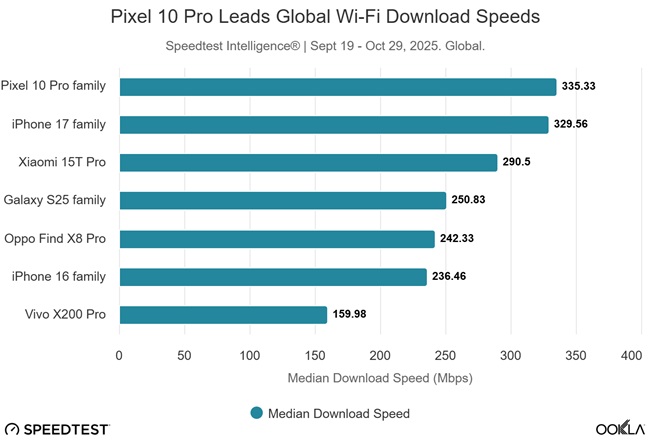
However, at the 10th percentile, the iPhone 17 leads globally with 56.08 Mbps, ahead of the Pixel 10 Pro at 53.25 Mbps, pointing to stronger weak-signal performance.
Xiaomi 15T Pro: High uploads and low latency
Powered by MediaTek Wi-Fi silicon integrated with the Dimensity 9400(+), the 15T Pro delivers:
- 90th-percentile download: 887.25 Mbps
- Best global median latency: 15 ms
In France, with extensive fiber coverage, it reaches:
- 100 Mbps+ at 10th percentile
- 500+ Mbps median
- 1,000+ Mbps at 90th percentile
Samsung Galaxy S25: Lowest latency
Running Qualcomm’s FastConnect 7900, the Galaxy S25 series records the lowest measured latencies:
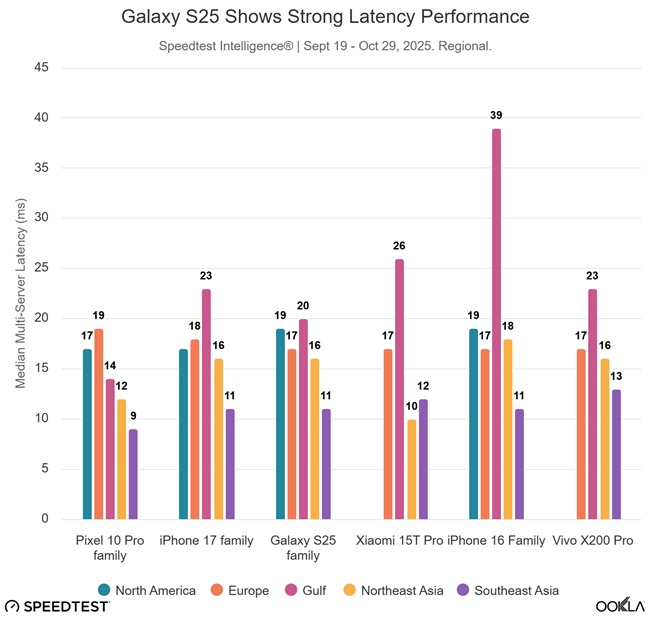
- 6 ms in North America
- 7 ms in Europe
- 9 ms in the Gulf
It also posts strong 90th-percentile upload speeds in the Gulf region.
HUAWEI Pura 80: No 6 GHz support
The Pura 80 uses in-house silicon but lacks 6 GHz support, affecting peak throughput. In Southeast Asia:
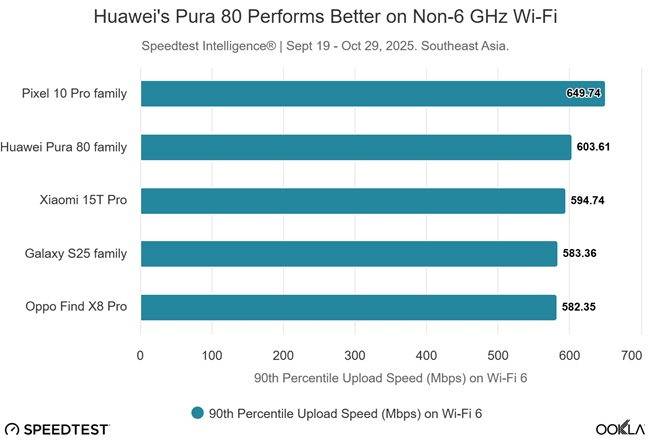
- 90th-percentile median download: 541.33 Mbps (39% below OPPO Find X8 Pro)
However, on Wi-Fi 6 networks, the Pura 80 ranks second in 90th-percentile uploads at 603.61 Mbps.
Wi-Fi 7, 6 GHz, and regional adoption
Ookla’s data highlights the performance lift of new-generation wireless standards.
Median download uplift:
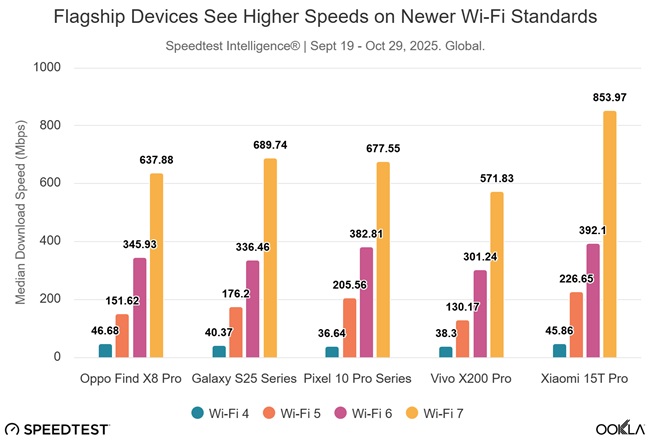
- Wi-Fi 7 vs Wi-Fi 6: +74% to +108%
- Wi-Fi 6 vs Wi-Fi 5: +72% to +123%
- 6 GHz vs 5 GHz: +77% or higher
Adoption varies by region:
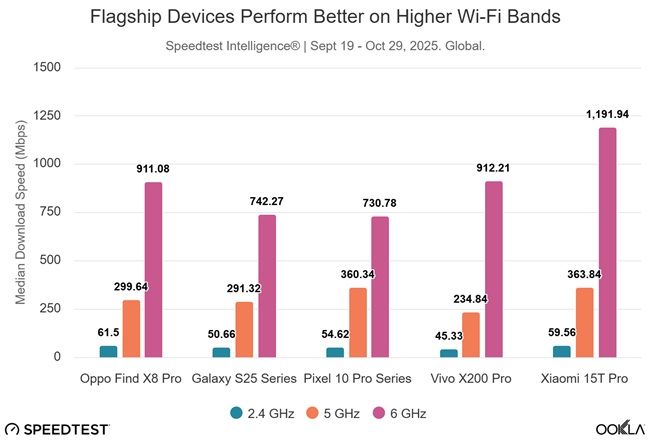
- North America: ~20% of Galaxy S25 samples on 6 GHz
- Europe & Northeast Asia: ~5%
- Gulf: 1.7%
These differences directly influence percentile results and achievable peak speeds.
Devices included in Ookla’s Wi-Fi 7 evaluation
- Apple iPhone 16 series
- Apple iPhone 17 series
- Samsung Galaxy S25 series
- Google Pixel 10 Pro series
- HUAWEI Pura 80 series
- Xiaomi 15T Pro
- vivo X200 Pro
- OPPO Find X8 Pro
Conclusion
Ookla’s initial findings show that Apple’s in-house N1 Wi-Fi chip delivers measurable improvements over the Broadcom solution used in the iPhone 16 series. Despite the lack of 320 MHz channel support, real-world limitations in Wi-Fi 7 deployments mean this does not currently impact practical performance.
The iPhone 17 family records strong results across percentiles and regions, performing competitively with Android flagships powered by Qualcomm, MediaTek, and other wireless platforms. As Wi-Fi 7 and 6 GHz adoption expands, overall performance is expected to shift further, particularly in markets with faster next-generation router rollout.